Loading...
Done
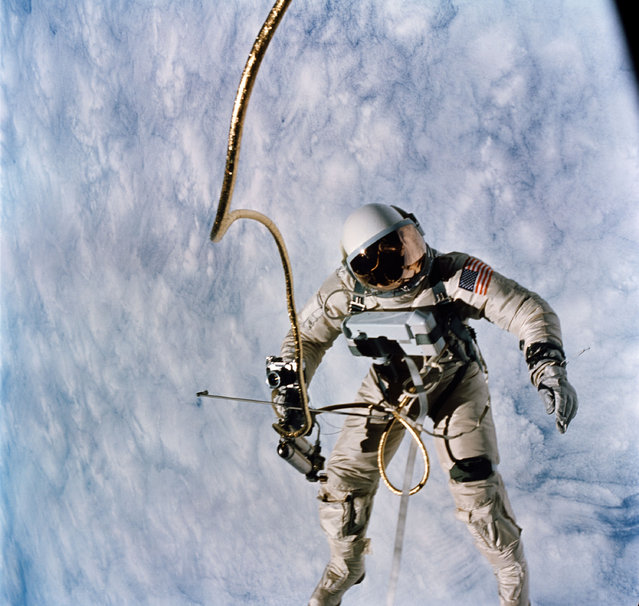
Astronaut Edward H. White II, pilot for the Gemini-Titan 4 (GT-4) spaceflight, floats in the zero-gravity of space during the third revolution of the GT-4 spacecraft on June 3, 1965. White wears a specially designed spacesuit. His face is shaded by a gold-plated visor to protect him from unfiltered rays of the sun. (Photo by NASA)

Astronaut Edward H. White II, pilot for the Gemini-Titan 4 (GT-4) spaceflight, floats in the zero-gravity of space during the third revolution of the GT-4 spacecraft on June 3, 1965. White wears a specially designed spacesuit. His face is shaded by a gold-plated visor to protect him from unfiltered rays of the sun. In his right hand he carries a Hand-Held Self-Maneuvering Unit (HHSMU) that gives him control over his movements in space. White also wears an emergency oxygen chest pack; and he carries a camera mounted on the HHSMU for taking pictures of the sky, Earth and the GT-4 spacecraft. He is secured to the spacecraft by a 25-feet umbilical line and a 23-feet tether line. Both lines are wrapped together in gold tape to form one cord. Astronaut James A. McDivitt, command pilot, remained inside the spacecraft during the extravehicular activity (EVA). Astronaut White died in the Apollo/Saturn 204 fire at Cape Kennedy on January 27, 1967. (Photo by NASA)
Details
22 Jul 2014 12:05:00
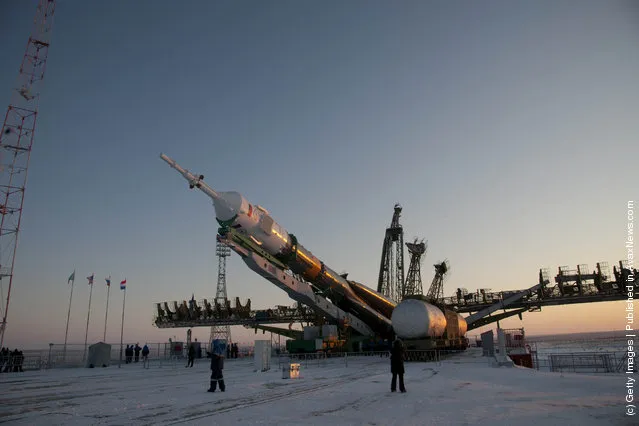
Soyuz TMA-03M Flight To International Space Station

In this handout image supplied by the European Space Agency, the Soyuz TMA-03M spacecraft is raised into vertical position on December 19, 2011 at the Baikonur Cosmodrome in Kazakhstan. (Photo by Stephane Corvaja/ESA via Getty Images)
Details
20 Dec 2011 14:32:00
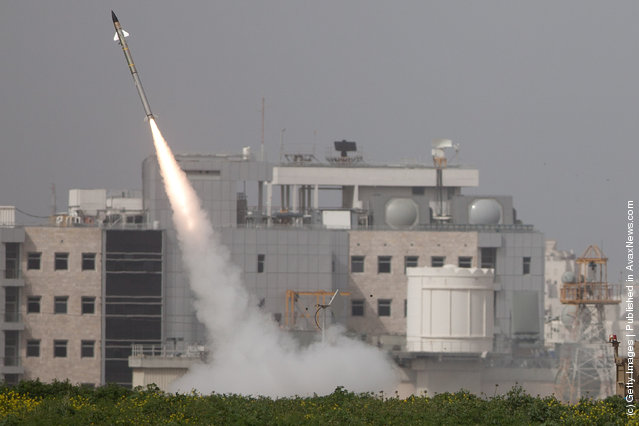
An Israeli missile is launched from the Iron Dome missile system in response to a rocket launch from the nearby Palestinian Gaza Strip, on March 12, 2012 near Ashdod

An Israeli missile is launched from the Iron Dome missile system in response to a rocket launch from the nearby Palestinian Gaza Strip, on March 12, 2012 near Ashdod, Israel. (Photo by Uriel Sinai/Getty Images)
Details
13 Mar 2012 11:24:00
A female pitch invader is caught by a steward during Day Two of the Fourth Test between South Africa and England at Wanderers on January 25, 2020 in Johannesburg, South Africa. (Photo by Stu Forster/Getty Images)

A female pitch invader is caught by a steward during Day Two of the Fourth Test between South Africa and England at Wanderers on January 25, 2020 in Johannesburg, South Africa. (Photo by Stu Forster/Getty Images)
Details
27 Jan 2020 00:07:00
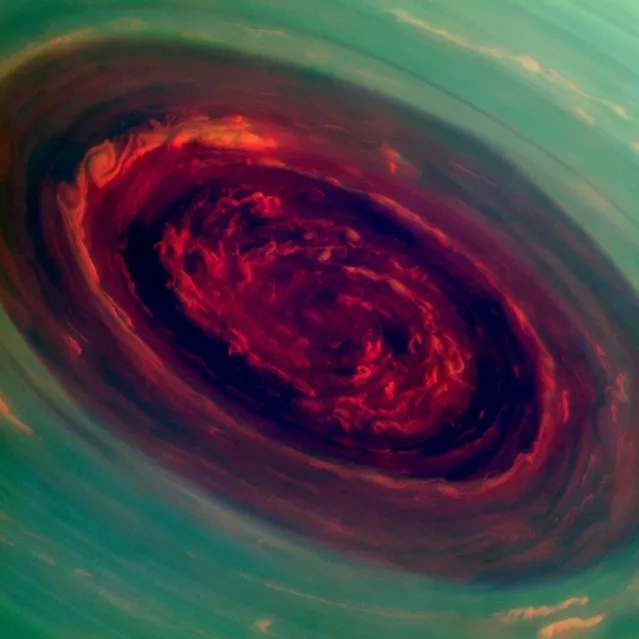
The spinning vortex of Saturn's north polar storm resembles a deep red rose of giant proportions surrounded by green foliage in this false-color image from NASA's Cassini spacecraft. (Photo by NASA/JPL-Caltech/SSI)

NASA's Cassini spacecraft has provided scientists the first close-up, visible-light views of a behemoth hurricane swirling around Saturn's north pole. In high-resolution pictures and video, scientists see the hurricane's eye is about 1,250 miles (2,000 kilometers) wide, 20 times larger than the average hurricane eye on Earth. Thin, bright clouds at the outer edge of the hurricane are traveling 330 mph(150 meters per second). The hurricane swirls inside a large, mysterious, six-sided weather pattern known as the hexagon. Photo: The spinning vortex of Saturn's north polar storm resembles a deep red rose of giant proportions surrounded by green foliage in this false-color image from NASA's Cassini spacecraft. (Photo by NASA/JPL-Caltech/SSI)
Details
31 May 2015 09:11:00
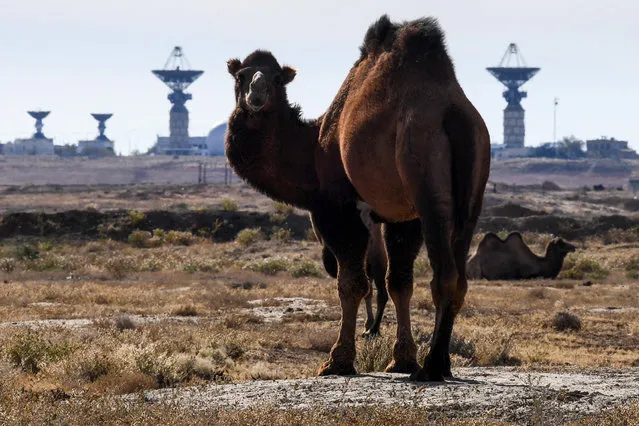
A camel is pictured in front of the Saturn tracking complex at the Russian-leased Baikonur cosmodrome in Kazakhstan on October 9, 2018. An astronaut and cosmonaut are due to travel to the ISS on October 11 aboard a Russian Soyuz MS-10 spacecraft from the Baikonur Cosmodrome in Kazakhstan. (Photo by Kirill Kudryavtsev/AFP Photo)

A camel is pictured in front of the Saturn tracking complex at the Russian-leased Baikonur cosmodrome in Kazakhstan on October 9, 2018. An astronaut and cosmonaut are due to travel to the ISS on October 11 aboard a Russian Soyuz MS-10 spacecraft from the Baikonur Cosmodrome in Kazakhstan. (Photo by Kirill Kudryavtsev/AFP Photo)
Details
08 Feb 2019 00:01:00
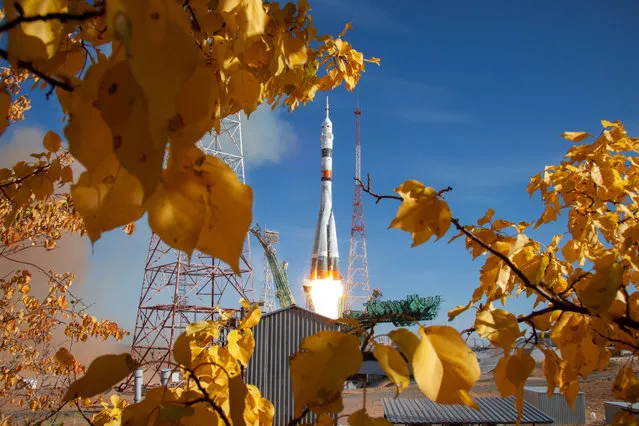
The Soyuz MS-17 spacecraft carrying the crew formed of Kathleen Rubins of NASA, Sergey Ryzhikov and Sergey Kud-Sverchkov of the Russian space agency Roscosmos blasts off to the International Space Station (ISS) from the launchpad at the Baikonur Cosmodrome, Kazakhstan on October 14, 2020. (Photo by Russian space agency Roscosmos/Handout via Reuters)

The Soyuz MS-17 spacecraft carrying the crew formed of Kathleen Rubins of NASA, Sergey Ryzhikov and Sergey Kud-Sverchkov of the Russian space agency Roscosmos blasts off to the International Space Station (ISS) from the launchpad at the Baikonur Cosmodrome, Kazakhstan on October 14, 2020. (Photo by Russian space agency Roscosmos/Handout via Reuters)
Details
12 Apr 2021 00:01:00
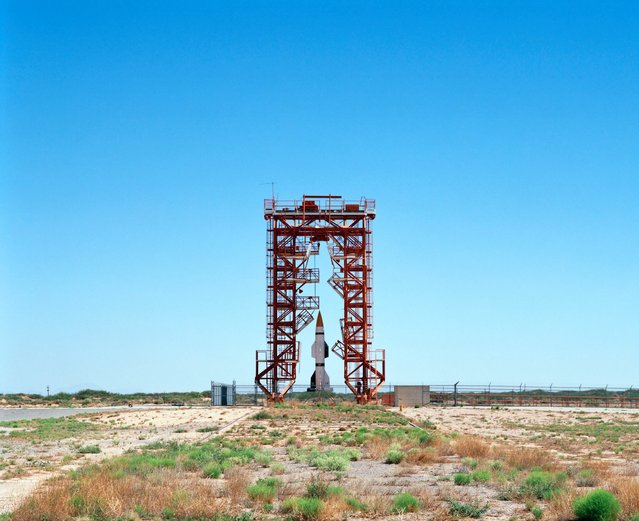
Launch Pad and Gantry with Hermes A-1 Rocket – V2 Launch Complex 33, White Sands missile range, New Mexico in 2006. (Photo by Roland Miller)

Roland Miller is on a mission to document the deserted sites of America’s space race. He has photographed launch pads, bunkhouses and research facilities across the country, some of which no longer exist or are closed to the public on secure military bases. His book, “Abandoned in Place”, is published by the University of New Mexico Press in March. Here: Launch Pad and Gantry with Hermes A-1 Rocket – V2 Launch Complex 33, White Sands missile range, New Mexico in 2006. (Photo by Roland Miller)
Details
25 Feb 2016 11:38:00