Loading...
Done
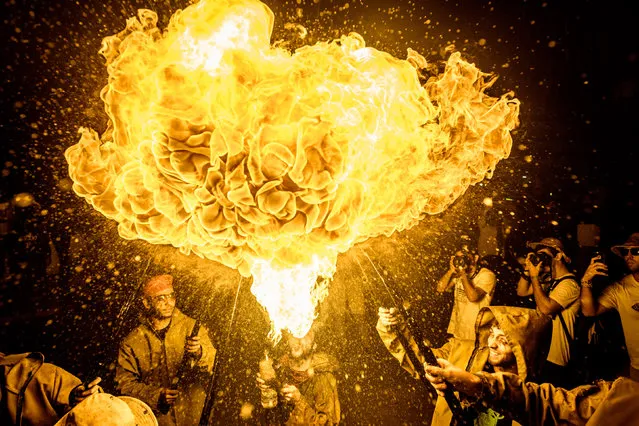
A fire-eater of the “Diables de Terrassa” performs during Sitges' little “Festa Major”, “Santa Tecla” in Sitges, Spain on September 19, 2016. This celebration brings together some of Catalonia’s most emblematic festive traditions. The central axis of the celebrations is the traditional parade, made up of “big-head” carnival figures and characters who dance to music played on different traditional instruments. One of the most popular events is the Correfoc or fire-running, which is also the closing event of the fiesta. The people run and jump over characters dressed up as devils and dragons, carrying fire. (Photo by Matthias Oesterle/ZUMA Press/Splash News)

A fire-eater of the “Diables de Terrassa” performs during Sitges' little “Festa Major”, “Santa Tecla” in Sitges, Spain on September 19, 2016. This celebration brings together some of Catalonia’s most emblematic festive traditions. The central axis of the celebrations is the traditional parade, made up of “big-head” carnival figures and characters who dance to music played on different traditional instruments. One of the most popular events is the Correfoc or fire-running, which is also the closing event of the fiesta. The people run and jump over characters dressed up as devils and dragons, carrying fire. (Photo by Matthias Oesterle/ZUMA Press/Splash News)
Details
20 Sep 2016 09:28:00
Women wear the traditional costume of the Alto Tio Diego carnival during the Women's Afro-Mestizo Carnival of Alto Tio Diego on February 11, 2024 in Veracruz, Mexico. Alto Tio Diego is a small town near the State capital Xalapa where every year inhabitants celebrate their traditional carnival. Women of the town demanded a special day for them to parade and few years ago, they started to do it by walking through the streets wearing traditional costumes and masks (mostly of animals) but the attires have evolved to more modern characters. (Photo by Hector AD Quintanar/Getty Images)

Women wear the traditional costume of the Alto Tio Diego carnival during the Women's Afro-Mestizo Carnival of Alto Tio Diego on February 11, 2024 in Veracruz, Mexico. Alto Tio Diego is a small town near the State capital Xalapa where every year inhabitants celebrate their traditional carnival. Women of the town demanded a special day for them to parade and few years ago, they started to do it by walking through the streets wearing traditional costumes and masks (mostly of animals) but the attires have evolved to more modern characters. (Photo by Hector AD Quintanar/Getty Images)
Details
24 May 2025 02:27:00
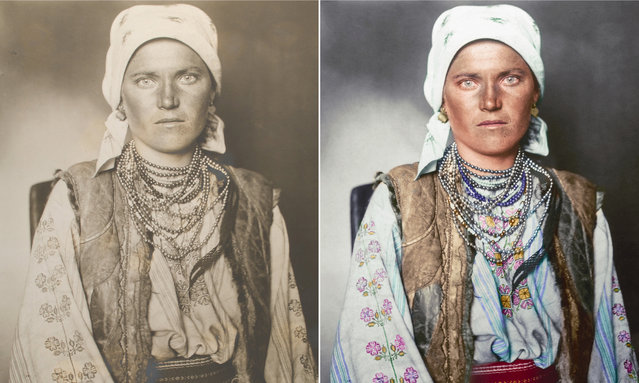
A Ruthenian woman circa 1906 from the region historically inhabiting the kingdom of the Rus, incorporating parts of modern-day Slavic speaking countries. Her outfit consists of a shirt and underskirt made from linen embroidered with traditional floral-based patterns. (Photo by Augustus Francis Sherman/New York Public Library/The Guardian)

Many of the 12 million people who entered the US through New York’s Ellis Island wore traditional dress from their homelands. Here: A Ruthenian woman circa 1906 from the region historically inhabiting the kingdom of the Rus, incorporating parts of modern-day Slavic speaking countries. Her outfit consists of a shirt and underskirt made from linen embroidered with traditional floral-based patterns. (Photo by Augustus Francis Sherman/New York Public Library/The Guardian)
Details
03 Oct 2016 09:15:00
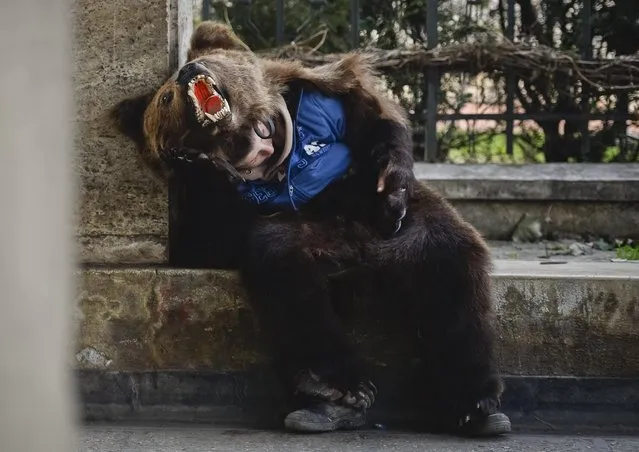
Florin Bors, aged 8 from Bacau, northern Romania, wearing a bear fur takes a break from performing a holiday season ritual in Bucharest, Romania, Tuesday, December 16, 2014. In pre-Christian rural traditions, dancers wearing colored costumes or animal furs, touring house to house in villages singing and dancing to ward off evil. (Photo by Octav Ganea/AP Photo/Mediafax)

Florin Bors, aged 8 from Bacau, northern Romania, wearing a bear fur takes a break from performing a holiday season ritual in Bucharest, Romania, Tuesday, December 16, 2014. In pre-Christian rural traditions, dancers wearing colored costumes or animal furs, touring house to house in villages singing and dancing to ward off evil. In recent years following the economic downturn in Romania, a European Union member since 2007, the tradition has moved to Romania's cities where dancers travel to perform the ritual for money. (Photo by Octav Ganea/AP Photo/Mediafax)
Details
20 Dec 2014 12:07:00
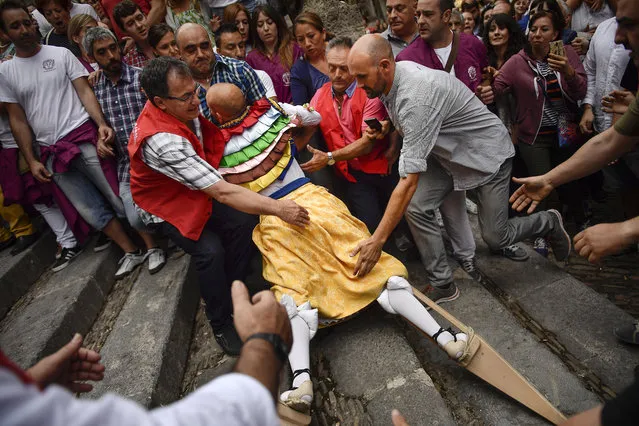
People help a dancer as he falls on stilts in honor of Saint Mary Magdalene in a street for the traditional “Danza de Los Zancos” (Los Zancos Dance), in the small town of Anguiano, northern Spain, Saturday, July 23, 2016. (Photo by Alvaro Barrientos/AP Photo)

People help a dancer as he falls on stilts in honor of Saint Mary Magdalene in a street for the traditional “Danza de Los Zancos” (Los Zancos Dance), in the small town of Anguiano, northern Spain, Saturday, July 23, 2016. As an ancient tradition for more than 4th centuries, eight young people from the town balance on stilts down the old street, turning to the sound of folk music played on a pipe and drum. (Photo by Alvaro Barrientos/AP Photo)
Details
25 Jul 2016 11:36:00
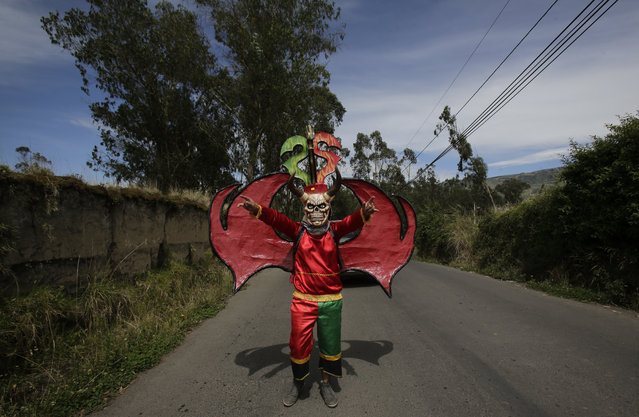
Dressed for the traditional New Year's festival known as “La Diablada”, in Pillaro, Ecuador, Friday, January 5, 2018. (Photo by Dolores Ochoa/AP Photo)

Dressed for the traditional New Year's festival known as “La Diablada”, in Pillaro, Ecuador, Friday, January 5, 2018. Thousands of singing and dancing devils take over the mountain town for six days of revelry in the streets. Local legend holds that anyone who adopts a costume for the celebration and wears it at the event six years in a row will have good luck. (Photo by Dolores Ochoa/AP Photo)
Details
12 Jan 2018 06:47:00
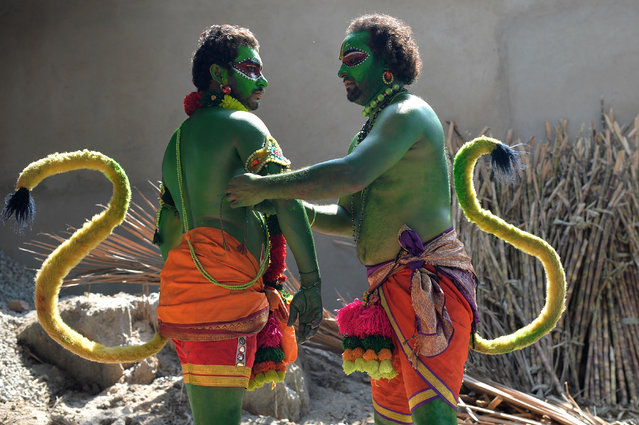
Indian artists dress up as the Hindu deity “Hanuman” – the monkey God in Hindu mythology – to mark the Rama Navami festival in Bangalore on March 25, 2018. Rama Navami is a spring Hindu festival that celebrates the birthday of the deity Rama. He is particularly important to the Vaishnavism tradition of Hinduism, as the seventh avatar of Vishnu. (Photo by Manjunath Kiran/AFP Photo)

Indian artists dress up as the Hindu deity “Hanuman” – the monkey God in Hindu mythology – to mark the Rama Navami festival in Bangalore on March 25, 2018. Rama Navami is a spring Hindu festival that celebrates the birthday of the deity Rama. He is particularly important to the Vaishnavism tradition of Hinduism, as the seventh avatar of Vishnu. (Photo by Manjunath Kiran/AFP Photo)
Details
27 Mar 2018 00:03:00
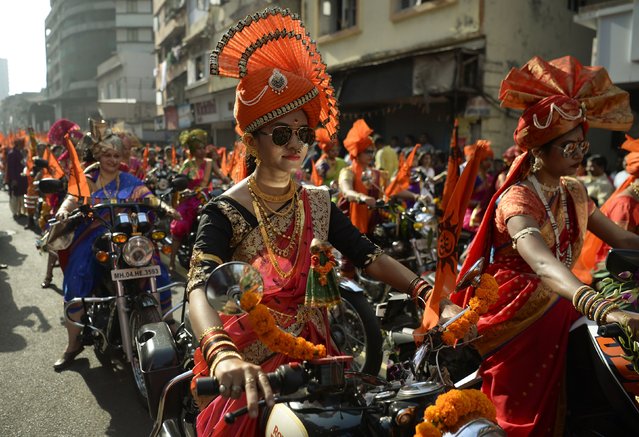
Indian women dressed in traditional attire drive motorcycles as they take part in a procession celebrating “Gudhi Padwa” or the Maharashtrian New Year in Mumbai on March 28, 2017. Gudhi Padwa is the Hindu New Year for people in India's Maharashtra state and marks the end of a harvest and the beginning of a new one. (Photo by Punit Paranjpe/AFP Photo)

Indian women dressed in traditional attire drive motorcycles as they take part in a procession celebrating “Gudhi Padwa” or the Maharashtrian New Year in Mumbai on March 28, 2017. Gudhi Padwa is the Hindu New Year for people in India's Maharashtra state and marks the end of a harvest and the beginning of a new one. (Photo by Punit Paranjpe/AFP Photo)
Details
29 Mar 2017 09:39:00