Loading...
Done
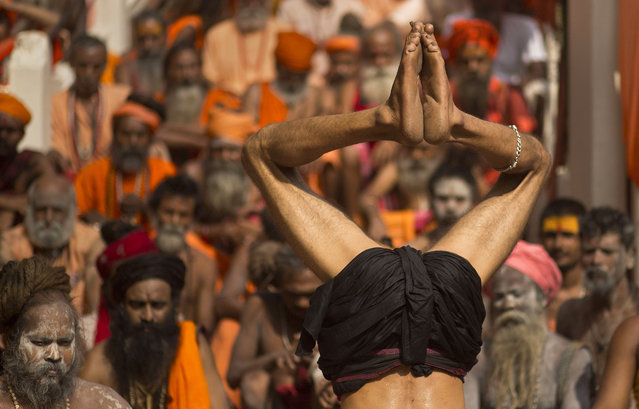
An Indian Sadhu, or Hindu holy man, performs a yoga position on International Yoga Day at Kamakhya temple in Gauhati, India, Friday, June 21, 2019. (Photo by Anupam Nath/AP Photo)

An Indian Sadhu, or Hindu holy man, performs a yoga position on International Yoga Day at Kamakhya temple in Gauhati, India, Friday, June 21, 2019. (Photo by Anupam Nath/AP Photo)
Details
02 Jul 2019 00:03:00
Students dressed up as Hindu gods Lord Krishna and Lord Shiva participate in a cultural event in their school in Mumbai on August 21, 2019. (Photo by Indranil Mukherjee/AFP Photo)

Students dressed up as Hindu gods Lord Krishna and Lord Shiva participate in a cultural event in their school in Mumbai, India on August 21, 2019. (Photo by Indranil Mukherjee/AFP Photo)
Details
26 Aug 2019 00:01:00
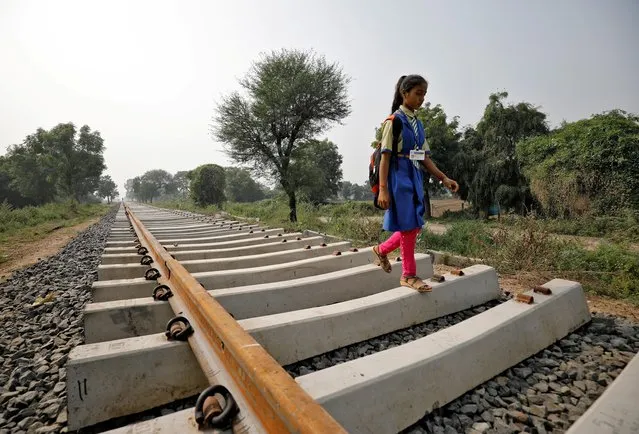
A schoolgirl walks on an under-construction railway track at Navapura, on the outskirts of Ahmedabad, November 29, 2019. (Photo by Amit Dave/Reuters)

A schoolgirl walks on an under-construction railway track at Navapura, on the outskirts of Ahmedabad, November 29, 2019. (Photo by Amit Dave/Reuters)
Details
14 Dec 2019 00:01:00
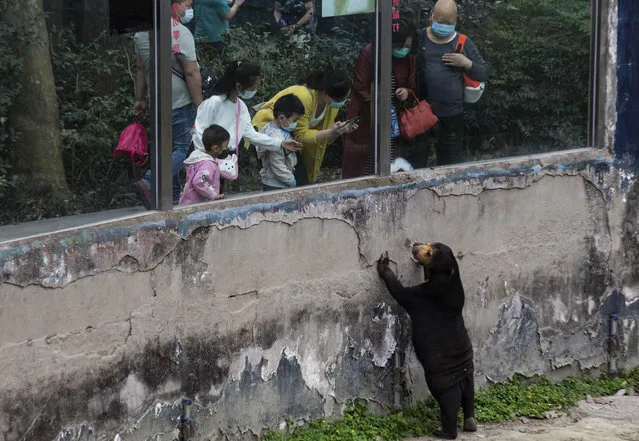
People look at a black bear at the Chengdu zoo amid the coronavirus outbreak on March 26, 2020 in Chengdu, Sichuan Province of China. (Photo by Wang Lei/China News Service via Getty Images)

People look at a black bear at the Chengdu zoo amid the coronavirus outbreak on March 26, 2020 in Chengdu, Sichuan Province of China. (Photo by Wang Lei/China News Service via Getty Images)
Details
01 Apr 2020 00:01:00
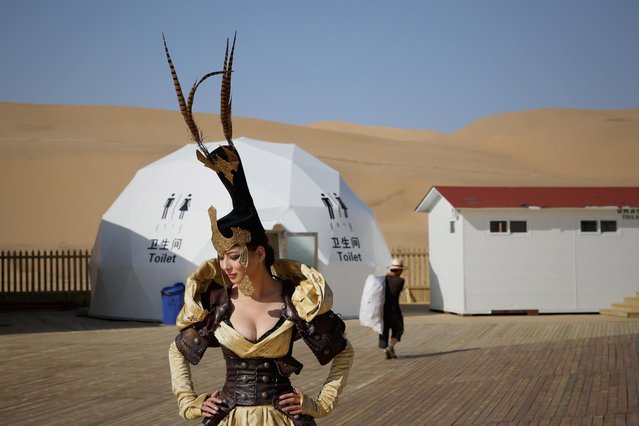
A model in Mongolia costumes prepares backstage in Xiangshawan Desert, also called Sounding Sand Desert on July 18, 2013 in Ordos of Inner Mongolia Autonomous Region, China. Xiangshawan is China's famous tourist resort in the desert. It is located along the middle section of Kubuqi Desert on the south tip of Dalate League under Ordos City. Sliding down from the 110-metre-high, 45-degree sand hill, running a course of 200 metres, the sands produce the sound of automobile engines, a natural phenomenon that nobody can explain. (Photo by Feng Li/Getty Images)

A model in Mongolia costumes prepares backstage in Xiangshawan Desert, also called Sounding Sand Desert on July 18, 2013 in Ordos of Inner Mongolia Autonomous Region, China. Xiangshawan is China's famous tourist resort in the desert. It is located along the middle section of Kubuqi Desert on the south tip of Dalate League under Ordos City. Sliding down from the 110-metre-high, 45-degree sand hill, running a course of 200 metres, the sands produce the sound of automobile engines, a natural phenomenon that nobody can explain. (Photo by Feng Li)
Details
26 Aug 2013 08:43:00
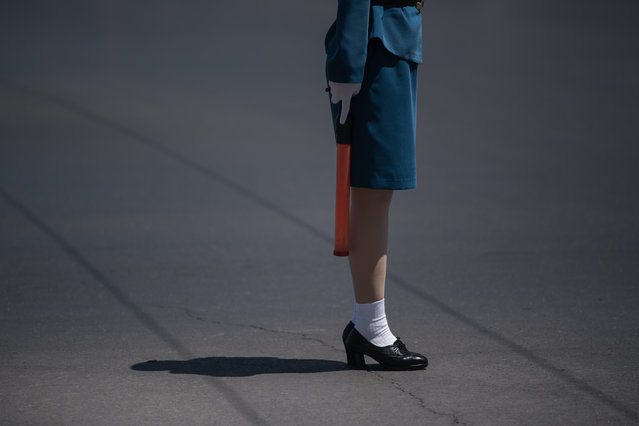
In a photo taken on June 5, 2017 a traffic security officer stands on duty at an intersection in Pyongyang. Officially known as traffic security officers but universally referred to as traffic ladies, they are chosen for their looks in a society that remains traditionalist in many respects. They must leave the role if they marry, and have a finite shelf-life, with compulsory retirement looming at just 26. The 300-odd ladies are unique to Pyongyang, which North Korean authorities are always keen to present in the best possible light despite their nuclear-armed country's impoverished status, and ensure a steady supply of photogenic young women who are the favourite subject of visiting tourists and journalists. (Photo by Ed Jones/AFP Photo)

In a photo taken on June 5, 2017 a traffic security officer stands on duty at an intersection in Pyongyang. Officially known as traffic security officers but universally referred to as traffic ladies, they are chosen for their looks in a society that remains traditionalist in many respects. They must leave the role if they marry, and have a finite shelf-life, with compulsory retirement looming at just 26. (Photo by Ed Jones/AFP Photo)
Details
21 May 2018 00:03:00
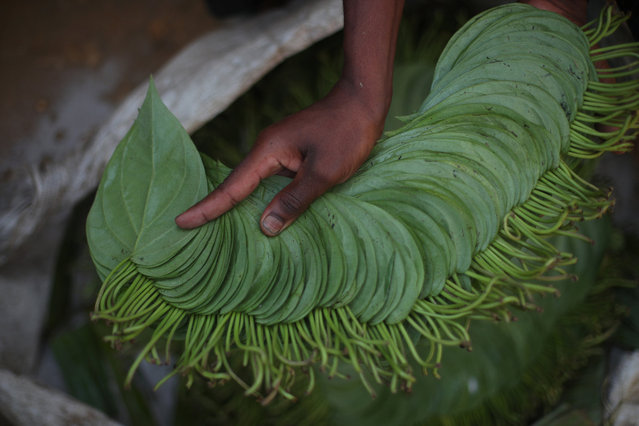
Faruk, 17, a Rohingya refugee trader holds betel leaves which are on sale at a stall in Palong Khali refugee camp near Cox's Bazar, Bangladesh, November 3, 2017. He left his village in Myanmar when the military opened fire towards the Rohingya. “I buy this betel leaf from Palong Khali market, in one bundle there are 160 pieces, I buy it for 80 taka and I sell it for 100 taka. Bangladeshi's and I sell for the same rate in the camp. Outside in the local market it is 80 taka per bundle. My problem is that I don't have money so I can't buy anything to eat, I can't buy fish to eat”, he said. (Photo by Hannah McKay/Reuters)

Faruk, 17, a Rohingya refugee trader holds betel leaves which are on sale at a stall in Palong Khali refugee camp near Cox's Bazar, Bangladesh, November 3, 2017. He left his village in Myanmar when the military opened fire towards the Rohingya. “I buy this betel leaf from Palong Khali market, in one bundle there are 160 pieces, I buy it for 80 taka and I sell it for 100 taka (1 Bangladeshi Taka = 0.012 US Dollar). Bangladeshi's and I sell for the same rate in the camp. Outside in the local market it is 80 taka per bundle. My problem is that I don't have money so I can't buy anything to eat, I can't buy fish to eat”, he said. (Photo by Hannah McKay/Reuters)

Details
27 Nov 2017 08:54:00
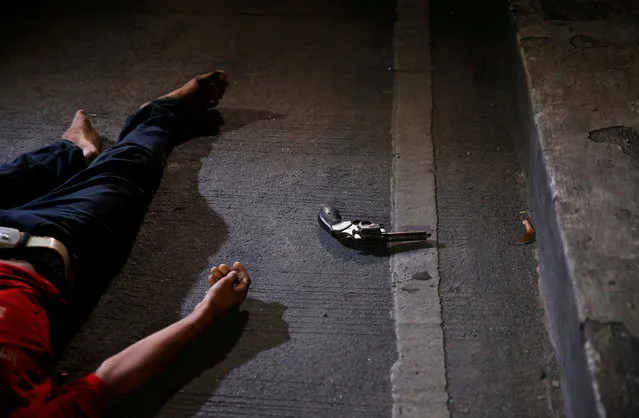
A rusty revolver is seen near the body of a man, who police said was killed by police operatives, and two sachets of “Shabu” or methampethamine chloride were found on his pockets in Manila, Philippines August 17, 2017. (Photo by Erik De Castro/Reuters)

A rusty revolver is seen near the body of a man, who police said was killed by police operatives, and two sachets of “Shabu” or methampethamine chloride were found on his pockets in Manila, Philippines August 17, 2017. (Photo by Erik De Castro/Reuters)
Details
19 Aug 2017 08:54:00