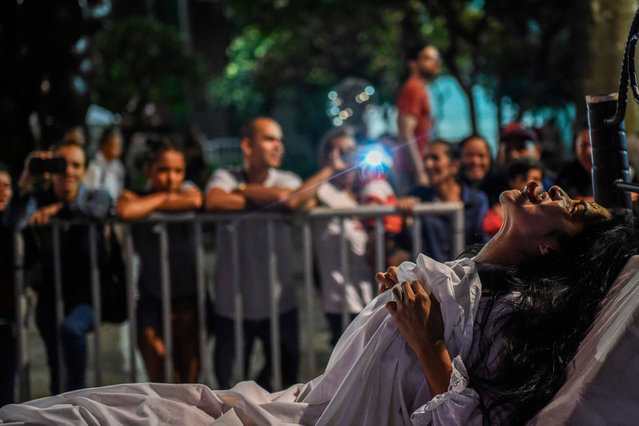
A reveler performs during the Myths and Legends parade in Medellin, Antioquia department, Colombia on December 8, 2018. (Photo by Joaquín Sarmiento/AFP Photo)
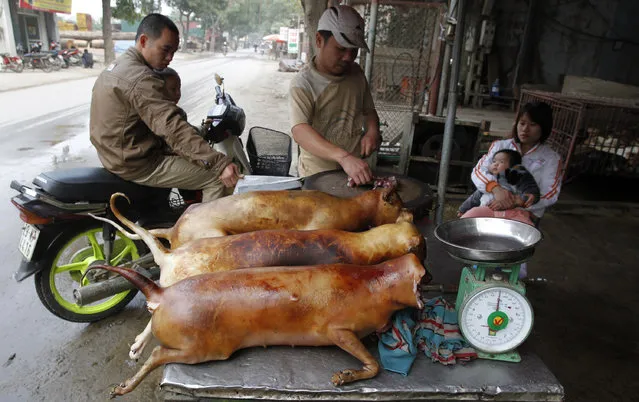
A vendor (C) cuts slaughtered dogs for sale at his roadside stall in Duong Noi village, outside Hanoi December 16, 2011. While animal rights activists have condemned eating dog meat as cruel treatment of the animals, it is still an accepted popular delicacy for some Vietnamese, as well in some other Asian countries. Duong Noi is well-known as a dog-meat village, where hundreds of dogs are killed each day for sale as popular traditional food. Dog-eating as a custom is rooted in Vietnam and was developed as a result of poverty. One kilogram of dog meat costs about 130,000 dongs ($6.2). (Photo by Reuters/Kham)
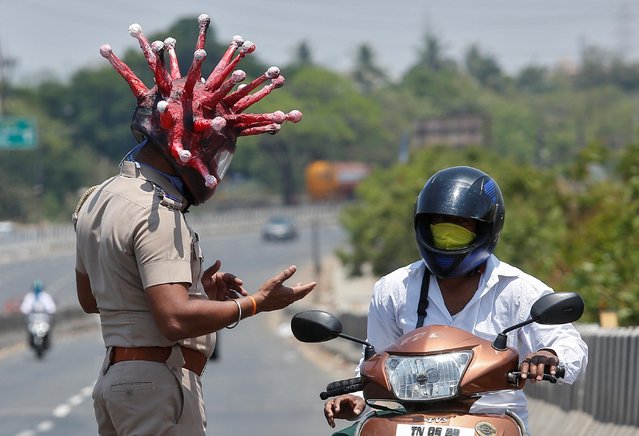
Rajesh Babu, a police officer, wearing a helmet depicting coronavirus, requests a commuter to stay at home during a 21-day nationwide lockdown to limit the spreading of coronavirus disease (COVID-19), in Chennai, India, March 28, 2020. (Photo by P. Ravikumar/Reuters)
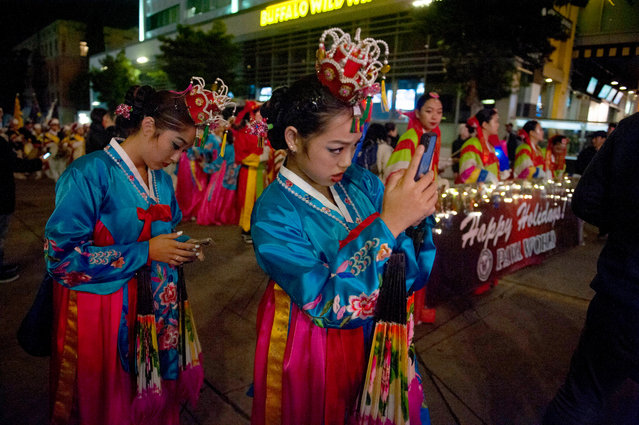
Participants wearing East Asian traditional costumes take photos during the 88th annual Hollywood Christmas Parade in Hollywood, California, USA, 01 December 2019. (Photo by Christian Monterrosa/EPA/EFE)
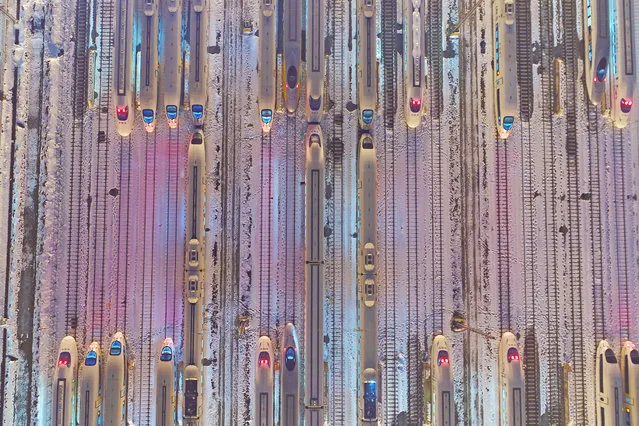
Aerial view of CRH bullet trains setting out ahead of Spring Festival travel rush on January 31, 2018 in Hefei, Anhui Province of China. About 2.98 billion trips will be made during the 40-day Spring Festival travel rush. China will take multiple measures to ensure a smooth Spring Festival travel rush. (Photo by VCG/VCG via Getty Images)
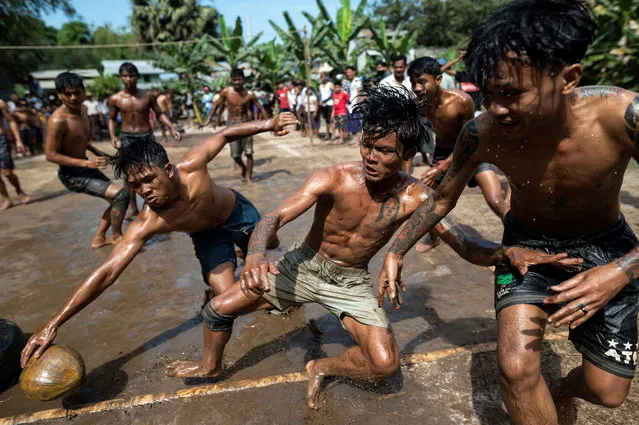
Men play with an oiled coconut during Myanmar's 73rd Independence Day celebrations amid the spread of the coronavirus disease (COVID-19) in Yangon, Myanmar, January 4, 2021. (Photo by Shwe Paw Mya Tin/Reuters)
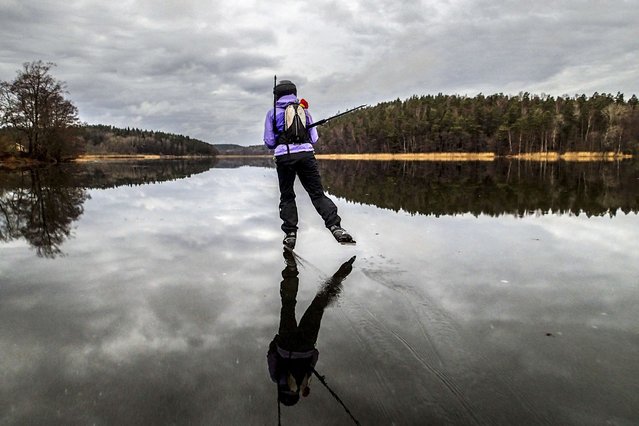
A long skater speeds away on the rain-wet ice on lake Orlangen, South of Stockholm on December 15, 2013. Meteorologists forecast temperatures around 5 degrees for southern Sweden. (Photo by Tobias Rostlund/AFP Photo)
P.S. All pictures, as usual, are presented in high resolution. To see Hi-Res images – just TWICE click on any picture. In other words, click small picture – opens the BIG picture. Click BIG picture – opens VERY BIG picture (if available; this principle works anywhere on the site AvaxNews).
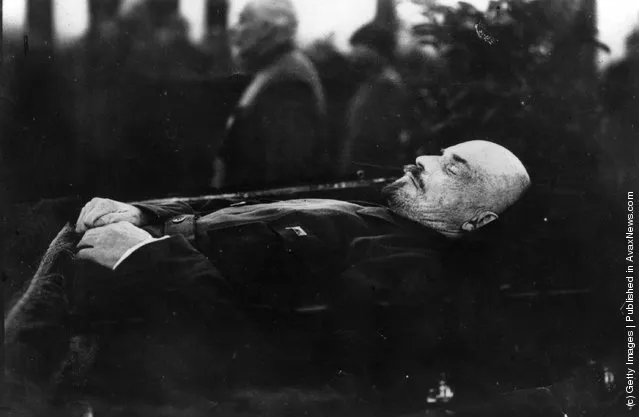
Photo: Vladimir Ilyich Lenin (1870 – 1924) lying in state in the Kremlin. (Photo by Hulton Archive/Getty Images). 1924
Important! For the same article in Russian language click here.
Something quite intriguing is happening within Russian-speaking internet during the last few – should you type a fully academic inquiry (at least, according to Russian academic requirements) in national search engines for "Lenin's mausoleum" – the first thing you get (even in top 10 searches) is website pages talking about black magic and occult. Website authors view this construction differently, but unconditionally agree on one thing: the mausoleum of the "leader of the world proletariat” – the essence of a magical artifact, a sort of “energy vampire”. It was built with a certain purpose: to drain the energy out of miserable Soviet citizens on one hand; and to poison the anthroposphere of one-sixth part of the earth with its vibes (the exact territory that was occupied by the former Soviet Union), depriving the Russian people of will to resist on the other hand. Complete nonsense? No doubt. Nevertheless, an intriguing one. Well, probably because some oddities do exist in mausoleum's history. These oddities are the thing we are going to discuss this time. First, let me refresh you memory on the subject.