Loading...
Done
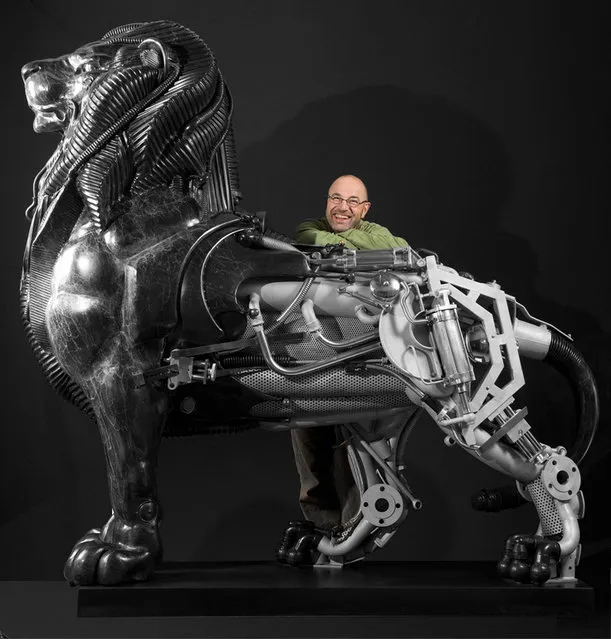
Steampunk Sculptures By Pierre Matter

French sculptor Pierre Matter was born in 1964. “A mystical child, then a tormented teenager, he studied mathematics half-heartedly. It was only logical that he headed naturally, though initially in an erratic manner, for the mysterious universe of artistic creation. His slow progression in this field led him to try out many kinds of expression and material, from oil to gouache to ink, from comic strips to canvas, and also bas-relief in stone.”
Details
14 Aug 2013 15:28:00
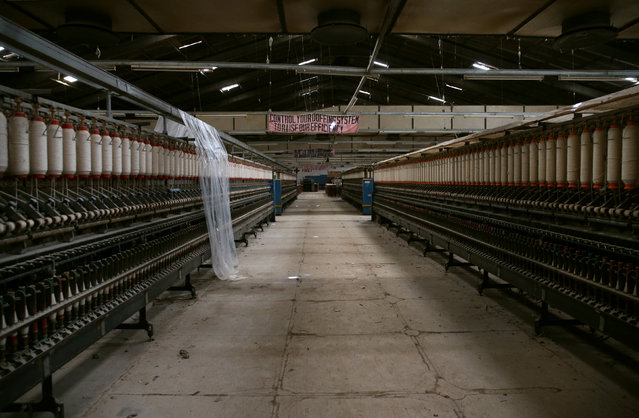
A production department of a textile factory is seen abandoned in Kaduna, Nigeria November 3, 2016. (Photo by Afolabi Sotunde/Reuters)

A production department of a textile factory is seen abandoned in Kaduna, Nigeria November 3, 2016. President Muhammadu Buhari hopes to revive the once flourishing textile and leather industries in northern Nigeria to end the country's dependence on oil exports and diversify Africa's biggest economy. (Photo by Afolabi Sotunde/Reuters)
Details
17 Feb 2017 00:01:00
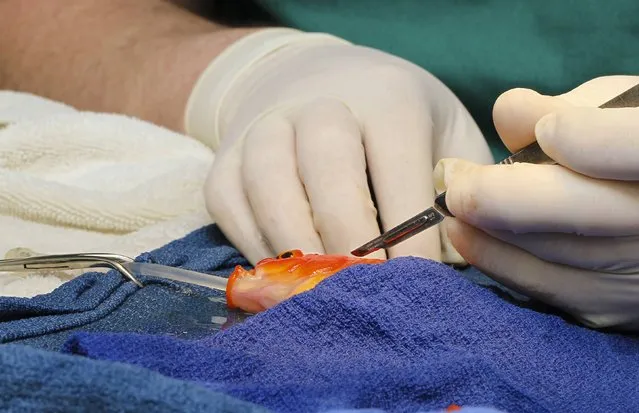
A 10-year-old pet goldfish named George undergoes veterinarian Tristan Rich's scalpel to remove a life-threatening head tumor in this handout picture taken September 11, 2014 and provided to Reuters by the Lort Smith Animal Hospital in Melbourne, Australia. (Photo by Reuters/Lort Smith Animal Hospital)

A 10-year-old pet goldfish named George undergoes veterinarian Tristan Rich's scalpel to remove a life-threatening head tumor in this handout picture taken September 11, 2014 and provided to Reuters by the Lort Smith Animal Hospital in Melbourne, Australia. In a 45-minute long procedure described by Rich as “fiddly”, the fish was sedated by water laced with anaesthetic, the tumour removed and the wound sealed with tissue glue followed by antibiotics and painkillers. (Photo by Reuters/Lort Smith Animal Hospital)
Details
16 Sep 2014 12:24:00
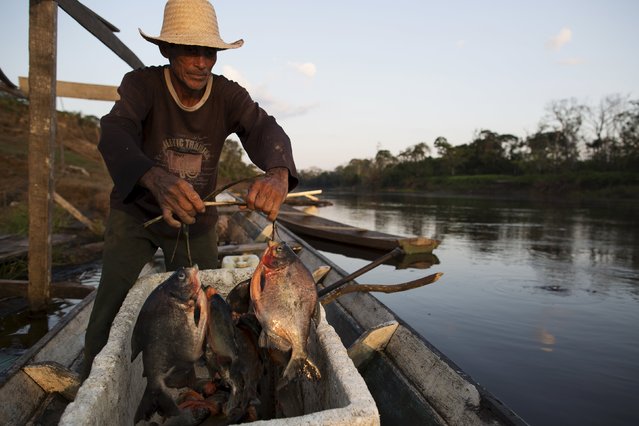
Francisco da Silva Vale, 61, cools off fish with ice produced on solar-powered ice machines at Vila Nova do Amana community in the Sustainable Development Reserve, in Amazonas state, Brazil, September 23, 2015. Three solar-powered machines, are producing about ninety kilos of ice per day, in a region with poor access to electric energy, which used to be produced only with diesel oil, in the Amazon rain forest. (Photo by Bruno Kelly/Reuters)

Francisco da Silva Vale, 61, cools off fish with ice produced on solar-powered ice machines at Vila Nova do Amana community in the Sustainable Development Reserve, in Amazonas state, Brazil, September 23, 2015. Three solar-powered machines, are producing about ninety kilos of ice per day, in a region with poor access to electric energy, which used to be produced only with diesel oil, in the Amazon rain forest. (Photo by Bruno Kelly/Reuters)
Details
10 Oct 2015 08:03:00
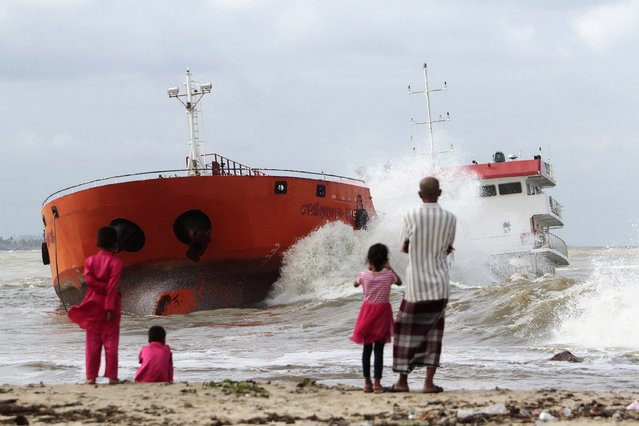
Locals watch from the beach as waves hit an Indonesian tanker that ran aground near Narathiwat in southern Thailand December 19, 2014. The tanker loaded with palm oil, previously hijacked by its crew members and then seized by Thai authorities, was anchored some 400 meters from the beach but strong wind and waves broke it free, according to local media. (Photo by Surapan Boonthanom/Reuters)

Locals watch from the beach as waves hit an Indonesian tanker that ran aground near Narathiwat in southern Thailand December 19, 2014. The tanker loaded with palm oil, previously hijacked by its crew members and then seized by Thai authorities, was anchored some 400 meters from the beach but strong wind and waves broke it free, according to local media. (Photo by Surapan Boonthanom/Reuters)
Details
20 Dec 2014 11:58:00
A devotee sits with lighted oil lamps while offering prayers during the “Dashain”, Hinduism's biggest religious festival in Bhaktapur October 3, 2014. Hindus in Nepal celebrate victory over evil during the festival by flying kites, feasting, playing swings, sacrificing animals and worshipping the Goddess Durga as well as other gods and goddess as part of celebrations held throughout the country. (Photo by Navesh Chitrakar/Reuters)

A devotee sits with lighted oil lamps while offering prayers during the “Dashain”, Hinduism's biggest religious festival in Bhaktapur October 3, 2014. Hindus in Nepal celebrate victory over evil during the festival by flying kites, feasting, playing swings, sacrificing animals and worshipping the Goddess Durga as well as other gods and goddess as part of celebrations held throughout the country. (Photo by Navesh Chitrakar/Reuters)
Details
03 Oct 2014 11:30:00
Sergei Bobkov, 59, paints Siberian cedar nut oil onto a life-size sculpture of Pallas's Cat, also known in Russia as Manul Cat, which he made from Siberian cedar wood shavings using more than 700 thousand pieces over four years, in the village of Kozhany, southwest of the Siberian city of Krasnoyarsk, Russia, April 28, 2017. (Photo by Ilya Naymushin/Reuters)

Sergei Bobkov, 59, paints Siberian cedar nut oil onto a life-size sculpture of Pallas's Cat, also known in Russia as Manul Cat, which he made from Siberian cedar wood shavings using more than 700 thousand pieces over four years, in the village of Kozhany, southwest of the Siberian city of Krasnoyarsk, Russia, April 28, 2017. (Photo by Ilya Naymushin/Reuters)
Details
29 Apr 2017 09:20:00
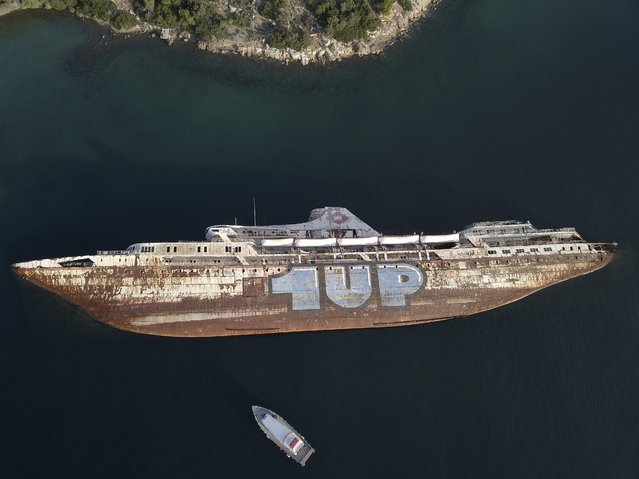
In this Friday, December 4, 2018 photo, a half sunken cruise ship lays on its side, in the Gulf of Elefsina, west of Athens. Dozens of abandoned cargo and passenger ships lie semi-submerged or completely sunken around the Gulf of Elefsina, near Greece’s major port of Piraeus. Now authorities are beginning to remove the dilapidated ships. Some of them have been there for decades, leaking hazards like oil into the environment and creating a danger to modern shipping. One expert calls the abandoned ships “an environmental bomb”. (Photo by Thanassis Stavrakis/AP Photo)

In this Friday, December 4, 2018 photo, a half sunken cruise ship lays on its side, in the Gulf of Elefsina, west of Athens. Dozens of abandoned cargo and passenger ships lie semi-submerged or completely sunken around the Gulf of Elefsina, near Greece’s major port of Piraeus. Now authorities are beginning to remove the dilapidated ships. Some of them have been there for decades, leaking hazards like oil into the environment and creating a danger to modern shipping. One expert calls the abandoned ships “an environmental bomb”. (Photo by Thanassis Stavrakis/AP Photo)
Details
08 Jan 2019 00:05:00