Loading...
Done
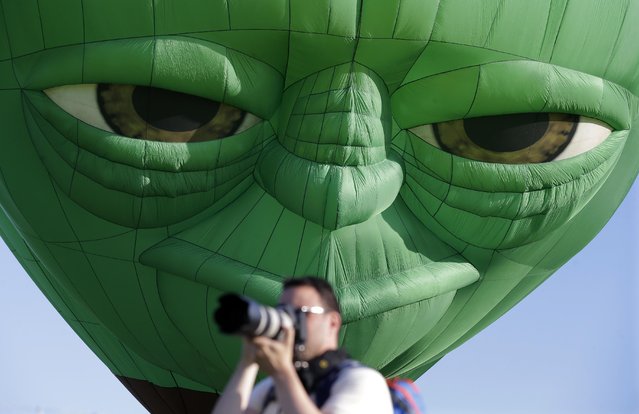
A photographer takes pictures near an inflated Master Yoda character hot air balloon during the 33rd annual QuickChek New Jersey Festival of Ballooning at Solberg Airport Friday, July 24, 2015, in Readington, N.J. The festival which runs through Sunday, July 26, 2015, will feature as many as 100 balloons, including many large, shaped balloons of Darth Vader, an American Flag, a giant whale, a Panda Bear, and a baby dinosaur. (Photo by Mel Evans/AP Photo)

A photographer takes pictures near an inflated Master Yoda character hot air balloon during the 33rd annual QuickChek New Jersey Festival of Ballooning at Solberg Airport Friday, July 24, 2015, in Readington, N.J. The festival which runs through Sunday, July 26, 2015, will feature as many as 100 balloons, including many large, shaped balloons of Darth Vader, an American Flag, a giant whale, a Panda Bear, and a baby dinosaur. (Photo by Mel Evans/AP Photo)
Details
25 Jul 2015 12:36:00
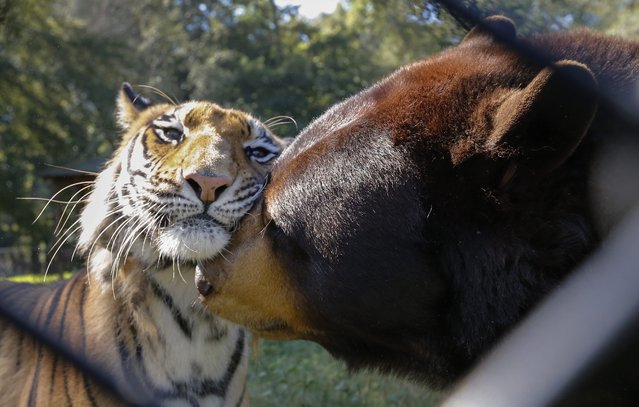
Baloo (R), a North American Black Bear, rubs snouts with his companion Shere Hkhan, a Bengal tiger, inside their shared enclosure at Noah's Ark animal sanctuary in Locust Grove, Georgia, USA, 28 August 2014. According to the facility, the pair and a lion named Leo, were confiscated at a young age from a drug dealer's basement in Atlanta, Georgia. Noah's Ark cares for about 100 different species of animals on a 250 acre farm since 1990. (Photo by Erik S. Lesser/EPA)

Baloo (R), a North American Black Bear, rubs snouts with his companion Shere Hkhan, a Bengal tiger, inside their shared enclosure at Noah's Ark animal sanctuary in Locust Grove, Georgia, USA, 28 August 2014. According to the facility, the pair and a lion named Leo, were confiscated at a young age from a drug dealer's basement in Atlanta, Georgia. Noah's Ark cares for about 100 different species of animals on a 250 acre farm since 1990. (Photo by Erik S. Lesser/EPA)
Details
30 Aug 2014 11:28:00
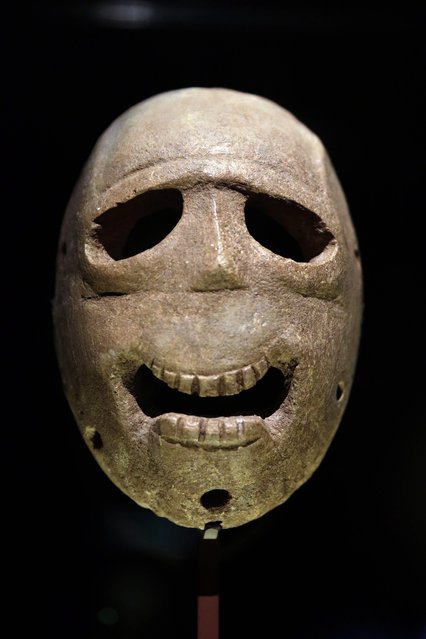
In this  Monday, March 10, 2014 photo, a 9,000 year-old mask is on display at the Israel Museum in Jerusalem.  (Photo by Tsafrir Abayov/AP Photo)

In this Monday, March 10, 2014 photo, a 9,000 year-old mask is on display at the Israel Museum in Jerusalem. The exhibition called “Face To Face” shows eleven stone masks, said to have been discovered in the Judean desert and hills near Jerusalem, which date back 9,000 years and offer a rare glimpse at some of civilization's first communal rituals. (Photo by Tsafrir Abayov/AP Photo)
Details
14 Mar 2014 08:25:00
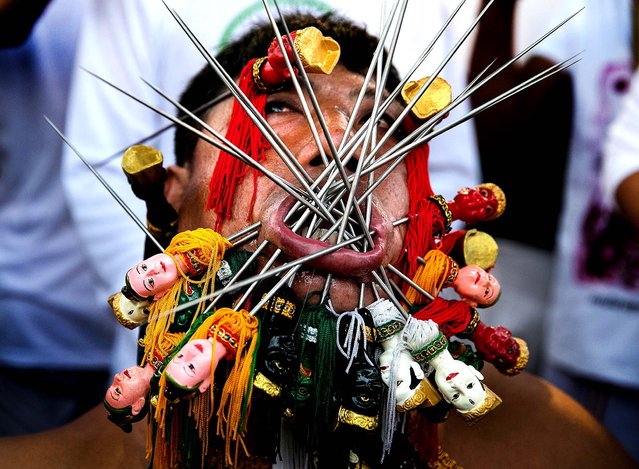
A devotee gest pierced at the Bang Neow shrine in Phuket. (Photo by Paula Bronstein/Getty Images)

“The Nine Emperor Gods Festival is a nine-day Taoist celebration beginning on the eve of 9th lunar month of the Chinese calendar, which is observed primarily in Southeast Asian countries like Myanmar, Singapore, Malaysia, Thailand and also the Riau Islands. In Thailand, this festival is called Tesagan Gin Je, the Vegetarian Festival. It is celebrated throughout the entire country, but the festivities are at their height in Phuket, where about 35% of the population is Chinese. It attracts crowds of spectators because of many of the unusual religious rituals that are performed”. – Wikipedia. Photo: A devotee gest pierced at the Bang Neow shrine in Phuket. (Photo by Paula Bronstein)
Details
11 Oct 2013 07:49:00
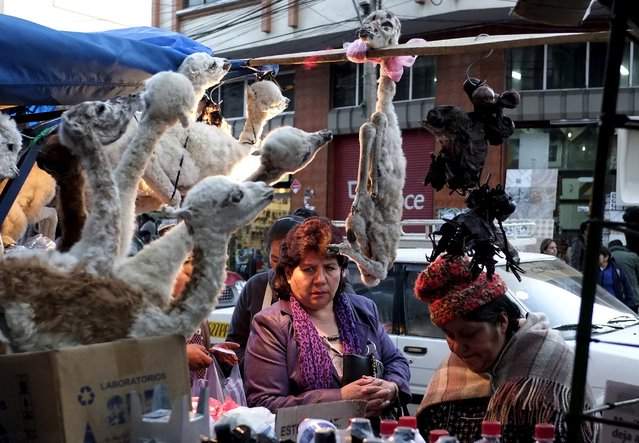
A woman (C) shops for an offering at the witch doctor's street in La Paz, July 31, 2015. (Photo by David Mercado/Reuters)

A woman (C) shops for an offering at the witch doctor's street in La Paz, July 31, 2015. According to Andean culture, the all the month of August is a time to give offerings to “Pachamama” to give thanks for their farms and health. The Aymaras use coca leaves, candies, animal fat, llama fetuses, some dried fruits, powdered minerals and alcohol during these rituals. (Photo by David Mercado/Reuters)
Details
02 Aug 2015 12:27:00
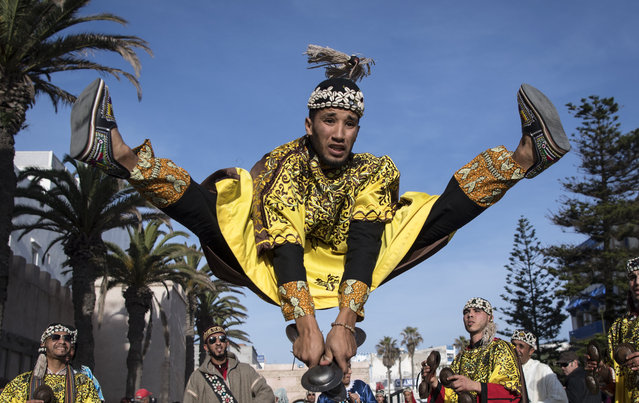
A Gnawa traditional group performs in the city of Essaouira on December 14, 2019, to celebrate the decision of adding the Gnawa culture to UNESCO's list of Intangible Cultural Heritage of Humanity. Gnawa culture, a centuries-old Moroccan practice rooted in music, African rituals and Sufi traditions, was added to UNESCO's list of Intangible Cultural Heritage of Humanity earlier in the week. Gnawa refers to a “set of musical productions, fraternal practices and therapeutic rituals where the secular mixes with the sacred”, according to the nomination submitted by Morocco. Often dressed in colourful outfits, Gnawa musicians play the guenbri, a type of lute with three strings, accompanied by steel castanets called krakebs. (Photo by Fadel Senna/AFP Photo)

A Gnawa traditional group performs in the city of Essaouira on December 14, 2019, to celebrate the decision of adding the Gnawa culture to UNESCO's list of Intangible Cultural Heritage of Humanity. Gnawa culture, a centuries-old Moroccan practice rooted in music, African rituals and Sufi traditions, was added to UNESCO's list of Intangible Cultural Heritage of Humanity earlier in the week. Gnawa refers to a “set of musical productions, fraternal practices and therapeutic rituals where the secular mixes with the sacred”, according to the nomination submitted by Morocco. Often dressed in colourful outfits, Gnawa musicians play the guenbri, a type of lute with three strings, accompanied by steel castanets called krakebs. (Photo by Fadel Senna/AFP Photo)
Details
18 Dec 2019 00:05:00
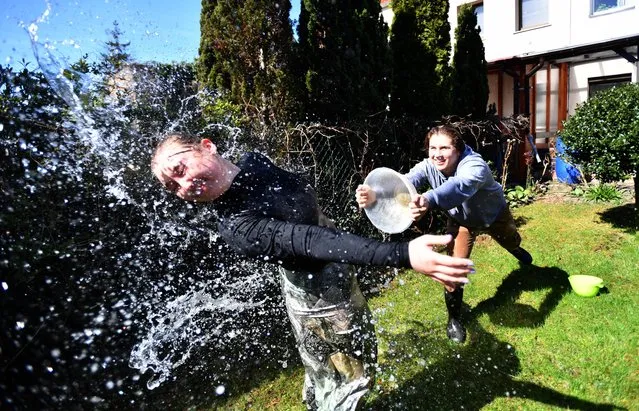
Polish boys and girls throw water over each other on “Smigus-dyngus” (or Wet Monday) during the Easter Monday in Szczecin, northwestern Poland, 18 April 2022. Smigus-dyngus is a Roman Catholic celebration held on Easter Monday in Poland. Traditionally, boys throw water over girls, this is accompanied by a number of other rituals, such as making verse declarations and holding door-to-door processions. (Photo by Marcin Bielecki/EPA/EFE)

Polish boys and girls throw water over each other on “Smigus-dyngus” (or Wet Monday) during the Easter Monday in Szczecin, northwestern Poland, 18 April 2022. Smigus-dyngus is a Roman Catholic celebration held on Easter Monday in Poland. Traditionally, boys throw water over girls, this is accompanied by a number of other rituals, such as making verse declarations and holding door-to-door processions. (Photo by Marcin Bielecki/EPA/EFE)
Details
15 Jul 2023 02:04:00
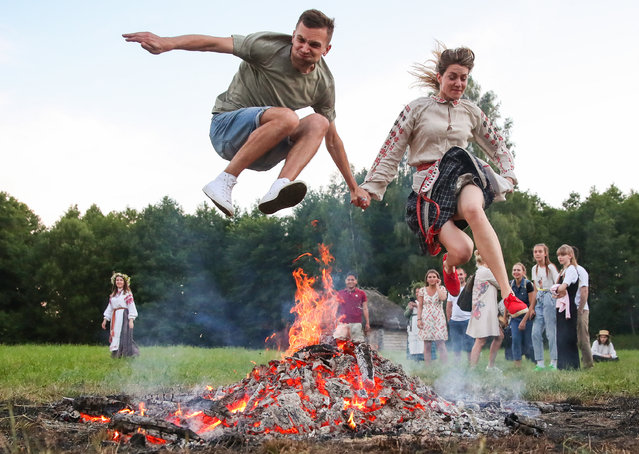
A man and a woman jump over a bonfire during Ivan Kupala Day celebrations held by the Belarusian State Museum of Folk Architecture and Rural Lifestyle in the village of Ozertso near Minsk, Belarus on July 4, 2020. Ivan Kupala Day, also known as Ivana-Kupala or Kupala Night, is a traditional pagan holiday celebrated in eastern Slavic cultures. Various rituals are traditionally performed on Kupala Night, including making flower wreaths, fortune-telling, jumping over bonfires, and burning a wheel-like effigy symbolizing the sun. (Photo by Natalia Fedosenko/TASS)

A man and a woman jump over a bonfire during Ivan Kupala Day celebrations held by the Belarusian State Museum of Folk Architecture and Rural Lifestyle in the village of Ozertso near Minsk, Belarus on July 4, 2020. Ivan Kupala Day, also known as Ivana-Kupala or Kupala Night, is a traditional pagan holiday celebrated in eastern Slavic cultures. Various rituals are traditionally performed on Kupala Night, including making flower wreaths, fortune-telling, jumping over bonfires, and burning a wheel-like effigy symbolizing the sun. (Photo by Natalia Fedosenko/TASS)
Details
23 Jan 2021 09:53:00