Loading...
Done
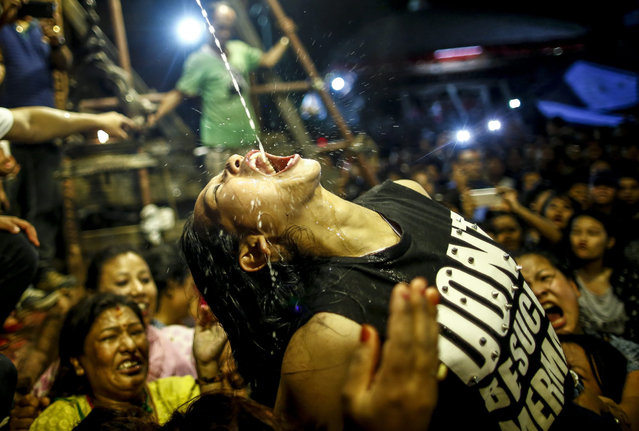
Nepalese women and young girls struggle to drink homemade alcohol poured through a pipe sticking out of the mouth of Swet Bhairab, a god of Power, during the Indra Jatra festival at Basantapur Durbar Square in Kathmandu, Nepal, 17 September 2016. Hundreds of women and young girls gathered to drink alcohol as a blessing from idol of Swet Bhairab which they believes will keep them free from all diseases. The Indra Jatra festival is celebrated to honor Indra, the king of gods and god of rains. The festival also marks the end of the monsoon. (Photo by Narendra Shrestha/EPA)

Nepalese women and young girls struggle to drink homemade alcohol poured through a pipe sticking out of the mouth of Swet Bhairab, a god of Power, during the Indra Jatra festival at Basantapur Durbar Square in Kathmandu, Nepal, 17 September 2016. Hundreds of women and young girls gathered to drink alcohol as a blessing from idol of Swet Bhairab which they believes will keep them free from all diseases. The Indra Jatra festival is celebrated to honor Indra, the king of gods and god of rains. The festival also marks the end of the monsoon. (Photo by Narendra Shrestha/EPA)
Details
18 Sep 2016 08:31:00
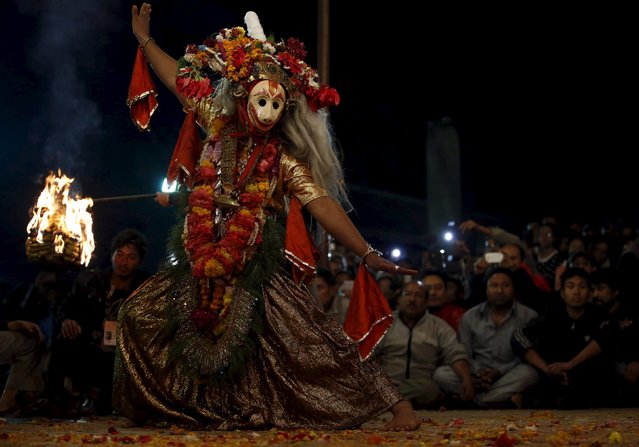
A medium performs the religious dance "Narsingh Avatar" during the traditional Kartik dance festival at Patan Durbar Square in Lalitpur, Nepal November 24, 2015. (Photo by Navesh Chitrakar/Reuters)

A medium performs the religious dance "Narsingh Avatar" during the traditional Kartik dance festival at Patan Durbar Square in Lalitpur, Nepal November 24, 2015. Observed for eight days, the festival is the longest dance festival in Nepal, and features a mix of drama, music and dialogues introduced by King Siddhinarsingh Malla in 1637 AD. (Photo by Navesh Chitrakar/Reuters)
Details
26 Nov 2015 08:04:00
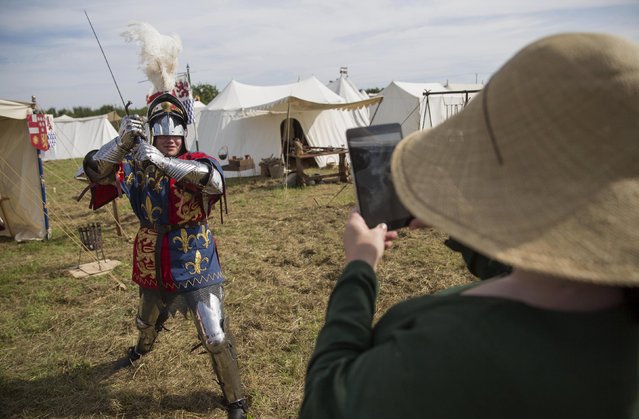
A historical re-enactor poses for a photograph in a living history camp  as he prepares to take part in an anniversary event for the Battle of Bosworth near Market Bosworth in central Britain August 22, 2015. (Photo by Neil Hall/Reuters)

A historical re-enactor poses for a photograph in a living history camp as he prepares to take part in an anniversary event for the Battle of Bosworth near Market Bosworth in central Britain August 22, 2015. The Battle of Bosworth took place in 1485 during the War of the Roses between the Houses of Lancaster and the House of York. King Richard III was defeated by Henry Tudor marking the end of Plantagenet rule and the beginning of the Tudor dynasty. (Photo by Neil Hall/Reuters)
Details
23 Aug 2015 09:55:00
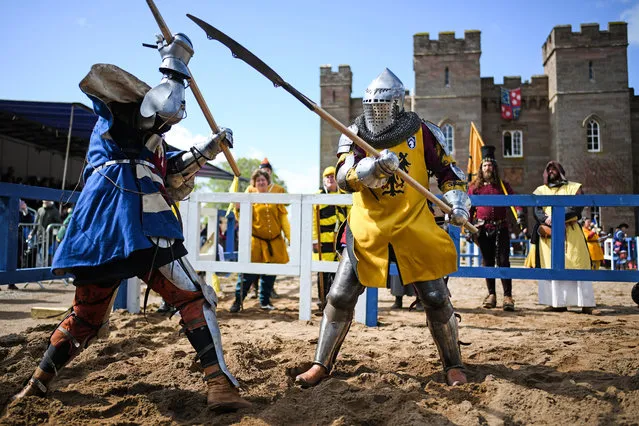
Competitors take part in the International Medieval Combat Federation World Championships at Scone Palace on May 10, 2018 in Perth, Scotland. (Photo by Jeff J. Mitchell/Getty Images)

Competitors take part in the International Medieval Combat Federation World Championships at Scone Palace on May 10, 2018 in Perth, Scotland. Thousands of visitors are expected to attend the crowning place of Scottish Kings, Scone Palace for the IMCF World Championships which has five hundred competitors and officials from all over the world, from the UK to as far afield as Australia, South Africa and Mexico. (Photo by Jeff J. Mitchell/Getty Images)
Details
12 May 2018 00:01:00
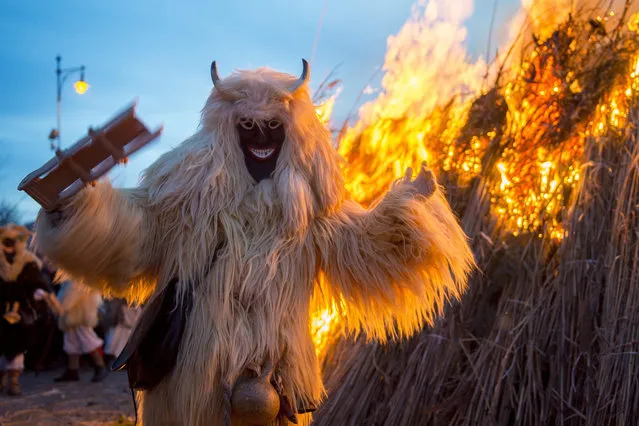
A reveler wearing sheepfur costume is seen in front of a bonfire on which they burn a coffin symbolizing winter during the closing ceremony of the traditional carnival parade in Mohacs, 189 kms south of Budapest, Hungary, 07 February 2016. (Photo by Tamas Soki/EPA)

A reveler wearing sheepfur costume is seen in front of a bonfire on which they burn a coffin symbolizing winter during the closing ceremony of the traditional carnival parade in Mohacs, 189 kms south of Budapest, Hungary, 07 February 2016. The carnival parade of people, the so-called busos, dressed in such costumes and frightening wooden masks, using various noisy wooden rattlers is traditionally held on the seventh weekend before Easter to drive away winter, and is a revival of a legend, which says that ethnic Croats ambushed the Osmanli Turkish troops, who escaped in panic seeing the terrifying figures during the Turkish occupation of Hungary. (Photo by Tamas Soki/EPA)
Details
09 Feb 2016 14:02:00
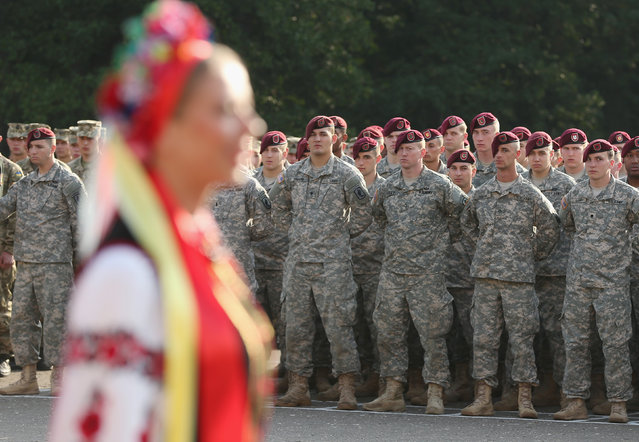
Members of the U.S. Army 173rd Airborne Brigade stand at attention as a Ukrainian folk dance group performs at the opening ceremony of the “Rapid Trident” NATO military exercises on September 15, 2014 near Yavorov, Ukraine. (Photo by Sean Gallup/Getty Images)

Members of the U.S. Army 173rd Airborne Brigade stand at attention as a Ukrainian folk dance group performs at the opening ceremony of the “Rapid Trident” NATO military exercises on September 15, 2014 near Yavorov, Ukraine. The two-week exercises include participating units from a variety of NATO and NATO-associate countries as well as Ukrainian troops. Meanwhile fighting between pro-Russian separatists and Ukrainian armed foces has flared again in eastern Ukraine in a battle for the control of Donetsk airport despite the tenuous ceasefire. (Photo by Sean Gallup/Getty Images)
Details
17 Sep 2014 12:34:00
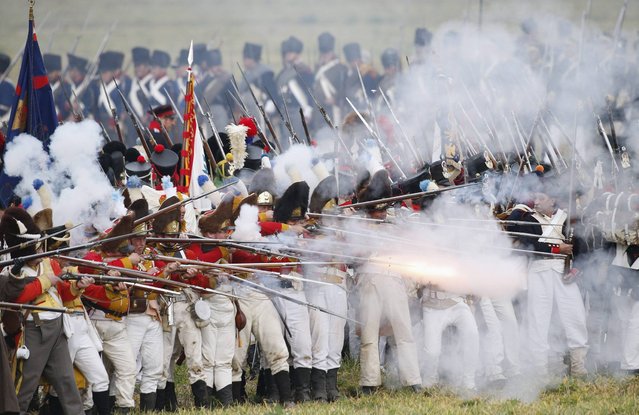
Performers wearing 19th century French military uniforms fire their weapons as they attack Allied forces during a reenactment of the Battle of the Nations, in a field in the village of Markkleeberg near Leipzig October 20, 2013. (Photo by Fabrizio Bensch/Reuters)

Performers wearing 19th century French military uniforms fire their weapons as they attack Allied forces during a reenactment of the Battle of the Nations, in a field in the village of Markkleeberg near Leipzig October 20, 2013. The east German city of Leipzig commemorated the 200th anniversary of the largest battle of the Napoleonic Wars on Sunday by reenacting the Battle of the Nations, with 6,000 military-historic association enthusiasts from all over Europe. The decisive encounter in which tens of thousands of soldiers were killed, took place from October 17-19, 1813, just outside of Leipzig. At the height of the hostilities Napoleon fielded more than 200,000 men against an Allied force of some 360,000 soldiers which included troops from Russia, Austria, Prussia and Sweden. (Photo by Fabrizio Bensch/Reuters)
Details
21 Oct 2013 11:19:00
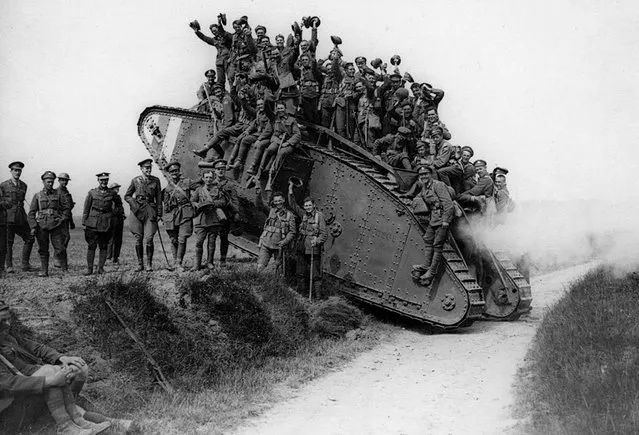
These black-and-white photos are taken from the new book “Armoured Warfare in the First World War 1916 – 1918” by Anthony Tucker-Jones and published by Pen & Sword Military. “Interestingly the British, French and Germans took completely different approaches with varying results”. The British military produced “Little Willie” in Autumn 1915 weighing 18 tonnes, which had a crew of two plus four gunners. “Inspired by a tracked artillery tractor “Little Willie” was referred to as a water tank – hence the name tank – to ensure secrecy”, said Anthony. “This led to the strange looking Mark I with its peculiar rhomboid shape, designed to cross trenches with guns in sponsons on either side. The Germans saw the tank as unchivalrous and were slow to grasp its utility. They favoured the Stormtrooper (specialist soldiers used to infiltrate enemy trenches) and artillery, not the tank”, said Anthony. “However, they didn’t hesitate to make use of captured British tanks. Although the tank helped secure victory and German soldiers dubbed it “Germany’s Downfall” the country was ultimately brought to its knees by the Allies blockade”. Here: British troops hitch a ride on a Mark IV after the massed tank fleet spearheading attack at Cambrai on November 20, 1917. (Photo by Anthony Tucker-Jones/Mediadrumworld.com)

These black-and-white photos are taken from the new book “Armoured Warfare in the First World War 1916 – 1918” by Anthony Tucker-Jones and published by Pen & Sword Military. Here: British troops hitch a ride on a Mark IV after the massed tank fleet spearheading attack at Cambrai on November 20, 1917. (Photo by Anthony Tucker-Jones/Mediadrumworld.com)
Details
23 Feb 2017 00:02:00