Loading...
Done
Glacier National Park Montana

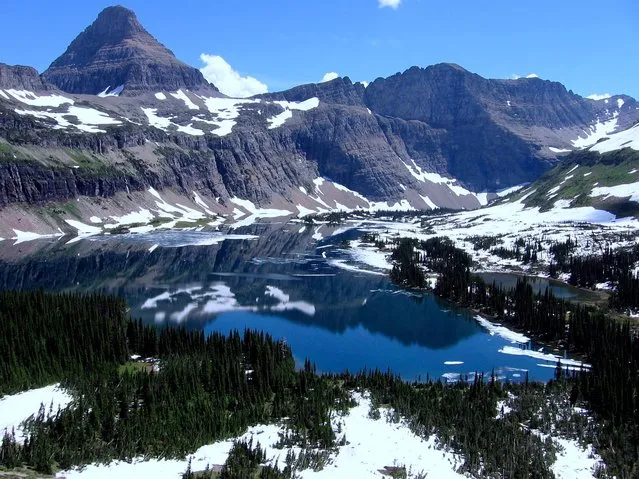
Glacier National Park is a national park located in the U.S. state of Montana, on the Canada–United States border with the Canadian provinces of Alberta and British Columbia. The park encompasses over 1,000,000 acres (4,000 km2) and includes parts of two mountain ranges (sub-ranges of the Rocky Mountains), over 130 named lakes, more than 1,000 different species of plants and hundreds of species of animals. This vast pristine ecosystem is the centerpiece of what has been referred to as the "Crown of the Continent Ecosystem", a region of protected land encompassing 16,000 square miles (41,000 km2).
Details
29 Oct 2013 11:13:00
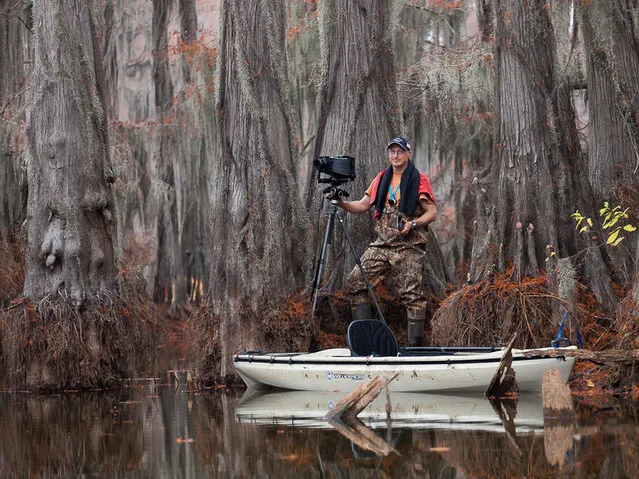
Verena Popp-Hackner And Georg Popp Professional Landscape Photographers

We – Verena Popp-Hackner and Georg Popp - are professional landscape photographers. While we are based in Vienna/Austria, running our own (rights managed) image library and a small but fine photo-gallery. Photographing our tiny country Austria, with all it's culture and nature, canoeing it's rivers or lakes and hiking the Alps is our profession but our photographic “backyard” includes the rest of the planet as well. We use analog large format cameras almost exclusively for our landscape work, shooting on 4x5” sheet film, to provide clients with the maximum of print-sharpness and details and unsurpassed clarity and depth of focus.
Details
15 Jan 2014 14:06:00
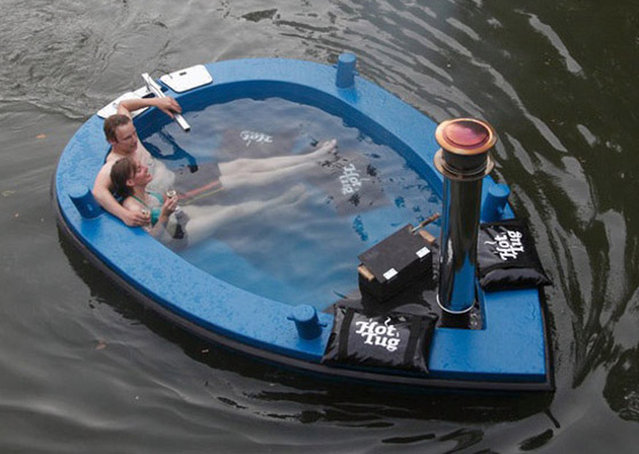
The Hot Tub Tug Boat

Slow walks along the river or lake in a small boat, meant for two passengers, this is a very nice and romantic. This game is very popular among honeymooners or couples who have recently together and have not lost to the heat and intensity of feelings that push young people to the incredible things. How to convert such travel in a more romantic, and healthy, invented Dutch designer Frank de Bruijn , “crossed” a boat and a bath-tub and calling a hybrid HotTug Boat.
Details
02 Nov 2012 11:56:00
Festivalgoers dance during the Balaton Sound music festival in Zamardi, Hungary, July 5, 2018. (Photo by Bernadett Szabo/Reuters)

Festivalgoers dance during the Balaton Sound music festival in Zamardi, Hungary, July 5, 2018. Balaton Sound is one of Europe's largest open air electronic music festivals. Held annually since 2007 on the southern bank of Lake Balaton, Hungary, it features live acts and DJ's from all around the world, from established artists to new names. The event was co-created by the organizers of Sziget Festival. (Photo by Bernadett Szabo/Reuters)
Details
07 Jul 2018 00:05:00
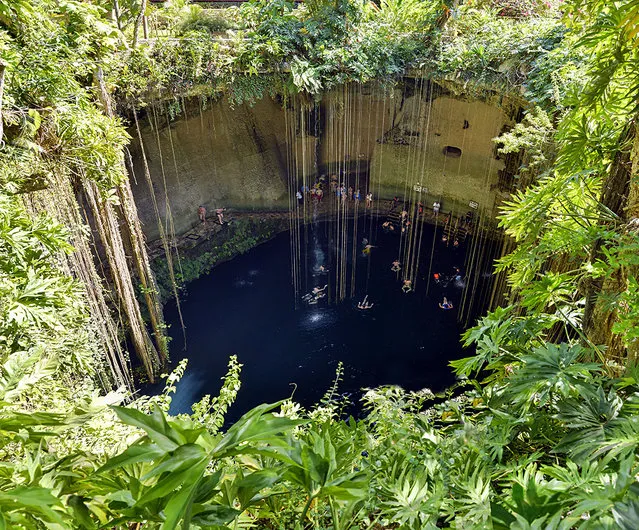
Cenote In Mexico

A cenote is a natural phenomenon, a sinkhole in the Earth’s surface. The Yucatan Peninsula in Mexico has an estimated 7,000 cenotes because it is primarily made up of porous limestone. For millions of years, rainfall slowly ate away at the limestone and a huge system of underground caves and caverns was formed. Many filled with water from rain or from the underground water table. When the roof of a water filled cave collapses, a cenote is born. The water found in a cenote may be fresh water, salt water, or both. Structurally it may be completely open, like a lake, almost completely closed with just a small opening at the top, or somewhere in between.
Details
06 Oct 2013 09:45:00
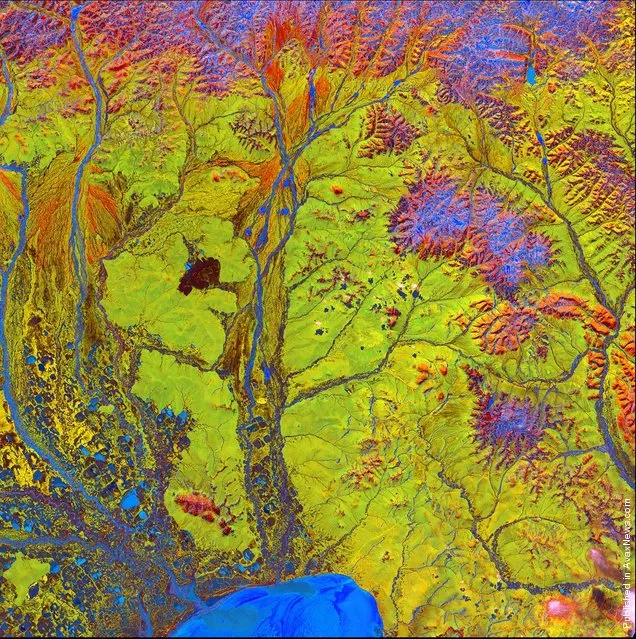
Vivid colors and bizarre shapes come together in a false-color image that could be an illustration for a fantasy story

Vivid colors and bizarre shapes come together in a false-color image that could be an illustration for a fantasy story. This labyrinth of exotic features winds its way along the edge of Russia’s Chaunskaya Bay in northeastern Siberia, seen as a vivid blue half-circle at the bottom of the image Two major rivers, the Chaun and Palyavaam, flow into the bay, which in turn opens into the Arctic Ocean. Ribbon lakes and bogs are present throughout the area, created by depressions left by receding glaciers. (Photo by USGS/NASA)
Details
14 Apr 2012 11:02:00
Salar de Uyuni

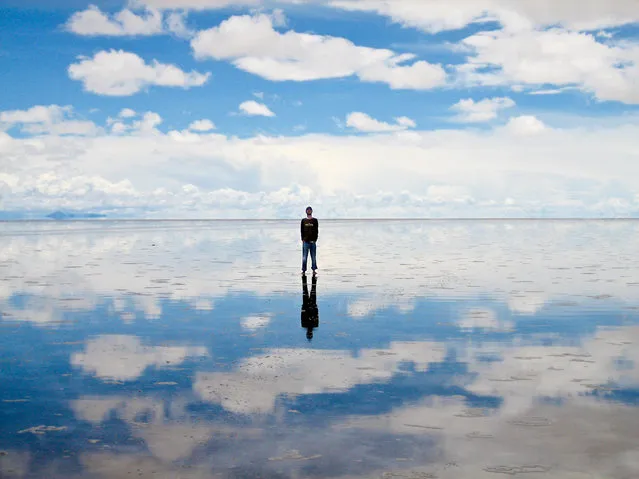
Salar de Uyuni (or Salar de Tunupa) is the world's largest salt flat at 10,582 square kilometers (4,086 sq mi). It is located in the Potosí and Oruro departments in southwest Bolivia, near the crest of the Andes, and is elevated 3,656 meters (11,995 ft) above mean sea level. The Salar was formed as a result of transformations between several prehistoric lakes. It is covered by a few meters of salt crust, which has an extraordinary flatness with the average altitude variations within one meter over the entire area of the Salar.
Details
04 Aug 2012 08:42:00
Victoria amazonica

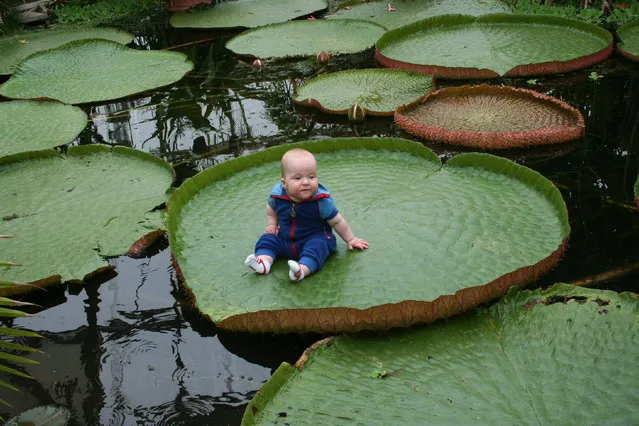
The species has very large leaves, up to 3 m in diameter, that float on the water's surface on a submerged stalk, 7–8 m in length. The species was once called Victoria regia after Queen Victoria, but the name was superseded. V. amazonica is native to the shallow waters of the Amazon River basin, such as oxbow lakes and bayous. It is depicted in the Guyanese coat of arms. The flowers are white the first night they are open and become pink the second night. They are up to 40 cm in diameter, and are pollinated by beetles.
Details
03 Sep 2012 06:58:00