Loading...
Done
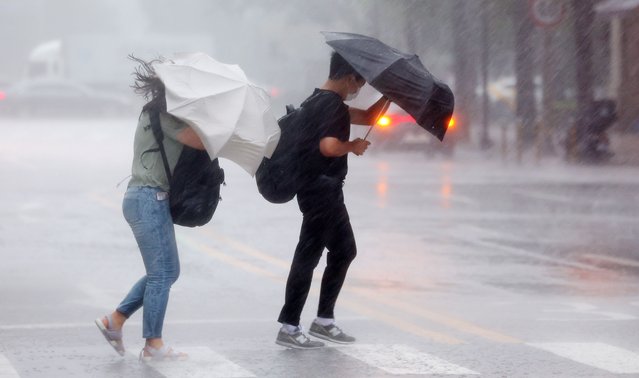
People struggle to hold onto their umbrellas in a crosswalk in the rain in Seoul, South Korea, 08 August 2022, as the rainy seas​on revisits the country. (Photo by Yonhap/EPA/EFE)

People struggle to hold onto their umbrellas in a crosswalk in the rain in Seoul, South Korea, 08 August 2022, as the rainy seas​on revisits the country. (Photo by Yonhap/EPA/EFE)
Details
11 Aug 2022 05:18:00
Members of the Israeli Mermaids Community bathe in the sea with a mermaid tails at the beachfront in Bat Yam, near Tel Aviv, Israel, Saturday, May 23, 2020. Members of the Israeli mermaid community gathered at the beachfront to mark the beginning of the bathing season. (Photo by Oded Balilty/AP Photo)

Members of the Israeli Mermaids Community bathe in the sea with a mermaid tails at the beachfront in Bat Yam, near Tel Aviv, Israel, Saturday, May 23, 2020. Members of the Israeli mermaid community gathered at the beachfront to mark the beginning of the bathing season. (Photo by Oded Balilty/AP Photo)
Details
25 May 2020 00:07:00
A man reacts as he receives 100 whippings by religious police as punishment for pre-marital sеx, outside a mosque in Jantho, Aceh province on June 5, 2020. A couple in Indonesia's conservative Aceh was publicly flogged 100 times each on June 5 after they were caught having pre-marital sеx, as one pleaded for an end to the painful punishment. Aceh is the only region in Muslim-majority Indonesia to impose Islamic law, which allows whipping for a range of charges. (Photo by Chaideer Mahyuddin/AFP Photo)

A man reacts as he receives 100 whippings by religious police as punishment for pre-marital sеx, outside a mosque in Jantho, Aceh province on June 5, 2020. A couple in Indonesia's conservative Aceh was publicly flogged 100 times each on June 5 after they were caught having pre-marital sеx, as one pleaded for an end to the painful punishment. Aceh is the only region in Muslim-majority Indonesia to impose Islamic law, which allows whipping for a range of charges. (Photo by Chaideer Mahyuddin/AFP Photo)
Details
12 Jun 2020 00:03:00
A government employee reacts as she is sprayed with disinfectant before entering a government office building to curb the spread of COVID-19 on March 19, 2020 in Pasig city, Metro Manila, Philippines. The Philippine government has sealed off Luzon, the country's largest and most populous island, to prevent the spread of COVID-19. Land, sea, and air travel has been suspended, while government work, schools, businesses, and public transportation have been ordered shut in a bid to keep some 55 million people at home. The Philippines' Department of Health has so far confirmed 217 cases of the new coronavirus in the country, with at least 17 recorded fatalities. (Photo by Ezra Acayan/Getty Images)

A government employee reacts as she is sprayed with disinfectant before entering a government office building to curb the spread of COVID-19 on March 19, 2020 in Pasig city, Metro Manila, Philippines. The Philippine government has sealed off Luzon, the country's largest and most populous island, to prevent the spread of COVID-19. Land, sea, and air travel has been suspended, while government work, schools, businesses, and public transportation have been ordered shut in a bid to keep some 55 million people at home. The Philippines' Department of Health has so far confirmed 217 cases of the new coronavirus in the country, with at least 17 recorded fatalities. (Photo by Ezra Acayan/Getty Images)

Details
07 Jan 2021 00:05:00
Noah, 10, cools himself off in his garden during hot weather in Hertford, Britain, June 25, 2020. The UK is experiencing a summer heatwave, with temperatures in many parts of the country expected to rise above 30°C and weather warnings in place for thunderstorms at the end of the week. (Photo by Andrew Couldridge/Reuters)

Noah, 10, cools himself off in his garden during hot weather in Hertford, Britain, June 25, 2020. The UK is experiencing a summer heatwave, with temperatures in many parts of the country expected to rise above 30°C and weather warnings in place for thunderstorms at the end of the week. (Photo by Andrew Couldridge/Reuters)
Details
18 Jan 2021 00:03:00
Breeder of baby goat Mohammad Hasan Narejo and a child show ears of 2-month-old female baby goat named Simbi in Karachi, Pakistan on June 07, 2023. Simbi has the world's longest ears which are 55 cm. (Photo by Sabir Mazhar/Anadolu Agency via Getty Images)

Breeder of baby goat Mohammad Hasan Narejo and a child show ears of 2-month-old female baby goat named Simbi in Karachi, Pakistan on June 07, 2023. Simbi has the world's longest ears which are 55 cm. (Photo by Sabir Mazhar/Anadolu Agency via Getty Images)
Details
17 Jun 2023 03:14:00
A lunar eclipse appears behind a gargoyle atop the old red Dallas County Courthouse early Wednesday morning, October 8, 2014. The moon appears orange or red, the result of sunlight scattering off Earth's atmosphere. This is known as the blood moon. (Photo by Tom Fox/AP Photo/The Dallas Morning News)

A lunar eclipse appears behind a gargoyle atop the old red Dallas County Courthouse early Wednesday morning, October 8, 2014. The moon appears orange or red, the result of sunlight scattering off Earth's atmosphere. This is known as the blood moon. (Photo by Tom Fox/AP Photo/The Dallas Morning News)
Details
11 Oct 2014 13:57:00
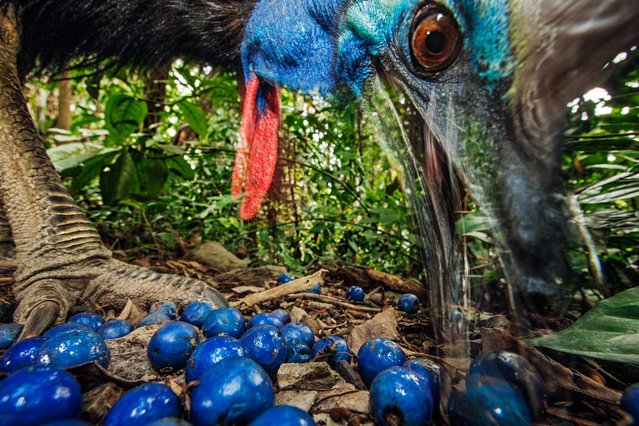
“Cassowaries are large, flightless birds related to emus and (more distantly) to ostriches, rheas, and kiwis”, writes Olivia Judson in the September issue of National Geographic magazine. (Photo by Christian Ziegler/National Geographic)

“Cassowaries are large, flightless birds related to emus and (more distantly) to ostriches, rheas, and kiwis”, writes Olivia Judson in the September issue of National Geographic magazine. How large? People-size: Adult males stand well over five foot five and top 110 pounds. Females are even taller, and can weigh more than 160 pounds. Dangerous when roused, they’re shy and peaceable when left alone. But even birds this big and tough are prey to habitat loss. The dense New Guinea and Australia rain forests where they live have dwindled. Today cassowaries might number 1,500 to 2,000. And because they help shape those same forests – by moving seeds from one place to another – “if they vanish”, Judson writes, “the structure of the forest would gradually change” too. (Photo by Christian Ziegler/National Geographic)
Details
06 Jan 2014 12:21:00