Loading...
Done
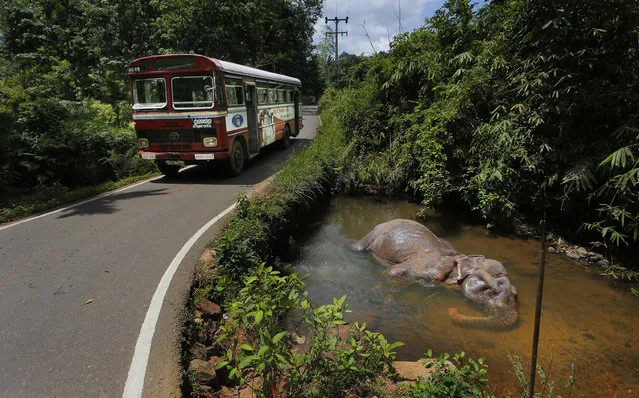
In this July 5, 2016 photo, a tamed elephant rests in a pool of water by a road in Baduraliya, a village outside Colombo, Sri Lanka. Even as the country cracks down on illegal ownership, the enduring demand for elephants has the government planning to set up its own pool of captive animals to be hired out to temples for ceremonies and maintained with budget funds. For Buddhists, who make up 70 percent of the island's 20 million population, elephants are believed to have been a servant of the Buddha and even a previous incarnation of the holy man himself. (Photo by Eranga Jayawardena/AP Photo)

In this July 5, 2016 photo, a tamed elephant rests in a pool of water by a road in Baduraliya, a village outside Colombo, Sri Lanka. Even as the country cracks down on illegal ownership, the enduring demand for elephants has the government planning to set up its own pool of captive animals to be hired out to temples for ceremonies and maintained with budget funds. (Photo by Eranga Jayawardena/AP Photo)
Details
04 Jan 2017 08:10:00
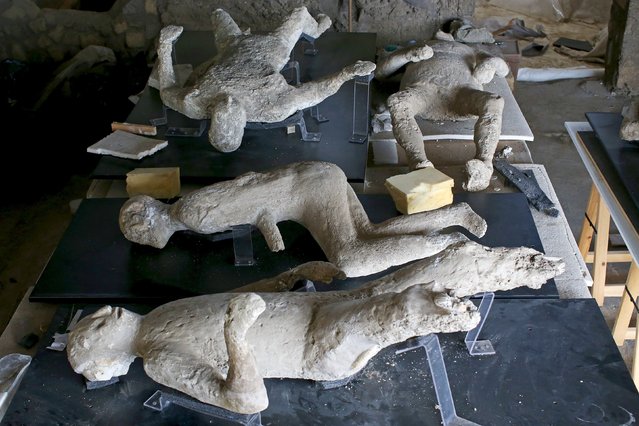
Plaster cast moulds of victims of the Mount Vesuvius eruption lie on a display table in a laboratory at Pompeii October 13, 2015. An expert team made up of archaeologists, radiologists, orthodontists and anthropologists began on September 2015 to use CAT scan technology (computerised axial tomography) to peer inside the plaster cast moulds of Pompeii's victims, in a study that has added more detail to previous findings. (Photo by Alessandro Bianchi/Reuters)

Plaster cast moulds of victims of the Mount Vesuvius eruption lie on a display table in a laboratory at Pompeii October 13, 2015. An expert team made up of archaeologists, radiologists, orthodontists and anthropologists began on September 2015 to use CAT scan technology (computerised axial tomography) to peer inside the plaster cast moulds of Pompeii's victims, in a study that has added more detail to previous findings. A 16-layer scan had to be used in order to penetrate the hardened plaster but the results showed up impressive skeletal remains and near perfect teeth. (Photo by Alessandro Bianchi/Reuters)
Details
22 Oct 2015 08:02:00
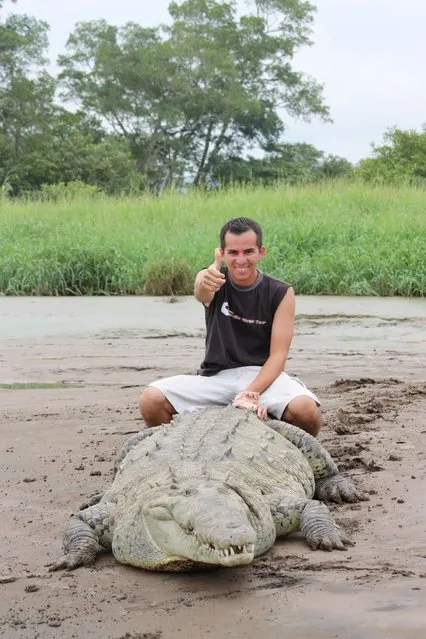
A tour guide shows a thumbs up as he sits on top of a crocodile on the Tarcoles river in Tarcoles, Costa Rica. (Photo and caption by Barcroft Media)

To most of us, hand-feeding crocodiles might sound like a one-way ticket to a watery grave. But for Jose Eduardo Chaves Salas, 32, coming within inches of the fearsome creatures’ razor-sharp teeth is all in a day’s work. He runs Jose's Crocodile River Tour on the Tarcoles River in Costa Rica, where tourists can watch him feed crocs up to 17 feet long. Photo: A tour guide shows a thumbs up as he sits on top of a crocodile on the Tarcoles river in Tarcoles, Costa Rica. (Photo and caption by Barcroft Media)
Details
20 Oct 2013 09:06:00
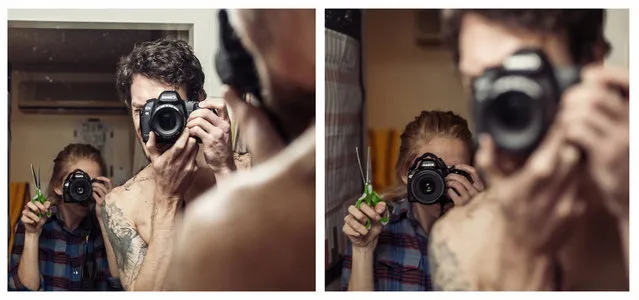
Globe-trotting photographer couple Peter Sedlacik and Zuzu Galova have found a fun way to document their travels around the world. Wherever they are, they face each other, frame up a great composition, and take a picture of each other… taking a picture of each other. Thus was born the photo series/project “Lens Between Us”. (Photo by Peter Sedlacik/Zuzu Galova)

Globe-trotting photographer couple Peter Sedlacik and Zuzu Galova have found a fun way to document their travels around the world. Wherever they are, they face each other, frame up a great composition, and take a picture of each other… taking a picture of each other. Thus was born the photo series/project “Lens Between Us”, which is quickly scooping up followers on Tumblr, Facebook and Instagram alike. The resulting diptychs are creative, well-composed, and whimsical in the best way. A tribute to how their focus is always on each other, the images are part travel photography, part portraiture, and challenging to boot since each shot requires that they figure out not one, but two compositions. (Photo by Peter Sedlacik/Zuzu Galova)
Details
11 Aug 2014 11:30:00
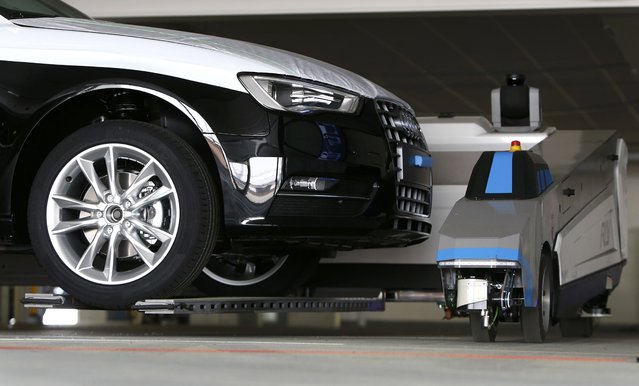
Automated guided vehicle robot “Ray” lifts up an Audi car during a pilot project at the parking area of the Audi plant in Ingolstadt, Germany, May 13, 2015. (Photo by Michaela Rehle/Reuters)

Automated guided vehicle robot “Ray” lifts up an Audi car during a pilot project at the parking area of the Audi plant in Ingolstadt, Germany, May 13, 2015. The robot has been designed to help make work more efficient and more comfortable for employees, some whom walk up to eight kilometres a day, while coordinating the finished cars for the subsequent train transportation. “Robot Ray” technology, currently being used at Dusseldorf International Airport in Germany, claims to be able to park 60 per cent more vehicles in one area compared with a human driver. (Photo by Michaela Rehle/Reuters)
Details
14 May 2015 12:04:00
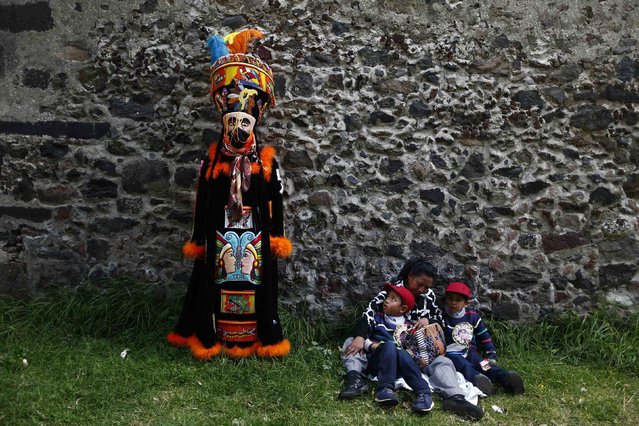
A boy sitting with his family looks up at a traditional Chinelo costumed dancer during a celebration 40 days after the birth of Jesus, in Xochimilco on the outskirts of Mexico City, February 2, 2015. (Photo by Edgard Garrido/Reuters)

A boy sitting with his family looks up at a traditional Chinelo costumed dancer during a celebration 40 days after the birth of Jesus, in Xochimilco on the outskirts of Mexico City, February 2, 2015. The tradition of the Chinelo dates back to colonial times and the outfits and masks, which are supposed to resemble the faces of the Europeans and always sport an uptilted beard, became more elaborate between the 1800s and 1900s to make fun of the upper social classes. (Photo by Edgard Garrido/Reuters)
Details
03 Feb 2015 13:09:00
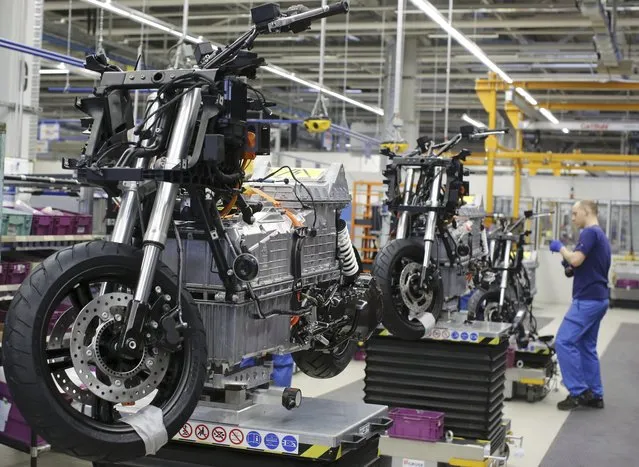
A mechanic assembles a BMW C evolution electric maxi-scooter at the BMW Berlin motorcycle plant February 23, 2015. The storage capacity of the BMW C evolution's high-voltage 8 kWh battery provides a range of up to 100 kilometres and a maximum speed of 120 km/h. (Photo by Fabrizio Bensch/Reuters)

A mechanic assembles a BMW C evolution electric maxi-scooter at the BMW Berlin motorcycle plant February 23, 2015. The storage capacity of the BMW C evolution's high-voltage 8 kWh battery provides a range of up to 100 kilometres and a maximum speed of 120 km/h. (Photo by Fabrizio Bensch/Reuters)
Details
25 Feb 2015 08:38:00
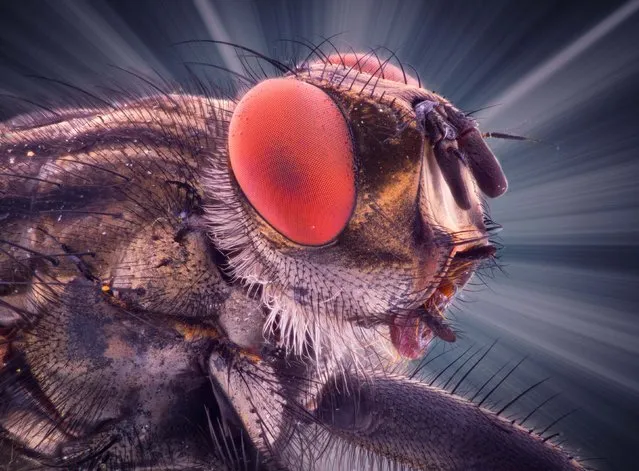
House Fly. (Photo by Kutub Uddin/Caters News)

“Creepy crawlies have become stunning examples of the natural world in these incredible close-up pictures. Photographer Kutub Uddin, 28, snapped the tiny creatures in a forest near his home of Bognor Regis over the course of the summer. Taken in close-up using special macro lenses and filters, he managed to turn house flies, damsel flies and wasps into gorgeous jeweled works of art. Kutub said: “I found the bugs in the forest near where I live when I was taking pictures”. – Cater News
Details
01 Sep 2014 10:29:00