Loading...
Done
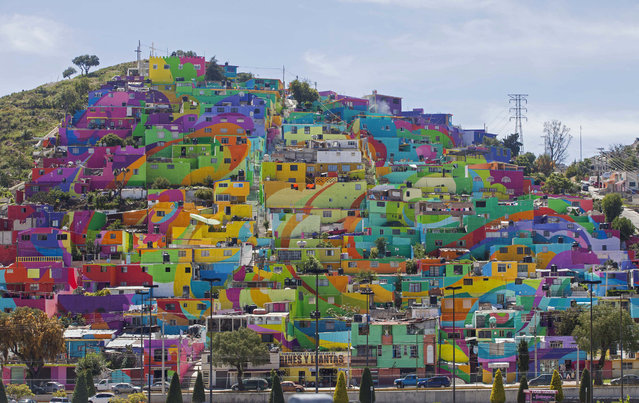
Hundreds of houses painted in bright colors in what organizers claim is Mexico's largest mural, is part of a government-sponsored project is called Pachuca Paints Itself, in the Palmitas neighborhood, in Pachuca, Mexico, Thursday, July 30, 2015. German Crew is the artist collective responsible for painting the mural project. Director Enrique Gomez, who goes by MYBE, said the crew has painted 1,500 square meters with 20,000 liters of paint. (Photo by Sofia Jaramillo/AP Photo)

Hundreds of houses painted in bright colors in what organizers claim is Mexico's largest mural, is part of a government-sponsored project is called Pachuca Paints Itself, in the Palmitas neighborhood, in Pachuca, Mexico, Thursday, July 30, 2015. German Crew is the artist collective responsible for painting the mural project. Director Enrique Gomez, who goes by MYBE, said the crew has painted 1,500 square meters with 20,000 liters of paint. Working hand-in-hand with residents, muralists have painted the facades of 200 homes bright lavender, lime green, incandescent orange – hues more commonly found in a bag of Skittles than in the drab, cement-and-cinderblock neighborhoods where many of Mexico's poor live. The project aims to bring the community together and rehabilitate the area. (Photo by Sofia Jaramillo/AP Photo)
Details
03 Aug 2015 12:02:00
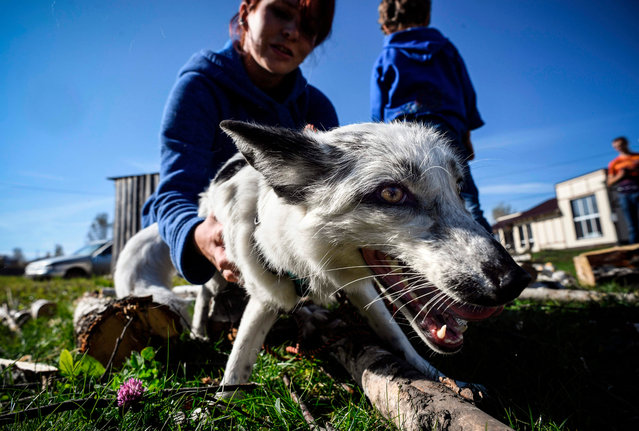
Tatyana Abramova, 33, plays with her home fox Plombir at her countryside house outside Siberian city of Novosibirsk on September 12, 2020. The official start of the Soviet experiment to better understand the domestication of animals by humans began in 1959, and was initiated by geneticists Dmitri Beliaiev and Lioudmila Trout on a farm in Akademgorodok, the scientific center of excellence in Siberia. Their primary objective was to domesticate foxes, to understand how the ancestor of wolves, another canine, evolved into a loyal and loving dog. And understand what this domestication tells us about the genetic evolution of species. (Photo by Alexander Nemenov/AFP Photo)

Tatyana Abramova, 33, plays with her home fox Plombir at her countryside house outside Siberian city of Novosibirsk on September 12, 2020. The official start of the Soviet experiment to better understand the domestication of animals by humans began in 1959, and was initiated by geneticists Dmitri Beliaiev and Lioudmila Trout on a farm in Akademgorodok, the scientific center of excellence in Siberia. Their primary objective was to domesticate foxes, to understand how the ancestor of wolves, another canine, evolved into a loyal and loving dog. And understand what this domestication tells us about the genetic evolution of species. (Photo by Alexander Nemenov/AFP Photo)
Details
25 Oct 2020 00:05:00
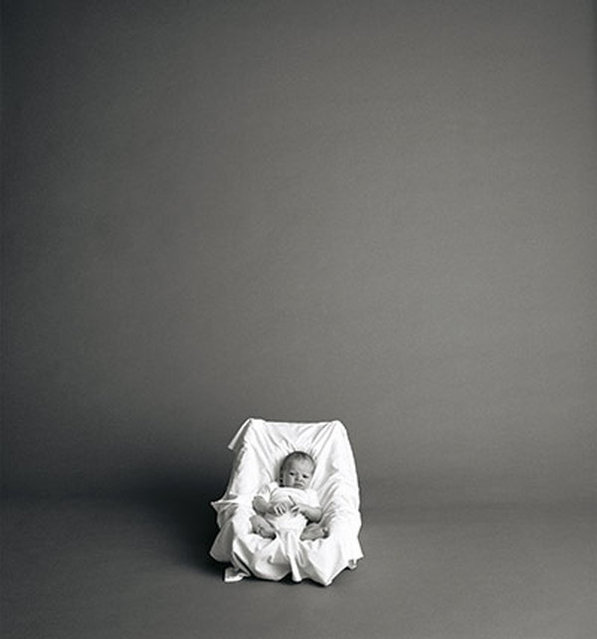
Zed Nelson by The Family

Zed Nelson has photographed the same family, once a year on the same day, for 20 years. I take hundreds of photo’s of my extended family all year round, some just languish on my computer screen unseen by anyone, some get printed, some framed. What is really interesting about this project is not only the obvious time scale but his “ analytical approach“. The same plain background is used for each session and he chooses only 1 frame to represent that years image. My many photographs are a mishmash of family events, his create a family history unfolding . Perhaps less really is more.
Details
22 Jun 2015 10:27:00
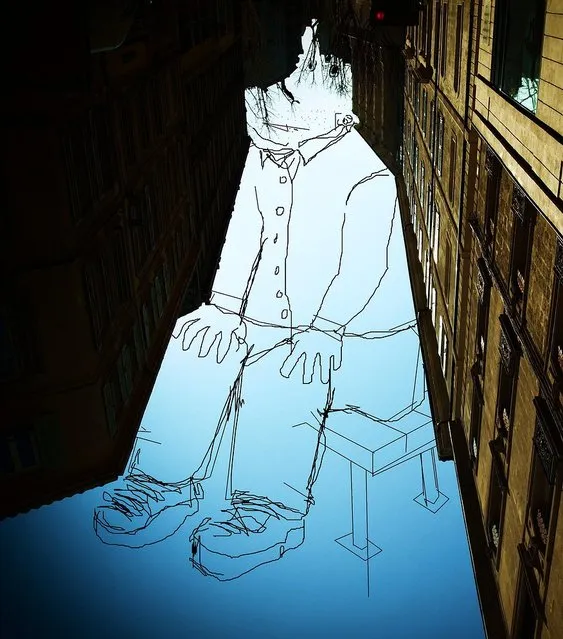
Whimsical Sky Art by Thomas Lamadieu

French artist Thomas Lamadieu, also know as Roots Art, must really love looking at the sky. Every time he looks up, Thomas sees a potential canvas where the building rooftops frame the sky. He photographs it and uses the odd sky shapes to create whimsical line drawings. “My artistic aim is to show a different perception of urban architecture and the everyday environment around us, what we can construct with a boundless imagination,” says Thomas. (Photo by Thomas Lamadieu)
Details
22 Apr 2013 05:17:00


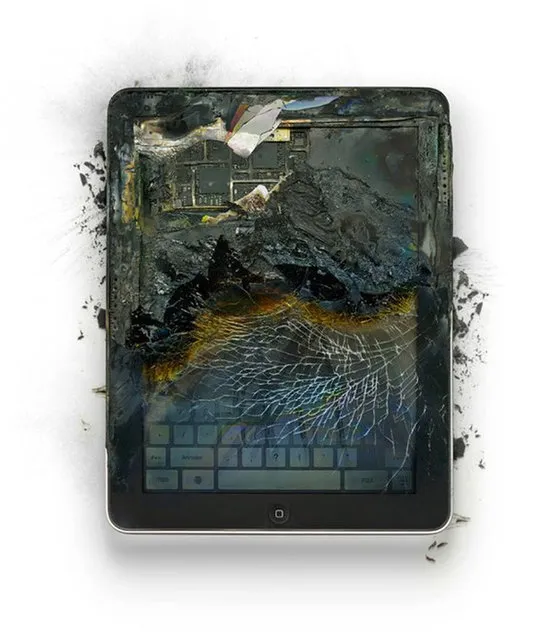
Artist Michael Tompert, a former graphic designer at Apple, is putting on an exhibition showing Apple products which he has destroyed in various ways – burned with blowtorches, smashed with sledgehammers, chopped up with handsaws or shot with a handgun.

The results are then photographed in the typically fetishistic style of Tompert’s former employer, all close-up and against a plain white background.

Presumably the image editing was done elsewhere, what with all his own gear being smashed up all over the studio and all.
Details
10 Jan 2013 13:17:00
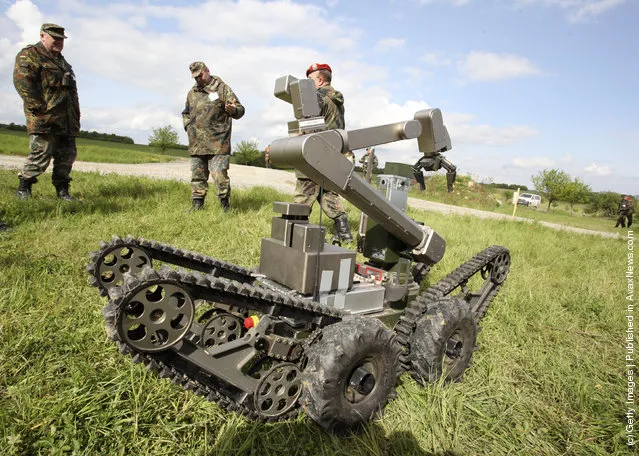
European Land-Robot Trial (ELROB), Military robot, teleMAX

The land-robot “teleMAX” of German company telerob stands next to soldiers during a trial at the German army base on May 18, 2010 in Hammelburg, Germany. ELROB provides an overview of the current state of affairs in European unmanned system technology and to evaluate commercial off-the-shelf products for military use. It is to show what is feasible in robotics, to support technological developments in Europe, and to find solutions for the current military challenges. (Photo by Ralph Orlowski/Getty Images)
Details
16 Aug 2011 11:47:00
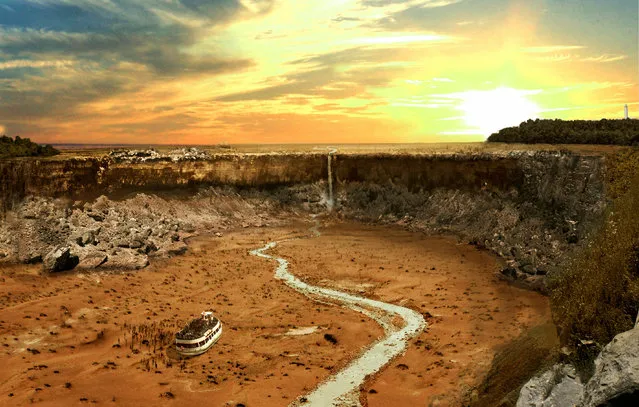
Niagara Falls, Canada, after severe drought. (Photo by Joel Krebs/Caters News)

A graphic designer has produced a haunting look at what the world’s most famous landmarks would look like if they were hit by a severe drought. Joel Krebs has intricately dried up hot spots such as the Tower Bridge in London, the Capitol in Washington, D.C., Niagara Falls and Machu Picchu. Here: Niagara Falls, Canada, after severe drought. (Photo by Joel Krebs/Caters News)
Details
14 Feb 2016 11:49:00
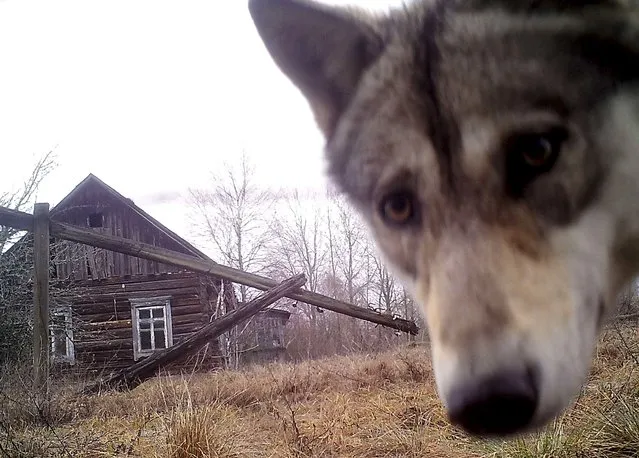
A wolf looks into the camera at the 30 km (19 miles) exclusion zone around the Chernobyl nuclear reactor in the abandoned village of Orevichi, Belarus, March 2, 2016. (Photo by Vasily Fedosenko/Reuters)

A wolf looks into the camera at the 30 km (19 miles) exclusion zone around the Chernobyl nuclear reactor in the abandoned village of Orevichi, Belarus, March 2, 2016. What happens to the environment when humans disappear? Thirty years after the Chernobyl nuclear disaster, booming populations of wolf, elk and other wildlife in the vast contaminated zone in Belarus and Ukraine provide a clue. (Photo by Vasily Fedosenko/Reuters)
Details
08 Apr 2016 15:13:00