Loading...
Done


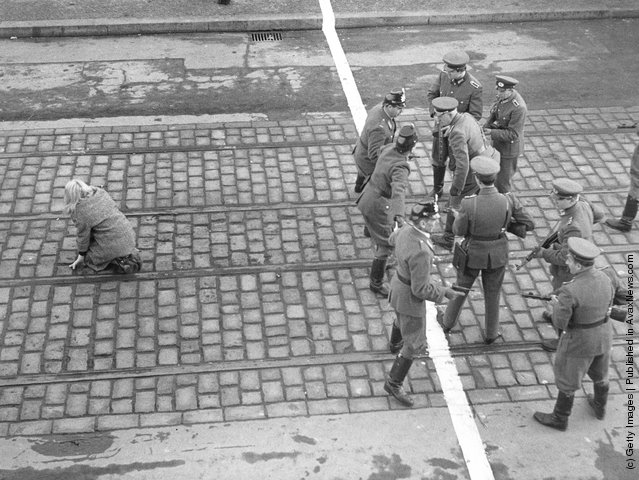
“The Berlin Wall (German: Berliner Mauer) was a barrier constructed by the German Democratic Republic (GDR, East Germany) starting on 13 August 1961, that completely cut off West Berlin from surrounding East Germany and from East Berlin. The barrier included guard towers placed along large concrete walls, which circumscribed a wide area (later known as the “death strip”) that contained anti-vehicle trenches, “fakir beds” and other defenses. The Soviet-dominated Eastern Bloc officially claimed that the wall was erected to protect its population from fascist elements conspiring to prevent the “will of the people” in building a socialist state in East Germany. However, in practice, the Wall served to prevent the massive emigration and defection that marked Germany and the communist Eastern Bloc during the post-World War II period”. – Wikipedia

Photo: West Berlin policemen and East German Volkspolizei face each other across the border in Berlin, circa 1955. (Photo by Three Lions/Hulton Archive/Getty Images)
Details
22 May 2011 10:49:00
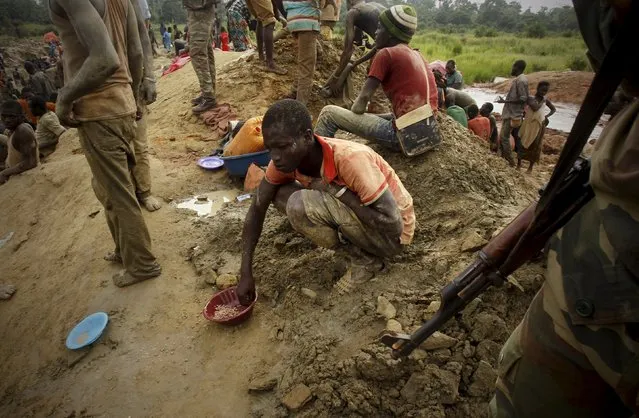
A gold prospector sits and eats close to a soldier at a gold mine near the village of Gamina, in western Ivory Coast, March 18, 2015. (Photo by Luc Gnago/Reuters)

Nestled among the cocoa plantations of western Ivory Coast is a gold mine that does not feature on any official maps. It is not run by an industrial mining company, nor does it pay taxes to the central government. The unlicensed mine is a key part of a lucrative business empire headed by the deputy commander of the West African nation's elite Republican Guard, United Nations investigators allege. Here: A gold prospector sits and eats close to a soldier at a gold mine near the village of Gamina, in western Ivory Coast, March 18, 2015. (Photo by Luc Gnago/Reuters)
Details
08 May 2015 13:54:00
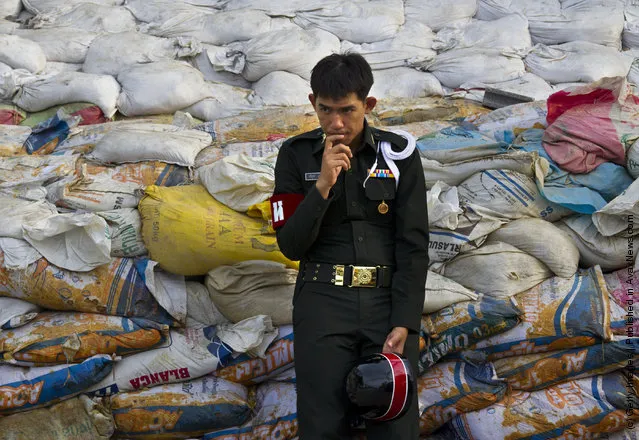
Bangkok Floods

A Thai security guard stands by a wall of sandbags in front of a factory at the Bangchan Industrial Estate area on the outskirts of the capitol city November 8, 2011 in Bangkok, Thailand. Over seven major industrial parks in Bangkok and, thousands of factories have been closed in the central Thai province of Ayutthaya and Nonthaburi with millions of tons of rice damaged. Across the country, the flooding which is now in its third month has affected 25 of Thailand's 64 provinces. Thailand is experiencing the worst flooding in over 50 years which has affected more than nine million people. Over 400 people have died in flood-related incidents since late July according to the Department of Disaster Prevention and Mitigation. (Photo by Paula Bronstein /Getty Images)
Details
10 Nov 2011 09:11:00
A pigeon, known as Siyah Kinifirli, with an approximate market value of 1000 Turkish Lira ($263), bred by 23-year-old Ismail Ozbek, is pictured in Sanliurfa, Turkey, December 23, 2016. As night-time approaches in Sanliurfa, southeastern Turkey, most of the alleyways of the city's old bazaar are emptying out of buyers and vendors, except for one. The bustle of daytime trading has died down, but on this little street, a stream of men carry cardboard boxes filled with pigeons to a cluster of three teahouses. Here, they sell the birds at Sanliurfa's famed auctions to a dedicated band of pigeon keepers and breeders, a pastime that has been thriving for hundreds of years across the region and over the nearby border into war-torn Syria. In a country where the minimum wage is about 1,400 Liras ($367) a month, enthusiasts regularly easily spend hundreds of dollars for one bird. “I once sold a pair of pigeons for 35,000 Turkish Lira”, says auctioneer Imam Dildas. “This is a passion, a hobby you cannot quit. I've been known to sell the fridge and my wife's gold bracelets to pay for pigeons”. (Photo by Umit Bektas/Reuters)

A pigeon, known as Siyah Kinifirli, with an approximate market value of 1000 Turkish Lira ($263), bred by 23-year-old Ismail Ozbek, is pictured in Sanliurfa, Turkey, December 23, 2016. As night-time approaches in Sanliurfa, southeastern Turkey, most of the alleyways of the city's old bazaar are emptying out of buyers and vendors, except for one. (Photo by Umit Bektas/Reuters)
Details
17 Jan 2017 12:05:00
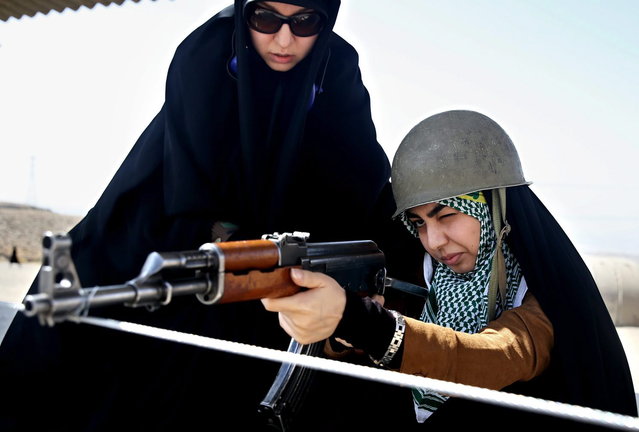
In this Thursday, August 22, 2013 photo, a female member of the Basij paramilitary militia aims a rifle as a trainer looks over her shoulder in Tehran, Iran. (Photo by Ebrahim Noroozi/AP Photo)

With a presence in nearly every city and town across Iran, the paramilitary Basij volunteer corps has an ever-increasing influence on life in the Islamic Republic. Authorities created the Basij, which means mobilization in Persian, just after the country's 1979 Islamic Republic. It is part of Iran's powerful Revolutionary Guard. Photo: In this Thursday, August 22, 2013 photo, a female member of the Basij paramilitary militia aims a rifle as a trainer looks over her shoulder in Tehran, Iran. (Photo by Ebrahim Noroozi/AP Photo)
Details
17 Jan 2014 09:19:00
Women sing and dance as children gather in the background during the so-called parade of children's troops in Rostov-on-Don, southern Russia, May 14, 2015. (Photo by Eduard Korniyenko/Reuters)

Women sing and dance as children gather in the background during the so-called parade of children's troops in Rostov-on-Don, southern Russia, May 14, 2015. About 500 children aged from 4 to 10, members of youth military patriotic clubs, honor guards and paratroopers took part in the event, which was organized under the guidance of Commander of Southern Military District Colonel-General Alexander Galkin and was held to honor World War Two veterans and mark the 70th anniversary of the victory over Nazi Germany, according to local media. (Photo by Eduard Korniyenko/Reuters)
Details
15 May 2015 10:39:00
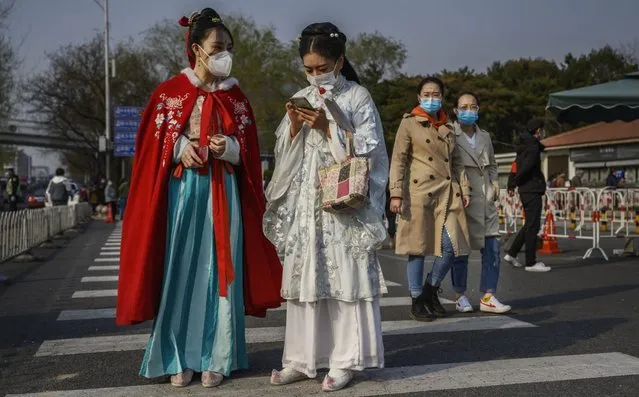
Chinese women wear protective masks as they are dressed in traditional clothing from the Qing Dynasty era outside a park on March 29, 2020 in Beijing, China. A limited section of the iconic tourist site was re-opened to the public this week allowing a smaller number of visitors to reserve tickets online in advance and to enter after passing health screening. With the pandemic hitting hard across the world, China recorded its first day with no new domestic cases of the coronavirus last week, since the government imposed sweeping measures to keep the disease from spreading. For two months, millions of people across China have been restricted in how they move from their homes, while other cities have been locked down in ways that appeared severe at the time but are now being replicated in other countries trying to contain the virus. Officials believe the worst appears to be over in China, though there are concerns of another wave of infections as the government attempts to reboot the worlds second largest economy. In Beijing, it is mandatory to wear masks outdoors, retail stores operate on reduced hours, restaurants employ social distancing among patrons, and tourist attractions at risk of drawing large crowds remain closed. Monitoring and enforcement of virus-related measures and the quarantine of anyone arriving to Beijing is carried out by neighborhood committees and a network of Communist Party volunteers who wear red arm bands. A primary concern for Chinese authorities remains the arrival of flights from Europe and elsewhere, given the exposure of passengers in regions now regarded as hotbeds for transmission. Since January, China has recorded more than 81,000 cases of COVID-19 and at least 3200 deaths, mostly in and around the city of Wuhan, in central Hubei province, where the outbreak first started. (Photo by Kevin Frayer/Getty Images)

Chinese women wear protective masks as they are dressed in traditional clothing from the Qing Dynasty era outside a park on March 29, 2020 in Beijing, China. A limited section of the iconic tourist site was re-opened to the public this week allowing a smaller number of visitors to reserve tickets online in advance and to enter after passing health screening. (Photo by Kevin Frayer/Getty Images)
Details
01 Apr 2020 00:05:00
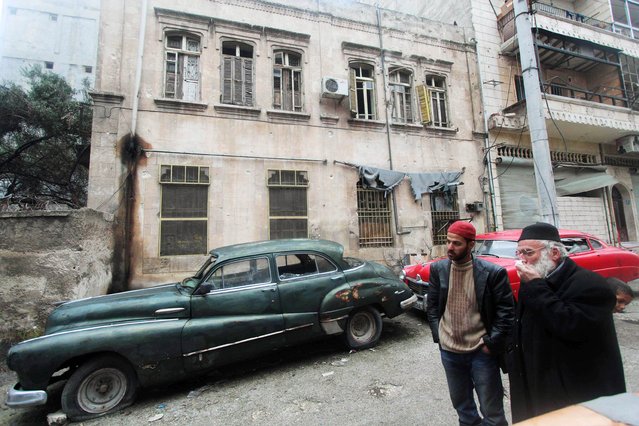
Mohamed Badr al-Din (R) stands in front of his vintage cars along a street where he keeps them, in the al-Shaar neighborhood of Aleppo January 31, 2015. The 66-year-old collector nicknamed Abu Omar inherited the hobby from his father and has a large collection of vintage cars, some of which he says belonged to former Syrian officials and were used in several movies and shows. (Photo by Abdalrhman Ismail/Reuters)

Mohamed Badr al-Din (R) stands in front of his vintage cars along a street where he keeps them, in the al-Shaar neighborhood of Aleppo January 31, 2015. The 66-year-old collector nicknamed Abu Omar inherited the hobby from his father and has a large collection of vintage cars, some of which he says belonged to former Syrian officials and were used in several movies and shows. Before the unrest, Abu Omar planned to open a museum to display his cars, which are guarded from pedestrians by a turkey that he owns. He hopes that the turmoil in the country will end so that he can pursue his hobby and repair his cars, which are heavily damaged from shelling. (Photo by Abdalrhman Ismail/Reuters)
Details
01 Feb 2015 10:34:00