Loading...
Done
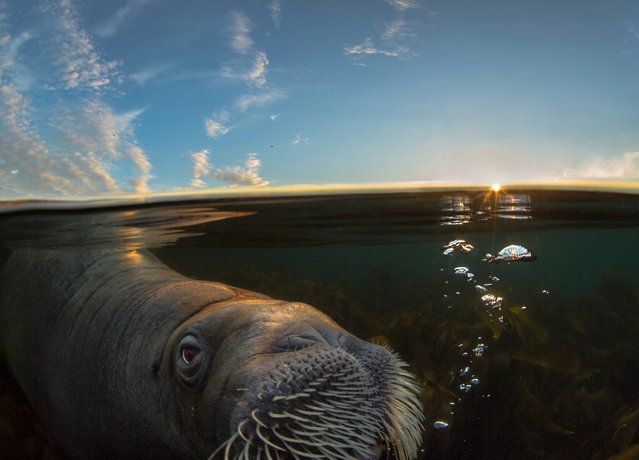
The Wildscreen festival is the world’s biggest celebration of screen-based natural history storytelling which takes place every two years in Bristol. Here: “Walrus in Midnight Sun”. Walrus feed mostly on bivalves in productive, shallow and often sandy habitats in the Arctic. This individual, though, arrived on a beach outside Tromsø, northern Norway, and found comfort on a stranded dead sperm whale. After two weeks he approached Audun, and only half a metre away he stretched his tusk forward and touched his hand gently. “This was one of the most memorable moments of my life”, Rikardsen says. He named the 500kg male Buddy. After two months, the dead whale was decomposed and Buddy suddenly disappeared. (Photo by Audun Rikardsen/Wildscreen 2016)

The Wildscreen festival is the world’s biggest celebration of screen-based natural history storytelling which takes place every two years in Bristol. Here: “Walrus in Midnight Sun”. Walrus feed mostly on bivalves in productive, shallow and often sandy habitats in the Arctic. This individual, though, arrived on a beach outside Tromsø, northern Norway, and found comfort on a stranded dead sperm whale. After two weeks he approached Audun, and only half a metre away he stretched his tusk forward and touched his hand gently. “This was one of the most memorable moments of my life”, Rikardsen says. He named the 500kg male Buddy. After two months, the dead whale was decomposed and Buddy suddenly disappeared. (Photo by Audun Rikardsen/Wildscreen 2016)
Details
07 Oct 2016 10:02:00
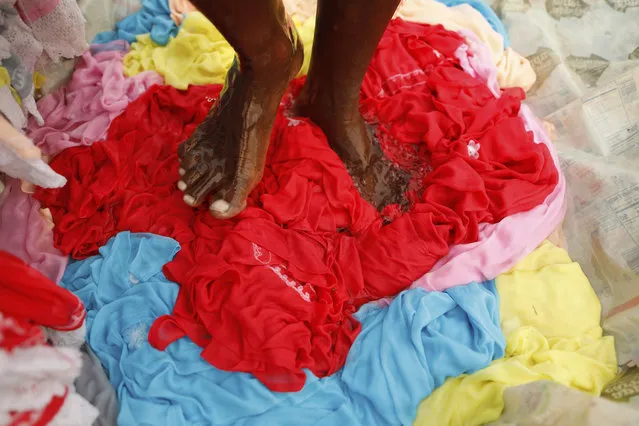
A dhobi, or a washerman washes cloths on the banks of the River Gomti in Lucknow, India, Saturday, September 12, 2020. Dhobis are traditional laundry workers who wash clothes by hand and dry them in the sun, an occupation which has been in existence for generations. Most cities in India have a Dhobi Ghat, or washermen's area, where the city's pile of clothes is laundered. This practice is still popular in India, despite of modern technology. Around 1,000 families work in Lucknow's Dhobi Ghat. However, in light of the novel coronavirus, their wages have decreased drastically. With each family earning around US$100-200 per month. (Photo by Rajesh Kumar Singh/AP Photo)

A dhobi, or a washerman washes cloths on the banks of the River Gomti in Lucknow, India, Saturday, September 12, 2020. Dhobis are traditional laundry workers who wash clothes by hand and dry them in the sun, an occupation which has been in existence for generations. Most cities in India have a Dhobi Ghat, or washermen's area, where the city's pile of clothes is laundered. This practice is still popular in India, despite of modern technology. Around 1,000 families work in Lucknow's Dhobi Ghat. However, in light of the novel coronavirus, their wages have decreased drastically. With each family earning around US$100-200 per month. (Photo by Rajesh Kumar Singh/AP Photo)
Details
25 Sep 2020 00:03:00
A protester spits fire during a protest to mark the second anniversary of months of civil unrising against social inequality, in Santiago, on October 18, 2021. The social-justice protests that rocked Chile in October 2019 led ultimately to the decision to create a new constitutional convention to draft a constitution to replace the one written during the dictatorship of Augusto Pinochet (1973-1990). The new 155-member the new body is in charge of writing a new constitution meant to pry power from the hands of the elite and spread it more equitably in the South American nation. (Photo by Martin Bernetti/AFP Photo)

A protester spits fire during a protest to mark the second anniversary of months of civil unrising against social inequality, in Santiago, on October 18, 2021. The social-justice protests that rocked Chile in October 2019 led ultimately to the decision to create a new constitutional convention to draft a constitution to replace the one written during the dictatorship of Augusto Pinochet (1973-1990). The new 155-member the new body is in charge of writing a new constitution meant to pry power from the hands of the elite and spread it more equitably in the South American nation. (Photo by Martin Bernetti/AFP Photo)
Details
20 Oct 2021 09:01:00
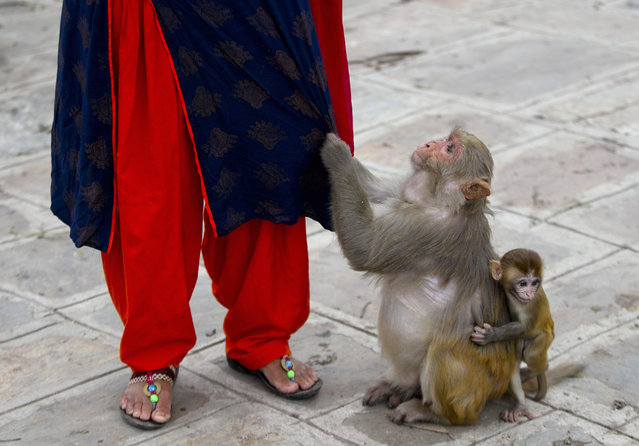
In this July 8, 2019, photo, a monkey pulls on the clothes of Saraswati Dangol as she arrives to feed monkeys in the forest near Pashupatinath temple in Kathmandu, Nepal. For the past four years, Dangol has been bringing the bread every day to feed the monkeys. As soon as they see her with her white sack, they gather around her, some patiently waiting for their turn while others less patiently snatching the bread from her hands. Many of Dangol's regulars are elderly, or are mother or baby monkeys who are unable to fight for their share of food in the wild. (Photo by Niranjan Shrestha/AP Photo)

In this July 8, 2019, photo, a monkey pulls on the clothes of Saraswati Dangol as she arrives to feed monkeys in the forest near Pashupatinath temple in Kathmandu, Nepal. For the past four years, Dangol has been bringing the bread every day to feed the monkeys. As soon as they see her with her white sack, they gather around her, some patiently waiting for their turn while others less patiently snatching the bread from her hands. Many of Dangol's regulars are elderly, or are mother or baby monkeys who are unable to fight for their share of food in the wild. (Photo by Niranjan Shrestha/AP Photo)
Details
26 Jul 2019 00:03:00
A woman poses for a photograph with light sculptures depicting animals that make up the twelve animals of the zodiac during a photocall to promote the Magical Lantern Festival at Chiswick House Gardens in west London on January 29, 2016. (Photo by Justin Tallis/AFP Photo)

A woman poses for a photograph with light sculptures depicting animals that make up the twelve animals of the zodiac during a photocall to promote the Magical Lantern Festival at Chiswick House Gardens in west London on January 29, 2016. The festival, to celebrate Chinese New Year 2016 – the Year of the Monkey, uses more than 50 hand-sculpted lanterns and is set to run from Febuary 3 to March 6, 2016. (Photo by Justin Tallis/AFP Photo)
Details
30 Jan 2016 13:35:00
Angora rabbit Emilson sits next to its freshly shaved hair at Georgia Spausta's small farm in Herzogbirbaum, Austria March 10, 2015. (Photo by Heinz-Peter Bader/Reuters)

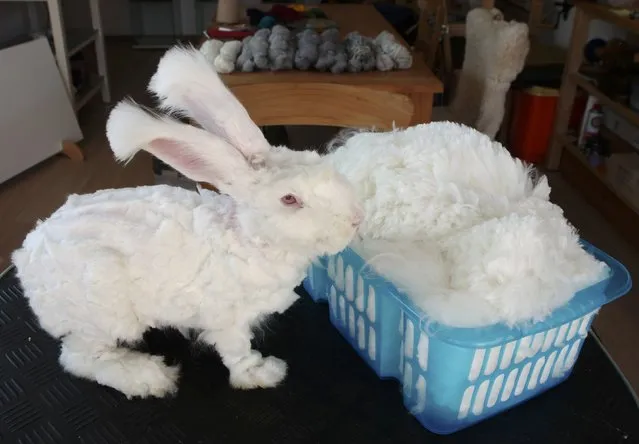
Angora rabbit Emilson sits next to its freshly shaved hair at Georgia Spausta's small farm in Herzogbirbaum, Austria March 10, 2015. Spausta produces hand-spun yarn from some 25 angora rabbits which is sold in small scale to enthusiasts or at local markets. The rabbits are clipped four times a year, each time giving some 300 grams of wool, about the amount needed to knit one pullover. (Photo by Heinz-Peter Bader/Reuters)
Details
26 Apr 2015 09:06:00
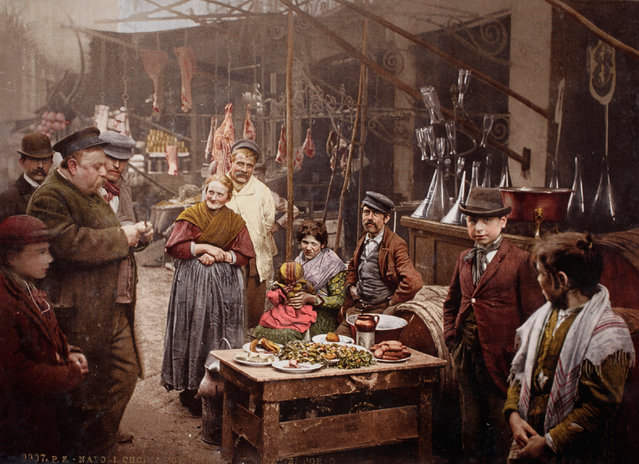
The finished photochromes were produced using at least six different tint stones, although many more were often used. Here: Street food in the Strada del Porto in Naples, Italy, 1899. (Photo by Swiss Camera Museum/The Guardian)

Photochromes are vibrant and nuanced prints hand-coloured from black-and-white negatives. Created using a process pioneered in the 1880s, these images offer a fascinating insight into the world when colour photography was still in its infancy. A Tour of the World in Photochromes is at the Swiss Camera Museum, Vevey, until 21 August. Here: Street food in the Strada del Porto in Naples, Italy, 1899. (Photo by Swiss Camera Museum/The Guardian)
Details
07 Jul 2016 10:56:00
Here real life mermaid Julia is diving with manta rays in Bali and looks incredible swimming among them while holding her breath for four and a half minute. (Photo by Julia Wheeler/Caters News Agency)

Julia Wheeler, 31, from Perth, Western Australia, has been a hands reach away from pilot whales, Bull sharks, manta rays and more during her time diving without any breathing equipment. Here real life mermaid Julia is diving with manta rays in Bali and looks incredible swimming among them while holding her breath for four and a half minute. (Photo by Julia Wheeler/Caters News Agency)
Details
02 Sep 2017 06:38:00