Loading...
Done
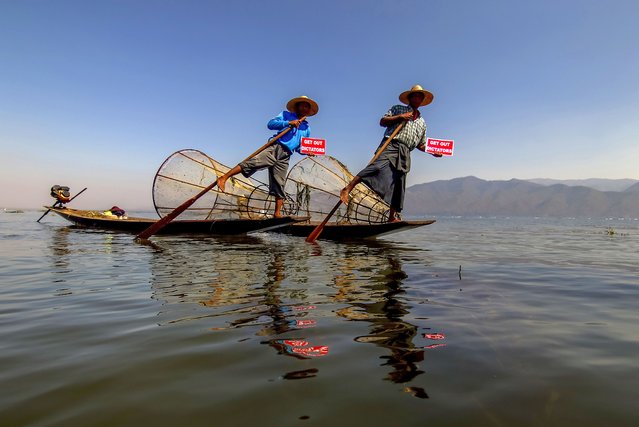
Ethnic Entha fishermen display placards during a protest against the military coup on Inle Lake, Taunggyi, Myanmar Thursday, February 11, 2021. Large crowds demonstrating against the military takeover in Myanmar again defied a ban on protests Thursday, even after security forces ratcheted up the use of force against them and raided the headquarters of the political party of ousted leader Aung San Suu Kyi a day earlier. (Photo by Aung Ko San/AP Photo)

Ethnic Entha fishermen display placards during a protest against the military coup on Inle Lake, Taunggyi, Myanmar Thursday, February 11, 2021. Large crowds demonstrating against the military takeover in Myanmar again defied a ban on protests Thursday, even after security forces ratcheted up the use of force against them and raided the headquarters of the political party of ousted leader Aung San Suu Kyi a day earlier. (Photo by Aung Ko San/AP Photo)
Details
05 Mar 2021 10:35:00
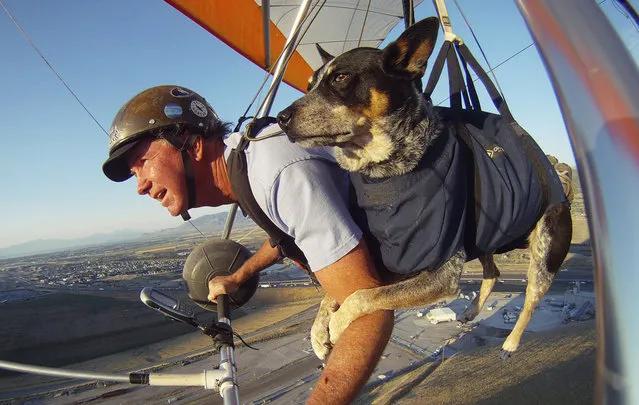
Dan McManus and his service dog Shadow hang glide together outside Salt Lake City, Utah, July 22, 2013. McManus suffers from anxiety and Shadow's presence and companionship help him to manage the symptoms. The two have been flying together for about nine years with a specially made harness for Shadow. (Photo by Jim Urquhart/Reuters)

Dan McManus and his service dog Shadow hang glide together outside Salt Lake City, Utah, July 22, 2013. McManus suffers from anxiety and Shadow's presence and companionship help him to manage the symptoms. The two have been flying together for about nine years with a specially made harness for Shadow. (Photo by Jim Urquhart/Reuters)
Details
23 Jul 2013 10:43:00
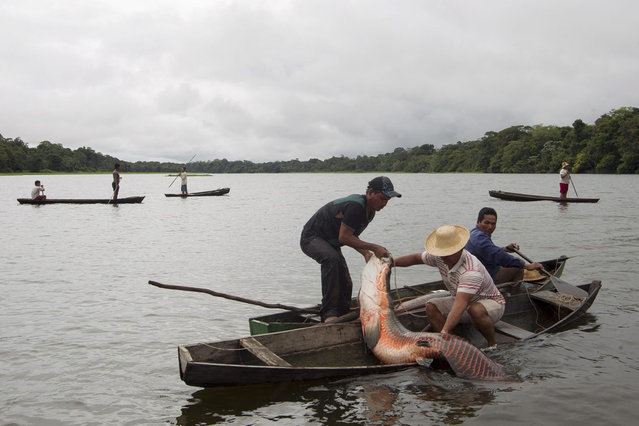
Villagers from the Porto Novo community load into their canoes arapaima or pirarucu, the largest freshwater fish species in South America and one of the largest in the world, while fishing in Poco Fundo lake along a branch of the Solimoes river, one of the main tributaries of the Amazon, in the Mamiraua nature reserve near Fonte Boa about 600 km (373 miles) west of Manaus, November 26, 2013. (Photo by Bruno Kelly/Reuters)

Villagers from the Porto Novo community load into their canoes arapaima or pirarucu, the largest freshwater fish species in South America and one of the largest in the world, while fishing in Poco Fundo lake along a branch of the Solimoes river, one of the main tributaries of the Amazon, in the Mamiraua nature reserve near Fonte Boa about 600 km (373 miles) west of Manaus, November 26, 2013. Catching the arapaima, a fish that is sought after for its meat and is considered by biologists to be a living fossil, is only allowed once a year by Brazil's environmental protection agency. The minimum size allowed for a fisherman to keep an arapaima is 1.5 meters (4.9 feet). (Photo by Bruno Kelly/Reuters)
Details
17 Dec 2013 08:03:00
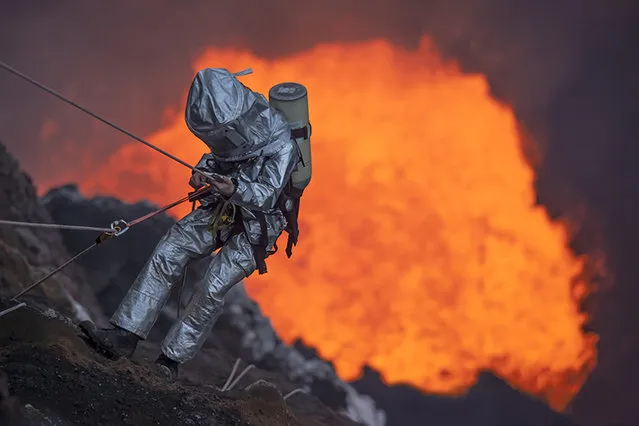
Descending into the Marum Volcano in Vanuatu, Intrepid explorers found an unusual way of staying warm this winter by spending Christmas day on an active volcano. British climber Chris Horsley, 22, and his friends Gareth Hawken, 30, Geoff Mackley, 50, and Bradley Ambrose, 36, from Auckland, New Zealand, hiked up the Marum Volcano, Vanuatu, on the morning of the 25th. Instead of passing the day with their families, the team climbed down a 1200ft cliff to get close to a flowing lake of lava. (Photo by Bradley Ambrose/Caters News)

Descending into the Marum Volcano in Vanuatu, Intrepid explorers found an unusual way of staying warm this winter by spending Christmas day on an active volcano. British climber Chris Horsley, 22, and his friends Gareth Hawken, 30, Geoff Mackley, 50, and Bradley Ambrose, 36, from Auckland, New Zealand, hiked up the Marum Volcano, Vanuatu, on the morning of the 25th. Instead of passing the day with their families, the team climbed down a 1200ft cliff to get close to a flowing lake of lava. (Photo by Bradley Ambrose/Caters News)
Details
31 Dec 2014 14:04:00
The American artist’s work encompasses fashion, photography and film with characteristically vivid colour and unsettling theatricality. Here: The Big Valley, Susie and Friends, 2008. (Photo by Alex Prager Studio/Lehmann Maupin Gallery)

Alex Prager is an American art photographer and filmmaker based in Los Angeles. Her photographs primarily use staged actors, models and extras to create “meticulously designed mise en scène”, often described as film-like and hyperreal. “Alex Prager: Silver Lake Drive” is at the Photographers’ Gallery, London, 15 June – 14 October 2018. Here: The Big Valley, Susie and Friends, 2008. (Photo by Alex Prager Studio/Lehmann Maupin Gallery)
Details
15 Jun 2018 00:01:00
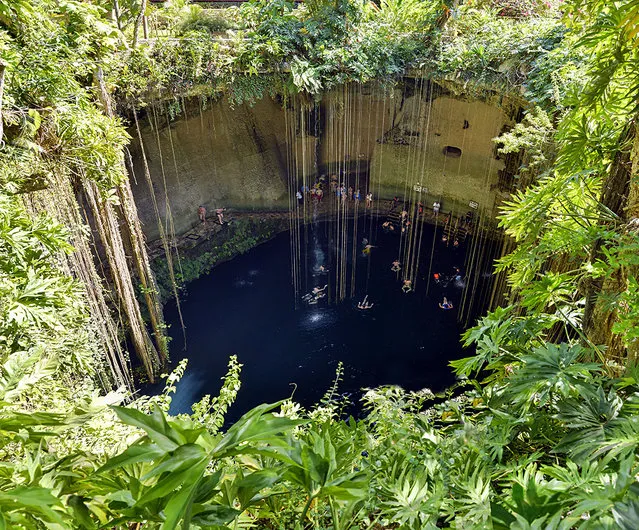
Cenote In Mexico

A cenote is a natural phenomenon, a sinkhole in the Earth’s surface. The Yucatan Peninsula in Mexico has an estimated 7,000 cenotes because it is primarily made up of porous limestone. For millions of years, rainfall slowly ate away at the limestone and a huge system of underground caves and caverns was formed. Many filled with water from rain or from the underground water table. When the roof of a water filled cave collapses, a cenote is born. The water found in a cenote may be fresh water, salt water, or both. Structurally it may be completely open, like a lake, almost completely closed with just a small opening at the top, or somewhere in between.
Details
06 Oct 2013 09:45:00
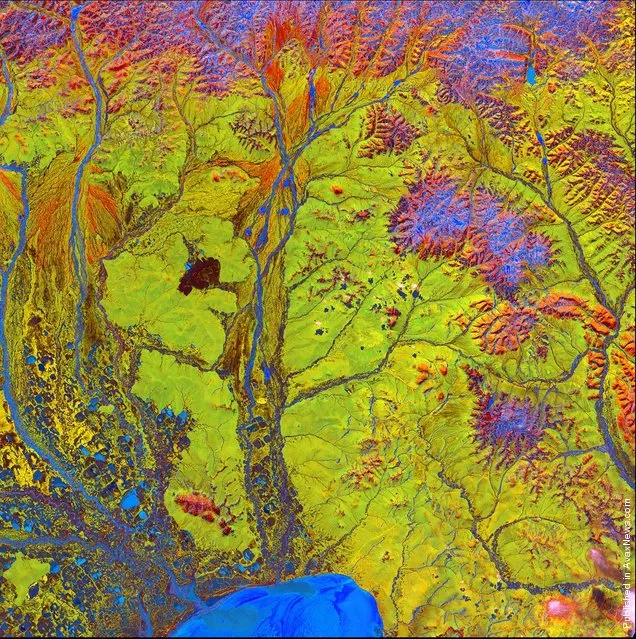
Vivid colors and bizarre shapes come together in a false-color image that could be an illustration for a fantasy story

Vivid colors and bizarre shapes come together in a false-color image that could be an illustration for a fantasy story. This labyrinth of exotic features winds its way along the edge of Russia’s Chaunskaya Bay in northeastern Siberia, seen as a vivid blue half-circle at the bottom of the image Two major rivers, the Chaun and Palyavaam, flow into the bay, which in turn opens into the Arctic Ocean. Ribbon lakes and bogs are present throughout the area, created by depressions left by receding glaciers. (Photo by USGS/NASA)
Details
14 Apr 2012 11:02:00
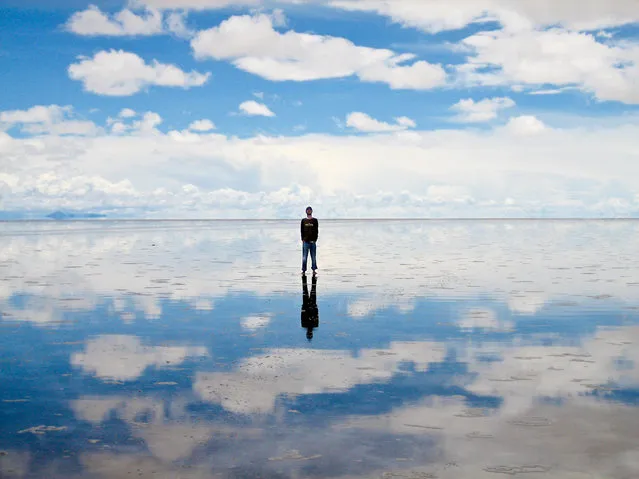
Salar de Uyuni

Salar de Uyuni (or Salar de Tunupa) is the world's largest salt flat at 10,582 square kilometers (4,086 sq mi). It is located in the Potosí and Oruro departments in southwest Bolivia, near the crest of the Andes, and is elevated 3,656 meters (11,995 ft) above mean sea level. The Salar was formed as a result of transformations between several prehistoric lakes. It is covered by a few meters of salt crust, which has an extraordinary flatness with the average altitude variations within one meter over the entire area of the Salar.
Details
04 Aug 2012 08:42:00