Loading...
Done
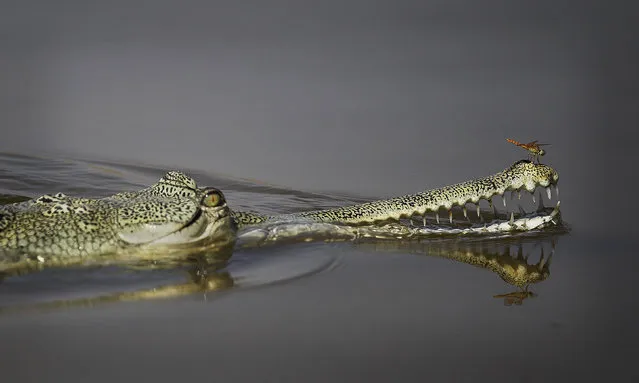
In this photo taken Wednesday, April 30, 2014, a dragonfly sits on the nose of a Gharial, rare crocodile-like creatures, in the River Chambal near Bhopepura village in the northern Indian state of Uttar Pradesh. The narrow 250-mile stretch of the Chambal is a place of crocodiles and jackals, of river dolphins and the occasional wolf. Hundreds of species of birds, storks, geese, babblers, larks, falcons and so many more, nest along the river. (Photo by Altaf Qadri/AP Photo)

In this photo taken Wednesday, April 30, 2014, a dragonfly sits on the nose of a Gharial, rare crocodile-like creatures, in the River Chambal near Bhopepura village in the northern Indian state of Uttar Pradesh. The narrow 250-mile stretch of the Chambal is a place of crocodiles and jackals, of river dolphins and the occasional wolf. Hundreds of species of birds, storks, geese, babblers, larks, falcons and so many more, nest along the river. Endangered birds lay small speckled eggs in tiny pits they dig in the sandbars. Gharials, rare crocodile-like creatures that look like they swaggered out of the Mesozoic Era, are commonplace here and nowhere else. (Photo by Altaf Qadri/AP Photo)
Details
23 Feb 2015 12:55:00
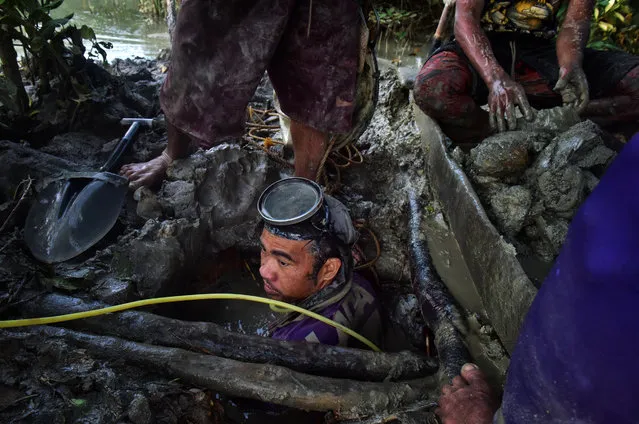
Christian Balderosdasco, 31, is being pulled up a mud pit after diving for 3 hours to look for gold on March 22, 2017 in Paracale, Philippines. (Photo by Jes Aznar/Getty Images)

Christian Balderosdasco, 31, is being pulled up a mud pit after diving for 3 hours to look for gold on March 22, 2017 in Paracale, Philippines. Apart from tunneling and sifting sand, locals dive down murky swamps with the aid of a compressor with air flowing in a small tube for breathing, as they blindly swim under the mud for up to four hours to look for tiny rocks containing gold particles. For decades, local residents at Paracale town work in hazardous conditions scavenging under the earth and diving into tunnels filled with mud using only makeshift tools to mine for gold, often placing their health and lives at risk. (Photo by Jes Aznar/Getty Images)
Details
06 Apr 2017 09:21:00
Scientists say that a “Martian flower”, seen here in an image from the Curiosity rover's Mars Hand Lens Imager, is a 2-millimeter-wide grain or pebble that's embedded in the surrounding rock. Another, darker-colored mineral grain can be seen above and to the left. (Photo by NASA)

“The scientists behind NASA's $2.5 billion Curiosity rover mission on Mars on Tuesday explained the nature of a tiny, gleaming "flower" embedded in Red Planet rock, and revealed where they'll be using the SUV-sized robot's drill for the first time”. – Alan Boyle via NBCNews.com

Photo: Scientists say that a “Martian flower”, seen here in an image from the Curiosity rover's Mars Hand Lens Imager, is a 2-millimeter-wide grain or pebble that's embedded in the surrounding rock. Another, darker-colored mineral grain can be seen above and to the left. (Photo by NASA)
Details
16 Jan 2013 11:12:00
Nikon Small World Photomicrography Competition 2012. Honorable Mention. “Snow crystal, illuminated with colored lights (5x)”. (Photo by Dr. Kenneth Libbrecht, California Institute of Technology (Caltech), Department of Physics, Pasadena, California, USA)

Most people know Nikon as a purveyor of pro and consumer-grade digital cameras. But the company's expertise with optics bleeds over into related markets – it's one of the science community's major suppliers of microscopes. And each year the company asks the community to send it some of their favorite images of tiny objects. A panel of scientists and journalists have chosen the best of this past year's submissions, which Nikon has placed on its Small World site.

Photo: Honorable Mention. “Snow crystal, illuminated with colored lights (5x)”. (Photo by Dr. Kenneth Libbrecht, California Institute of Technology (Caltech), Department of Physics, Pasadena, California, USA)
Details
25 Oct 2012 13:49:00
The stage for Haduwa Arts & Culture Institute, Ghana. Architect: (applied) Foreign Affairs. Nominated in the Sense of Place category. The open-air auditorium of this arts institute in Apam, Ghana, is built from ultra-strong curved bamboo. (Photo by Julien Lanoo)

The Arcaid awards highlight the best architectural photographs of the year – pictures of everything from giant arenas to tiny huts. The shortlisted photographs will be exhibited at the World Architecture Festival in Berlin, from 16 to 18 November, with an overall winner announced during the event’s gala dinner. Here: The stage for Haduwa Arts & Culture Institute, Ghana. Architect: (applied) Foreign Affairs. Nominated in the Sense of Place category. The open-air auditorium of this arts institute in Apam, Ghana, is built from ultra-strong curved bamboo. (Photo by Julien Lanoo)
Details
16 Nov 2016 11:03:00
A long-tailed macaque grabs a necklace from a statue during the annual Monkey Buffet Festival at the Pra Prang Sam Yot temple in Lopburi, north of Bangkok November 30, 2014. The festival provides food and drinks to the local monkey population, which numbers more than 2,000, to thank them for drawing tourists to the town. (Photo by Damir Sagolj/Reuters)

A long-tailed macaque grabs a necklace from a statue during the annual Monkey Buffet Festival at the Pra Prang Sam Yot temple in Lopburi, north of Bangkok November 30, 2014. The festival provides food and drinks to the local monkey population, which numbers more than 2,000, to thank them for drawing tourists to the town. (Photo by Damir Sagolj/Reuters)
Details
01 Dec 2014 14:22:00
What the World Eats By Peter Menzel And Faith D'Aluisio Part 2

A stunning photographic collection featuring portraits of people from 30 countries and the food they eat in one day. In this fascinating study of people and their diets, 80 profiles are organized by the total number of calories each person puts away in a day. Featuring a Japanese sumo wrestler, a Massai herdswoman, world-renowned Spanish chef Ferran Adria, an American competitive eater, and more, these compulsively readable personal stories also include demographic particulars, including age, activity level, height, and weight. Essays from Harvard primatologist Richard Wrangham, journalist Michael Pollan, and others discuss the implications of our modern diets for our health and for the planet. This compelling blend of photography and investigative reportage expands our understanding of the complex relationships among individuals, culture, and food.
Details
02 May 2014 09:20:00
Sri Lankan flood victims flock around a bus to receive food parcels on a inundated road in Colombo, Sri Lanka, Tuesday, May 17, 2016. The Disaster Management Center said that 114 homes have been destroyed and more than 137,000 people have been evacuated to safe locations as heavy rains continue. (Photo by Eranga Jayawardena/AP Photo)

Sri Lankan flood victims flock around a bus to receive food parcels on a inundated road in Colombo, Sri Lanka, Tuesday, May 17, 2016. The Disaster Management Center said that 114 homes have been destroyed and more than 137,000 people have been evacuated to safe locations as heavy rains continue. (Photo by Eranga Jayawardena/AP Photo)
Details
18 May 2016 14:31:00