Loading...
Done
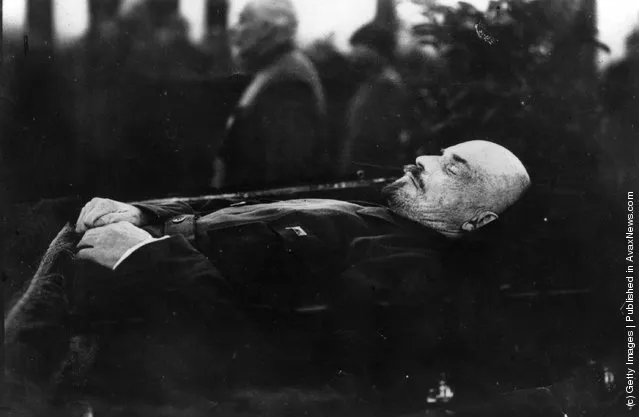
1924:  Vladimir Ilyich Lenin lying in state in the Kremlin

Photo: Vladimir Ilyich Lenin (1870 – 1924) lying in state in the Kremlin. (Photo by Hulton Archive/Getty Images). 1924

Important! For the same article in Russian language click here.

Something quite intriguing is happening within Russian-speaking internet during the last few – should you type a fully academic inquiry (at least, according to Russian academic requirements) in national search engines for "Lenin's mausoleum" – the first thing you get (even in top 10 searches) is website pages talking about black magic and occult. Website authors view this construction differently, but unconditionally agree on one thing: the mausoleum of the "leader of the world proletariat” – the essence of a magical artifact, a sort of “energy vampire”. It was built with a certain purpose: to drain the energy out of miserable Soviet citizens on one hand; and to poison the anthroposphere of one-sixth part of the earth with its vibes (the exact territory that was occupied by the former Soviet Union), depriving the Russian people of will to resist on the other hand. Complete nonsense? No doubt. Nevertheless, an intriguing one. Well, probably because some oddities do exist in mausoleum's history. These oddities are the thing we are going to discuss this time. First, let me refresh you memory on the subject.
Details
16 Oct 2011 11:27:00
Euro sculpture

The Euro sculpture is partially reflected in a puddle on a cobblestone pavement in front of the headquarters of the European Central Bank in Frankfurt on Jan. 21. (Kai Pfaffenbach/Reuters)
Details
15 May 2012 05:20:00
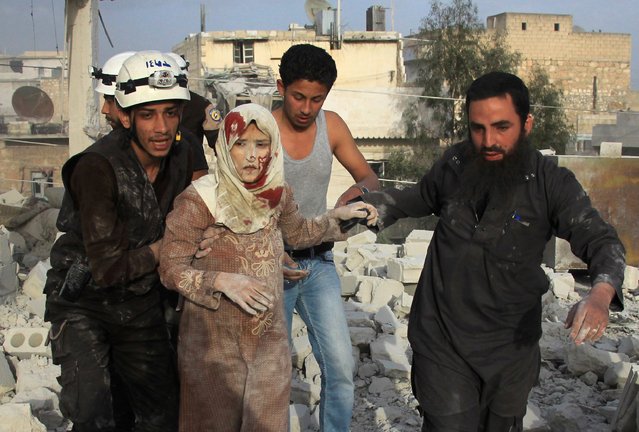
Syrian rescue workers and residents help an injured woman following a reported air strike by government forces on the rebel-held neighbourhood of Haydariya in the northern city of Aleppo on April 10, 2016. (Photo by Thaer Mohammed/AFP Photo)

Syrian rescue workers and residents help an injured woman following a reported air strike by government forces on the rebel-held neighbourhood of Haydariya in the northern city of Aleppo on April 10, 2016. (Photo by Thaer Mohammed/AFP Photo)
Details
12 Apr 2016 11:21:00
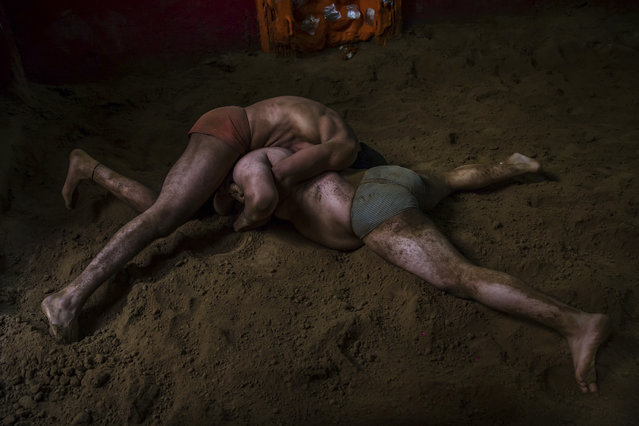
In this November 20, 2017 photo, Indian kushti wrestlers fight in the ring, during their daily training at an akhada, a kind of wrestling hostel at Sabzi Mandi, in New Delhi, India. (Photo by Dar Yasin/AP Photo)

In this November 20, 2017 photo, Indian kushti wrestlers fight in the ring, during their daily training at an akhada, a kind of wrestling hostel at Sabzi Mandi, in New Delhi, India. Like many traditions in rapidly modernizing India, kushti wrestling faces the threat of being left behind. But for many poor families, the ancient sport provides a glimmer of hope. (Photo by Dar Yasin/AP Photo)
Details
13 Dec 2017 07:35:00
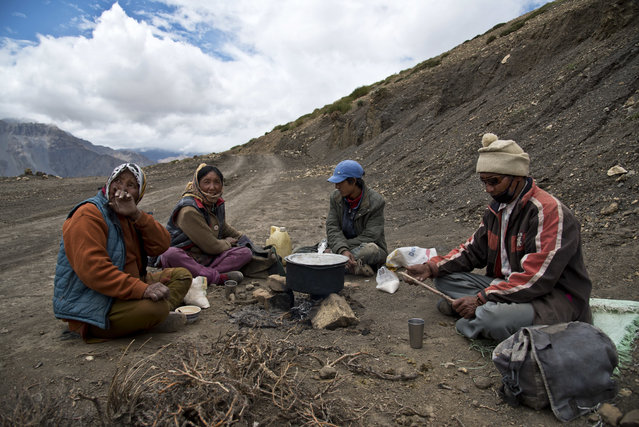
In this August 17, 2016, photo, from left to right, Chhering Chodom, 60, Tashi Yangzom, 50, Lobsang Chhering, 27, and Dorje Tandup, 58, drink milk tea on the side of the road. For centuries, the sleepy valley nestled in the Indian Himalayas remained a hidden Buddhist enclave forbidden to outsiders. Enduring the harsh year-round conditions of the high mountain desert, the people of Spiti Valley lived by a simple communal code – share the Earth's bounty, be hospitable to neighbors, and eschew greed and temptation at all turns. That's all starting to change, for better or worse. Since India began allowing its own citizens as well as outsiders to visit the valley in the early 1990s, tourism and trade have boomed. And the marks of modernization, such as solar panels, asphalt roads and concrete buildings, have begun to appear around some of the villages that dot the remote landscape at altitudes above 4,000 meters (13,000 feet). (Photo by Thomas Cytrynowicz/AP Photo)

In this August 17, 2016, photo, from left to right, Chhering Chodom, 60, Tashi Yangzom, 50, Lobsang Chhering, 27, and Dorje Tandup, 58, drink milk tea on the side of the road. For centuries, the sleepy valley nestled in the Indian Himalayas remained a hidden Buddhist enclave forbidden to outsiders. Enduring the harsh year-round conditions of the high mountain desert, the people of Spiti Valley lived by a simple communal code – share the Earth's bounty, be hospitable to neighbors, and eschew greed and temptation at all turns. That's all starting to change, for better or worse. (Photo by Thomas Cytrynowicz/AP Photo)
Details
15 Sep 2016 09:22:00
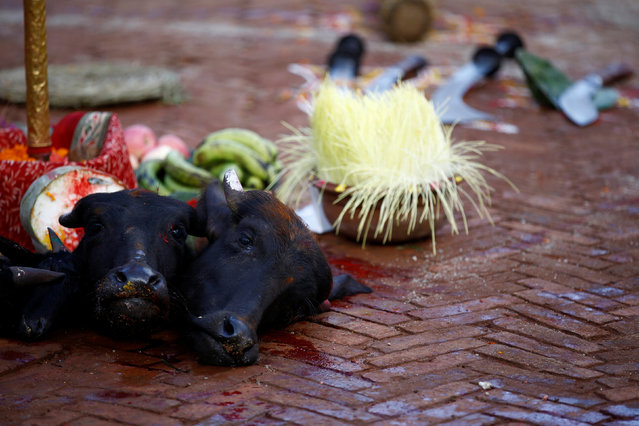
The heads of slaughtered water buffalos and a goat are lined up on the ground after the animals were sacrificed during “Dashain”, a Hindu religious festival in Kathmandu, Nepal October 10, 2016. (Photo by Navesh Chitrakar/Reuters)

The heads of slaughtered water buffalos and a goat are lined up on the ground after the animals were sacrificed during “Dashain”, a Hindu religious festival in Kathmandu, Nepal October 10, 2016. (Photo by Navesh Chitrakar/Reuters)
Details
12 Oct 2016 10:56:00
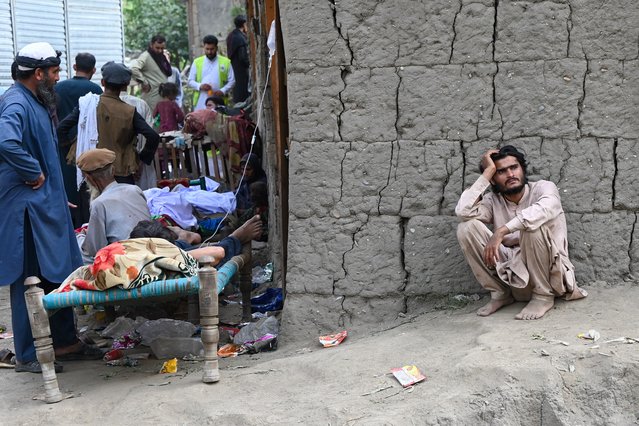
An Afghan man mourns outside a damaged house, after earthquakes at Mazar Dara village in Nurgal district, Kunar province, in Eastern Afghanistan, on September 1, 2025. (Photo by Wakil Kohsar/AFP Photo)

An Afghan man mourns outside a damaged house, after earthquakes at Mazar Dara village in Nurgal district, Kunar province, in Eastern Afghanistan, on September 1, 2025. (Photo by Wakil Kohsar/AFP Photo)
Details
11 Sep 2025 04:09:00
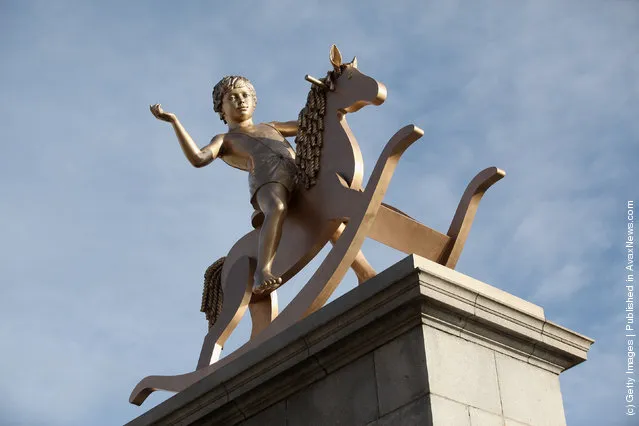
A sculpture entitled 'Powerless Structures, Fig.101' designed by Danish artist Michael Elmgreen and Norwegian artist Ingar Dragset is unveiled on the Fourth Plinth in Trafalgar Square

A sculpture entitled “Powerless Structures, Fig.101” designed by Danish artist Michael Elmgreen and Norwegian artist Ingar Dragset is unveiled on the Fourth Plinth in Trafalgar Square on February 23, 2012 in London, England. (Photo by Oli Scarff/Getty Images)
Details
29 Feb 2012 11:22:00