A man plays in front of a wave crashing into Beirut's Corniche, a seaside promenade, as high winds sweep through Lebanon ahead of an impending storm January 6, 2015. (Photo by Jamal Saidi/Reuters)
A woman holds her umbrella while walking against strong winds as Typhoon Soudelor approaches Taiwan in Taipei, August 7, 2015. Taiwan evacuated hundreds of people from their homes on Friday as the strongest typhoon to threaten the island in two years churned towards it and was expected to make landfall early on Saturday. (Photo by Pichi Chuang/Reuters)
People wade through a flooded street after Typhoon Fung-wong hit Dagupan City, Pangasinan, Philippines, on November 10, 2025. (Photo by Noel Celisn/Reuters)
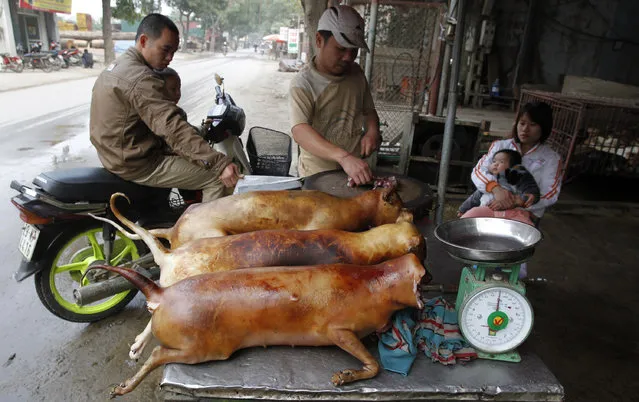
A vendor (C) cuts slaughtered dogs for sale at his roadside stall in Duong Noi village, outside Hanoi December 16, 2011. While animal rights activists have condemned eating dog meat as cruel treatment of the animals, it is still an accepted popular delicacy for some Vietnamese, as well in some other Asian countries. Duong Noi is well-known as a dog-meat village, where hundreds of dogs are killed each day for sale as popular traditional food. Dog-eating as a custom is rooted in Vietnam and was developed as a result of poverty. One kilogram of dog meat costs about 130,000 dongs ($6.2). (Photo by Reuters/Kham)
Sculptures entitled “The Rising Tide” by British sculptor Jason deCaires Taylor are seen beside the River Thames in front of the Houses of Parliament and the London Eye ferris wheel in London, September 3, 2015. The representations of four horses and riders are fully visible at low tide but become immersed underwater twice a day as the Thames rises to reach full tide. The installation will be on display throughout September as part of the annual Totally Thames festival. (Photo by Toby Melville/Reuters)
A group of friends dance the night away at Latitude Festival in Suffolk, United Kingdom on July 22, 2021. Suffolk, returns as a covid test event after a year off due to the pandemic. (Photo by Guy Bell/Alamy Live News)
A sales assistant poses for photographs with a mealworm cookie in Seoul, South Korea, August 8, 2016. Insect-eating, or entomophagy, has long been common in much of the world, including South Korea, where boiled silky worm pupae, or beondegi, are a popular snack. Now, South Korea is looking to expand its insect industry as a source of agricultural income. (Photo by Kim Hong-Ji/Reuters)