Loading...
Done
Chris Keegan By Cosmic Creatures

Looking up at the sky and forming images from the stars has been going on for just about as long as human life has existed, but that was only what could be seen from the Earth. Digital illustrator Chris Keegan has taken constellations to a whole new level with the use of images from NASA’s Chandra X-ray Observatory.
Details
10 Jun 2015 09:50:00
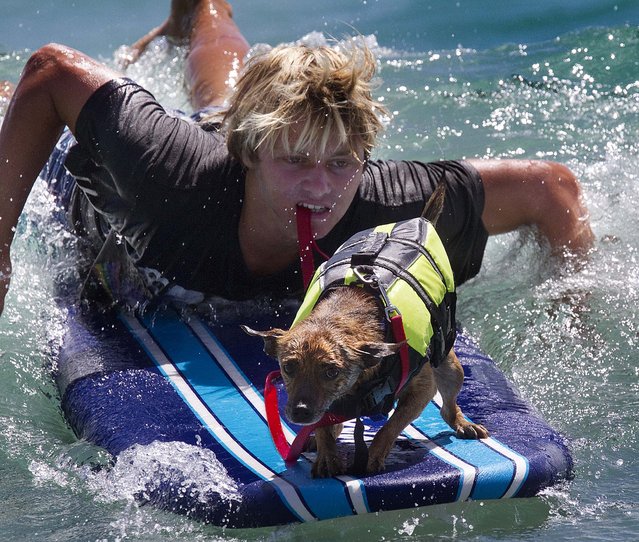
Musso paddles in with Jengo. (Photo by Taylor Jones/The Palm Beach Post)

About a dozen dogs traded in their leashes for life vests Saturday for the chance to ride the waves at Jupiter beach as part of a canine surfing competition to raise money for an animal rescue group. Photo: Musso paddles in with Jengo. (Photo by Taylor Jones/The Palm Beach Post)
Details
07 Jul 2013 10:00:00
Blooms

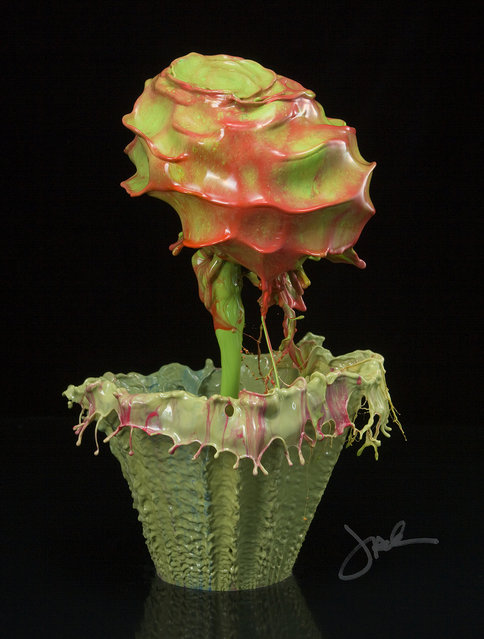
At first glance, these incredible images look like still-life portraits of flowers. But far from being drawn in the traditional way, they are created by photographing fast-moving droplets of paint as they fall through the air. Artist Jack Long, 53, spends months painstakingly planning and testing each work before capturing them with a high-speed camera.
Details
13 Jul 2012 11:17:00
Elephant Sculptures

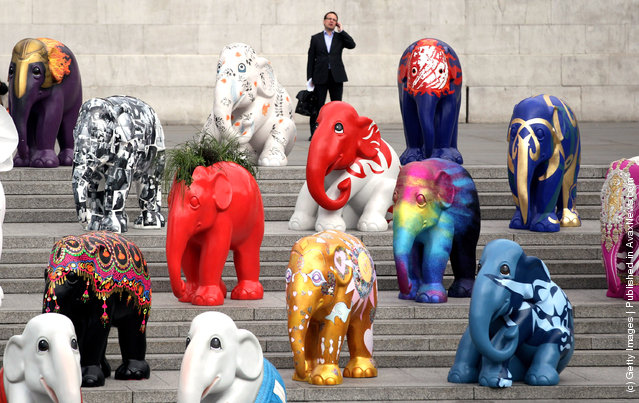
Decorative model Elephants stand in Trafalgar Square on May 4, 2010 in London, England. 260 of the decorative life size baby Elephants have been designed by established and emerging artists including Paul Smith, Marc Quinn and Julien Macdonald and have been placed across the capital in prominent places such as Buckingham Palace, Parliament Square and Trafalgar Square. (Photo by Dan Kitwood/Getty Images)
Details
14 Aug 2013 11:52:00
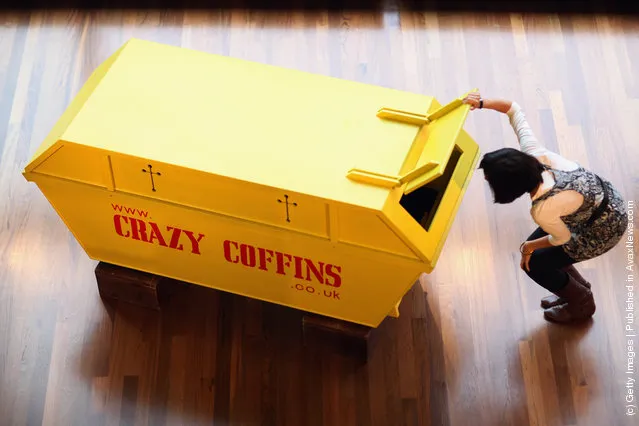
A coffin in the shape of a skip

A coffin in the shape of a skip is displayed at the South bank Centre on January 20, 2012 in London, England. A collection of bespoke coffins by “Crazy Coffins” in Nottingham and the famous “Pa Joe” workshop in Ghana are currently on display at the South Bank centre, who are currently running a festival celebrating life and death. (Photo by Dan Kitwood/Getty Images)
Details
26 Jan 2012 12:13:00


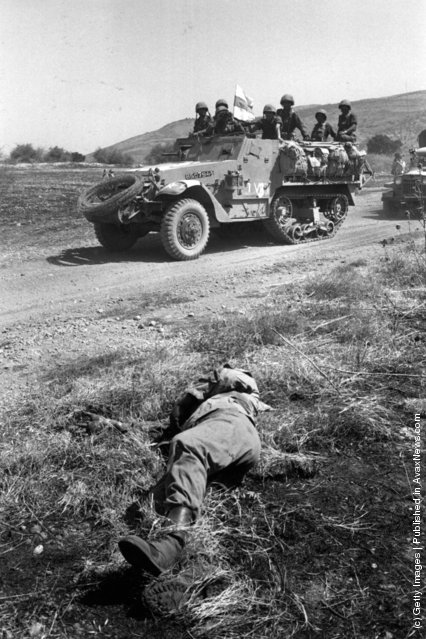
“The Six-Day War or June War, also known as the 1967 Arab-Israeli War or the Third Arab-Israeli War, was fought between June 5 and June 10, 1967, by Israel and the neighboring states of Egypt (known then as the United Arab Republic [UAR]), Jordan, and Syria. The war began with a large-scale surprise air strike by Israel on Egypt. The outcome was a swift and decisive Israeli victory. Israel took effective control of the Gaza Strip and the Sinai Peninsula from Egypt, the West Bank and East Jerusalem from Jordan, and the Golan Heights from Syria. Opinions are divided on whether Israel's attack was an act of aggression or a preemptive strike of a defensive nature”. – Wikipedia

Photo: The corpse of a soldier lying on the line of the Israeli advance into Syria during the Six-Day War. (Photo by Terry Fincher/Getty Images). 1967
Details
21 May 2011 08:29:00
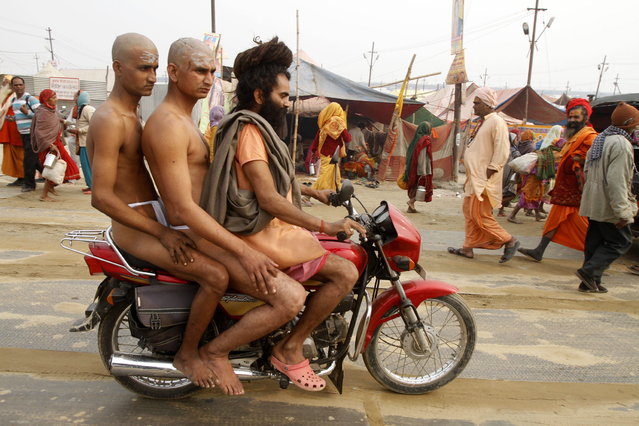
Two Hindu holy men of the Juna Akhara sect  are being take on a motorcycle by their teacher as they got delayed for a rituals that are believed to rid them of all ties in this life and dedicate themselves to serving God as a “Naga” or naked holy men, at Sangam, the confluence of the Ganges and Yamuna River during the Maha Kumbh festival in Allahabad, India, Wednesday, February 6, 2013. (Photo by Rajesh Kumar Singh/AP Photo)

Two Hindu holy men of the Juna Akhara sect are being take on a motorcycle by their teacher as they got delayed for a rituals that are believed to rid them of all ties in this life and dedicate themselves to serving God as a “Naga” or naked holy men, at Sangam, the confluence of the Ganges and Yamuna River during the Maha Kumbh festival in Allahabad, India, Wednesday, February 6, 2013. The significance of nakedness is that they will not have any worldly ties to material belongings, even something as simple as clothes. This ritual that transforms selected holy men to Naga can only be done at the Kumbh festival. (Photo by Rajesh Kumar Singh/AP Photo)
Details
07 Feb 2013 10:11:00
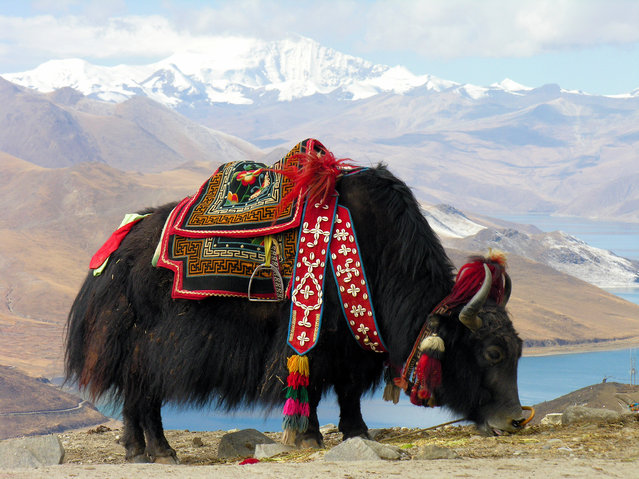
Yak near Yamdrok lake, Tibet. It is a long-haired bovinae found throughout the Himalayan region of south Central Asia, the Tibetan Plateau and as far north as Mongolia and Russia. The Tibetan economy is dominated by subsistence agriculture. Due to limited arable land, the primary occupation of the Tibetan Plateau is raising livestock, such as sheep, cattle, goats, camels, yaks, dzo, and horses. The Tibetan yak is an integral part of Tibetan life. (Photo by Dennis Jarvis)

Yak near Yamdrok lake, Tibet. It is a long-haired bovinae found throughout the Himalayan region of south Central Asia, the Tibetan Plateau and as far north as Mongolia and Russia. The Tibetan economy is dominated by subsistence agriculture. Due to limited arable land, the primary occupation of the Tibetan Plateau is raising livestock, such as sheep, cattle, goats, camels, yaks, dzo, and horses. The Tibetan yak is an integral part of Tibetan life. (Photo by Dennis Jarvis)
Details
10 Jun 2015 10:48:00