Loading...
Done
Revellers dressed as the Devil take part in a parade to celebrate Saint Nicholas Day (Mikulas) in Prague, Czech Republic on December 5, 2022. Meeting Saint Nicholas, the Aangel, and the Devil, who talk to children and reward those who have behaved well during the year with small presents, is tradition in the Czech Republic before the Christmas holidays. (Photo by Michal Cizek/AFP Photo)

Revellers dressed as the Devil take part in a parade to celebrate Saint Nicholas Day (Mikulas) in Prague, Czech Republic on December 5, 2022. Meeting Saint Nicholas, the Aangel, and the Devil, who talk to children and reward those who have behaved well during the year with small presents, is tradition in the Czech Republic before the Christmas holidays. (Photo by Michal Cizek/AFP Photo)
Details
06 Dec 2022 05:04:00
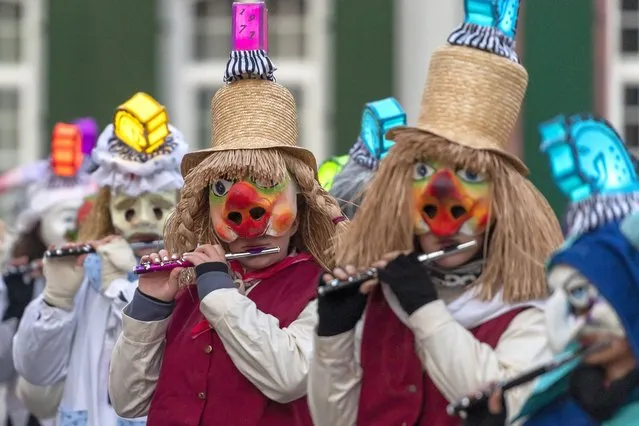
Members of carnival marching bands in costumes parade through the streets during the so-called “Morgestraich” carnival parade in Basel, Switzerland, on Monday, early 07 March 2022. The traditional “Morgenstraich” parade with colorful lanterns and revelers in traditional costumes is starting early morning at 4 a.m. and marks the kick-off for the Basel carnival. It was not held in its usual form in the past two years because of the measures against the Covid-19 pandemic. (Photo by Georgios Kefalas/EPA/EFE)

Members of carnival marching bands in costumes parade through the streets during the so-called “Morgestraich” carnival parade in Basel, Switzerland, on Monday, early 07 March 2022. The traditional “Morgenstraich” parade with colorful lanterns and revelers in traditional costumes is starting early morning at 4 a.m. and marks the kick-off for the Basel carnival. It was not held in its usual form in the past two years because of the measures against the Covid-19 pandemic. (Photo by Georgios Kefalas/EPA/EFE)
Details
23 May 2023 02:10:00
Revelers participate in the traditional Bloco da Lama (Mud block) carnival in Parati, Rio de Janeiro State, Brazil, on February 9, 2013. The event, which was begun by two men in a playful manner in 1986, has now become a traditional carnival in which participants disguised as primitives with rags, lianas or skulls and bones, dive in the mud. (Photo by Victor Moriyama/AFP Photo)

Revelers participate in the traditional Bloco da Lama (Mud block) carnival in Parati, Rio de Janeiro State, Brazil, on February 9, 2013. The event, which was begun by two men in a playful manner in 1986, has now become a traditional carnival in which participants disguised as primitives with rags, lianas or skulls and bones, dive in the mud. (Photo by Victor Moriyama/AFP Photo)
Details
12 Feb 2013 14:10:00
Revelers dance at a Jacarezinho samba school practice session ahead of Carnival celebrations on February 16, 2014 in Rio de Janeiro, Brazil. The Jacarezinho “favela” was previously controlled by drug traffickers and is now occupied by the city's Police Pacification Unit (UPP). Carnival officially begins February 28, but pre-Carnival celebrations are already underway. (Photo by Mario Tama/Getty Images)

Revelers dance at a Jacarezinho samba school practice session ahead of Carnival celebrations on February 16, 2014 in Rio de Janeiro, Brazil. The Jacarezinho “favela” was previously controlled by drug traffickers and is now occupied by the city's Police Pacification Unit (UPP). Carnival officially begins February 28, but pre-Carnival celebrations are already underway. (Photo by Mario Tama/Getty Images)
Details
19 Feb 2014 11:01:00
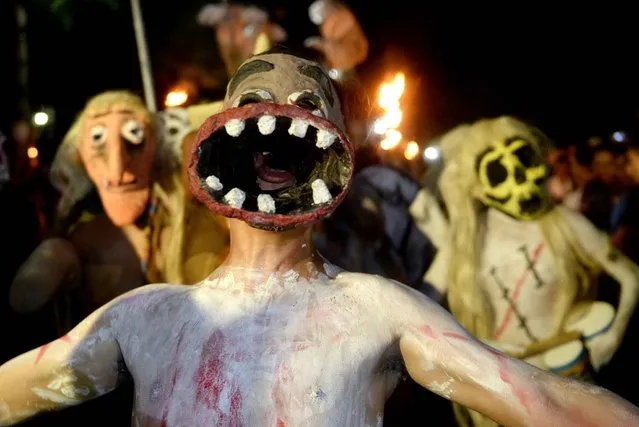
Young revelers take part in a parade called "La Calabiuza" on November 1, 2015, on the eve of the Day of the Dead in Tonacatepeque, 20 kms (13 miles) north of San Salvador. During the celebration, the residents of Tonacatepeque, originally an indigenous community, recall the characters from the mythology of Cuscatlan – pre-Columbian west and central regions of El Salvador – and their dead relatives. (Photo by Marvin Recinos/AFP Photo)

Young revelers take part in a parade called "La Calabiuza" on November 1, 2015, on the eve of the Day of the Dead in Tonacatepeque, 20 kms (13 miles) north of San Salvador. During the celebration, the residents of Tonacatepeque, originally an indigenous community, recall the characters from the mythology of Cuscatlan – pre-Columbian west and central regions of El Salvador – and their dead relatives. (Photo by Marvin Recinos/AFP Photo)
Details
04 Nov 2015 11:50:00
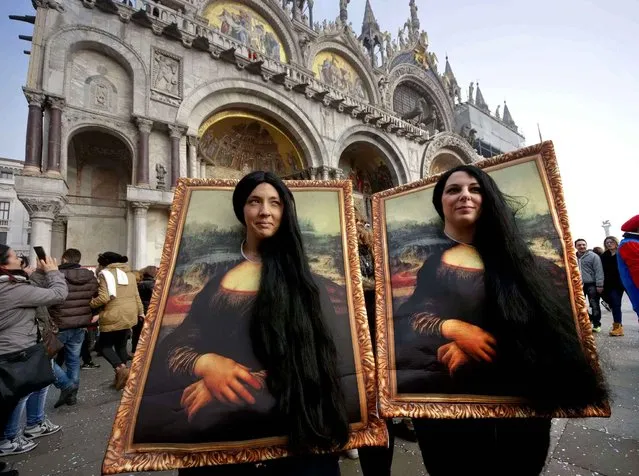
Two carnival revellers masquerade as Leonardo da Vinci's painting “Mona Lisa” pose in St. Mark's Square in Venice, Italy, Sunday, January 31, 2016. Carnival-goers in Venice are being asked by police to momentarily lift their masks as part of new anti-terrorism measures for the annual festivities. (Photo by Domenico Stinellis/AP Photo)

Two carnival revellers masquerade as Leonardo da Vinci's painting “Mona Lisa” pose in St. Mark's Square in Venice, Italy, Sunday, January 31, 2016. Carnival-goers in Venice are being asked by police to momentarily lift their masks as part of new anti-terrorism measures for the annual festivities. (Photo by Domenico Stinellis/AP Photo)
Details
02 Feb 2016 14:02:00
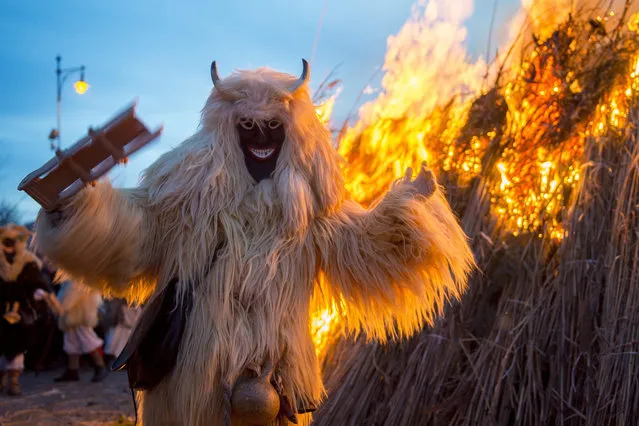
A reveler wearing sheepfur costume is seen in front of a bonfire on which they burn a coffin symbolizing winter during the closing ceremony of the traditional carnival parade in Mohacs, 189 kms south of Budapest, Hungary, 07 February 2016. (Photo by Tamas Soki/EPA)

A reveler wearing sheepfur costume is seen in front of a bonfire on which they burn a coffin symbolizing winter during the closing ceremony of the traditional carnival parade in Mohacs, 189 kms south of Budapest, Hungary, 07 February 2016. The carnival parade of people, the so-called busos, dressed in such costumes and frightening wooden masks, using various noisy wooden rattlers is traditionally held on the seventh weekend before Easter to drive away winter, and is a revival of a legend, which says that ethnic Croats ambushed the Osmanli Turkish troops, who escaped in panic seeing the terrifying figures during the Turkish occupation of Hungary. (Photo by Tamas Soki/EPA)
Details
09 Feb 2016 14:02:00
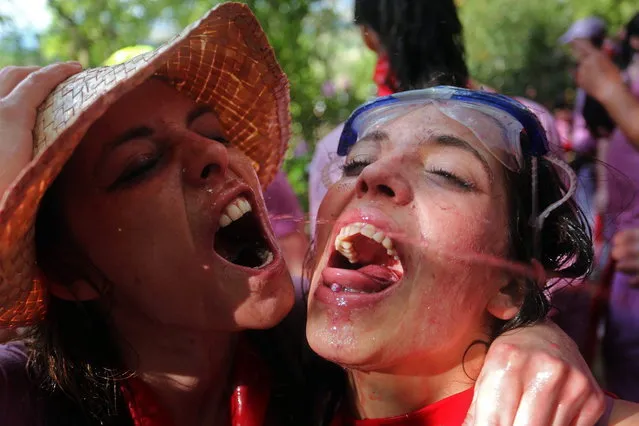
Revelers drink wine as they take part in the “Battle of Wine” (La batalla del vino de Haro), a wine fight, during the Haro Wine Festival, in Haro, in the northern province of La Rioja on June 29, 2014. More than nine thousand locals and tourists threw around 130.000 litres of wine at each other during the Haro Wine Festival, according to local media. (Photo by Cesar Manso/AFP Photo)

Revelers drink wine as they take part in the “Battle of Wine” (La batalla del vino de Haro), a wine fight, during the Haro Wine Festival, in Haro, in the northern province of La Rioja on June 29, 2014. More than nine thousand locals and tourists threw around 130.000 litres of wine at each other during the Haro Wine Festival, according to local media. (Photo by Cesar Manso/AFP Photo)
Details
30 Jun 2014 12:34:00