Loading...
Done
Black Nazarene devotees clamber on top of one another to to touch the cross on January 9, 2015 in Manila, Philippines. The Feast of the Black Nazarene culminates in a day long procession on January 9 as barefoot devotees march to see and touch the image of the Black Nazarene. (Photo by Dondi Tawatao/Getty Images)

Black Nazarene devotees clamber on top of one another to to touch the cross on January 9, 2015 in Manila, Philippines. The Feast of the Black Nazarene culminates in a day long procession on January 9 as barefoot devotees march to see and touch the image of the Black Nazarene. The Black Nazarene is a dark wood sculpture of Jesus brought to the Philippines in 1606 from Spain and considered miraculous by Filipino devotees. The event falls a week ahead of the visit of Pope Francis who will travel to Leyte and Manila during his visit to the Philippines from January 15–19. The visit is expected to attract crowds in the millions as Filipino Catholics flock to catch a glimpse of the leader of the Catholic Church. The Philippines is the only Catholic majority nation in Asia with around 90 percent of the population professing the faith. (Photo by Dondi Tawatao/Getty Images)
Details
11 Jan 2015 13:46:00

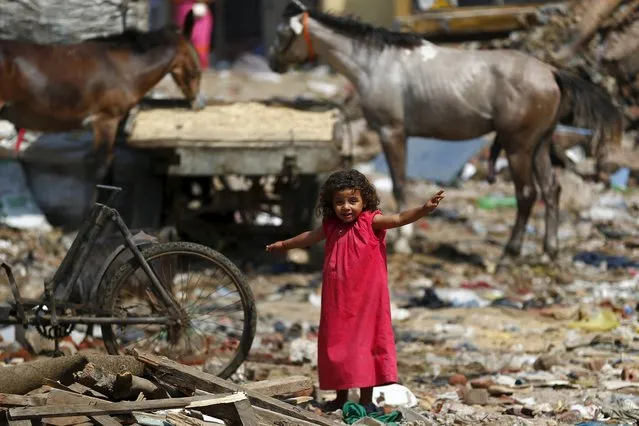
A girl plays in the Eshash el-Sudan slum in the Dokki neighbourhood of Giza, south of Cairo, Egypt September 2, 2015. (Photo by Amr Abdallah Dalsh/Reuters)

A girl plays in the Eshash el-Sudan slum in the Dokki neighbourhood of Giza, south of Cairo, Egypt September 2, 2015. Residents of the slum clashed with police in late August, when about 50 ramshackle huts were destroyed and at least 20 people were injured by teargas, local media reported, as authorities attempt to clear the area and rehouse residents. The slum dwellers, some of whom have called Eshash el-Sudan home for 50 years, say there are not enough apartments built nearby to house them. The residents of the slum eke out a living by disposing of rubbish or baking bread. Schooling is too expensive for most of their children, who play with salvaged rubbish amid shacks made out of discarded wood and leather. (Photo by Amr Abdallah Dalsh/Reuters)
Details
11 Sep 2015 12:47:00


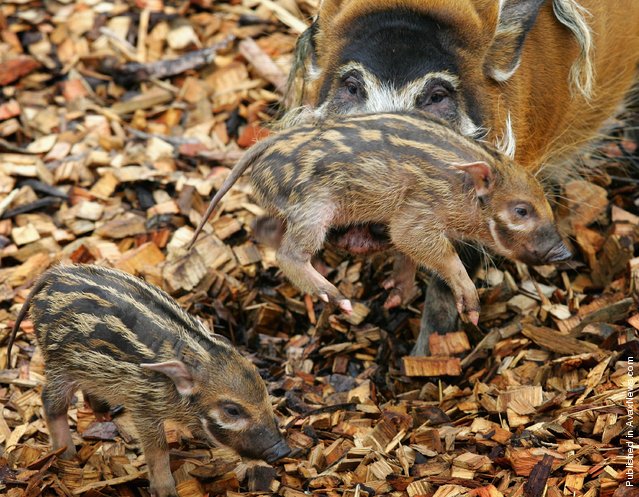
“The Red River Hog (Potamochoerus porcus), also known as the Bush Pig (but not to be confused with P. larvatus, common name “Bushpig”), is a wild member of the pig family living in Africa, with most of its distribution in the Guinean and Congolian forests. It is rarely seen away from rainforests, and generally prefers areas near rivers or swamps.

Red River Hogs eat grass, berries, roots, insects, molluscs, small vertebrates and carrion. They are capable of causing damage to plantations. Red River Hogs typically live in herds of 6-20 members led by a dominant boar. Sows rear 3-6 piglets at a time.”

Photo: Two 17 day old red river hoglet twins forage for food next to their mother Bahiti at London Zoo on August 23, 2007 in London, England. Red River hoglets inhabit the forests and swamps of West and Central Africa. The recent additions to the London Zoo pig pen have been eagerly awaited by zoo keepers. (Photo by Chris Jackson/Getty Images)
Details
18 Mar 2011 15:15:00
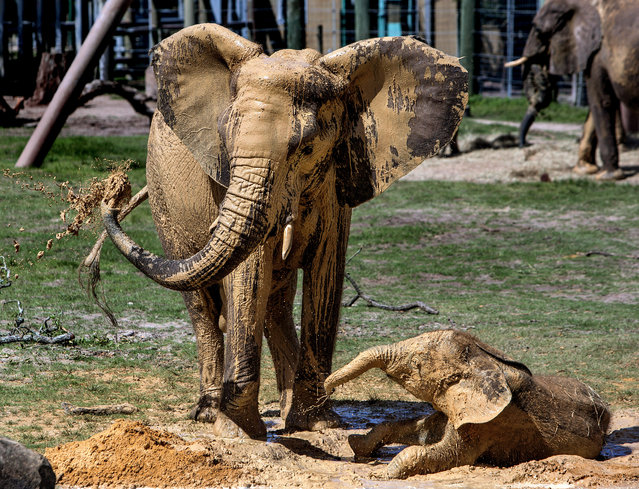
Lowry Park Zoo elephants Matjeka, 23, and her 1-year-old daughter, Mavi, apply a liberal coating of “sunscreen”  to themselves in a clay mud wallow at the park Tuesday, August 12, 2014, in Tampa, Fla., on the park's first observation of World Elephant Day to raise awareness of the wild African elephant crisis. (Photo by Cherie Diez/AP Photo/The Tampa Bay Times)

Lowry Park Zoo elephants Matjeka, 23, and her 1-year-old daughter, Mavi, apply a liberal coating of “sunscreen” to themselves in a clay mud wallow at the park Tuesday, August 12, 2014, in Tampa, Fla., on the park's first observation of World Elephant Day to raise awareness of the wild African elephant crisis. “Elephants are prone to being sunburned”, said associate curator Chris Massaro. “What they need is lot of mud or clay to roll around in and cover up their skin so it will protect it from the sun”. (Photo by Cherie Diez/AP Photo/The Tampa Bay Times)
Details
16 Aug 2014 11:38:00
Cuban-American artist Jorge Rodriguez-Gerada's six-acre sand and soil “facescape” stretches across the JFK Hockey Field on the north side of the Reflecting Pool along the National Mall October 1, 2014 in Washington, DC. Titled “Out of Many, One” and composed of 2,500 tons of sand, 800 tons of top soil and eight miles of string, the piece is the artist's interpreative blending of 30 different men's faces. (Photo by Chip Somodevilla/Getty Images)

Cuban-American artist Jorge Rodriguez-Gerada's six-acre sand and soil “facescape” stretches across the JFK Hockey Field on the north side of the Reflecting Pool along the National Mall October 1, 2014 in Washington, DC. Titled “Out of Many, One” and composed of 2,500 tons of sand, 800 tons of top soil and eight miles of string, the piece is the artist's interpreative blending of 30 different men's faces. Rodriguez-Gereda used high-precision global positioning satellites to place 10,000 wood pegs as waypoints for the giant face. The piece will be open to the public beginning October 4 and will eventually be tilled back into the earth. (Photo by Chip Somodevilla/Getty Images)
Details
04 Oct 2014 11:39:00
Female members of the PDI (Investigations Police of Chile) march during the traditional military parade as part of the independence day celebrations on September 19, 2021 in Santiago, Chile. This year the militar parade was celebrated with 30% of the staff present in pre-pandemic years. About 6,500 members of the Army, Navy, Air Force, Carabineros and PDI paraded. (Photo by Matias Basualdo/ZUMA Press Wire/Rex Features/Shutterstock)

Female members of the PDI (Investigations Police of Chile) march during the traditional military parade as part of the independence day celebrations on September 19, 2021 in Santiago, Chile. This year the militar parade was celebrated with 30% of the staff present in pre-pandemic years. About 6,500 members of the Army, Navy, Air Force, Carabineros and PDI paraded. (Photo by Matias Basualdo/ZUMA Press Wire/Rex Features/Shutterstock)
Details
20 Sep 2021 08:32:00
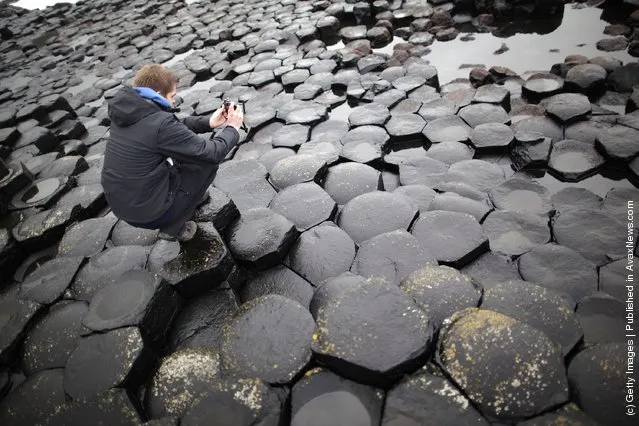
Visitors walk on the Giant's Causway in Portrush, Northern Ireland

“The Giant's Causeway is an area of about 40,000 interlocking basalt columns, the result of an ancient volcanic eruption. It is located in County Antrim on the northeast coast of Northern Ireland, about three miles (4.8 km) northeast of the town of Bushmills. It was declared a World Heritage Site by UNESCO in 1986, and a National Nature Reserve in 1987 by the Department of the Environment for Northern Ireland”. – Wikipedia

Photo: Visitors walk on the Giant's Causway on March 14, 2012 in Portrush, Northern Ireland. (Photo by Peter Macdiarmid/Getty Images)
Details
17 Mar 2012 11:10:00
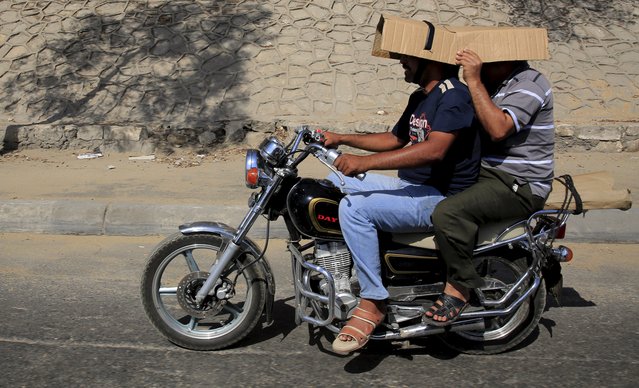
Men cover their heads from the sun while riding on a motorcycle during a hot day in Cairo, Egypt, August 17, 2015. A heatwave killed at least 61 people across Egypt from Sunday to Tuesday and caused nearly 600 people to be admitted to hospital, Egypt's health ministry said on state news agency MENA on Wednesday. (Photo by Amr Abdallah Dalsh/Reuters)

Men cover their heads from the sun while riding on a motorcycle during a hot day in Cairo, Egypt, August 17, 2015. A heatwave killed at least 61 people across Egypt from Sunday to Tuesday and caused nearly 600 people to be admitted to hospital, Egypt's health ministry said on state news agency MENA on Wednesday. (Photo by Amr Abdallah Dalsh/Reuters)
Details
18 Aug 2015 13:47:00