Loading...
Done
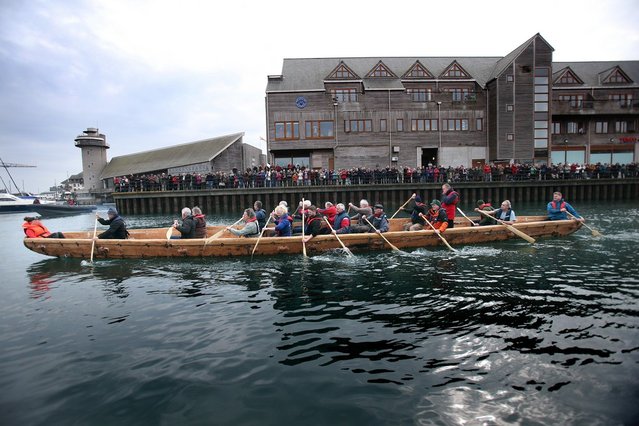
Crew in Britain's first ever full-size reconstructed sea-going Bronze Age boat, paddle out to sea near to the National Maritime Museum as it makes its maiden voyage on March 6, 2013 in Falmouth, England. With a crew of of 18, equipped with Bronze-Age-style wooden paddles, the 15 metre long experimental vessel – a replica of the sort of craft used for long-distance trade between Britain and the continent 4000 years ago – will be used to test prehistoric seafaring methods in a project in collaboration with the University of Exeter and the Falmouth-based National Maritime Museum Cornwall. (Photo by Matt Cardy)

Crew in Britain's first ever full-size reconstructed sea-going Bronze Age boat, paddle out to sea near to the National Maritime Museum as it makes its maiden voyage on March 6, 2013 in Falmouth, England. (Photo by Matt Cardy)
Details
07 Mar 2013 08:48:00
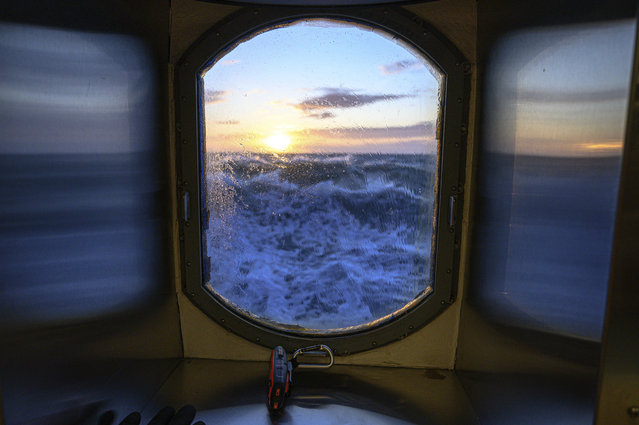
This November 8, 2019, photo provided by John Guillote shows a view from the main lab of the Sikuliaq in the Chukchi Sea. University of Washington scientists onboard the research vessel are studying the changes and how less sea ice will affect coastlines, which already are vulnerable to erosion because increased waves delivered by storms. More erosion would increase the chance of winter flooding in villages and danger to hunters in small boats. (Photo by John Guillote via AP Photo)

This November 8, 2019, photo provided by John Guillote shows a view from the main lab of the Sikuliaq in the Chukchi Sea. University of Washington scientists onboard the research vessel are studying the changes and how less sea ice will affect coastlines, which already are vulnerable to erosion because increased waves delivered by storms. More erosion would increase the chance of winter flooding in villages and danger to hunters in small boats. (Photo by John Guillote via AP Photo)
Details
26 Aug 2021 08:22:00
Dive by Tip Toland

Tip Toland is a sculptor and instructor living in the Seattle, Washington area. Her current focus is figurative ceramic sculpture. Tip is represented by the Nancy Margolis Gallery in New York City.

Photo: “Letter to God”, 2011. Stoneware, paint, chalk pastel, hair. (Photo by Tip Toland/Marie-Andrée Côté)
Details
02 Jun 2012 11:16:00


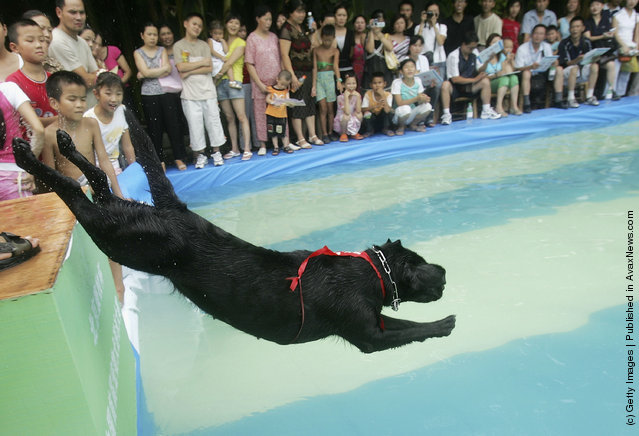
A dog dives during a pet dog swimming contest at the Taoyuan Pet Center on July 31, 2005 in Chengdu of Sichuan Province, southwest China. Over 30 dogs have attended the match. According to state media, with the country's pet population growing fast, analysts predict that the market potential for the “pet economy” in China could reach a minimum of RMB 15 billion (about USD 1.85 billion). (Photo by China Photos/Getty Images)
Details
23 Apr 2011 08:40:00
Ebrié Akan. Another series meanwhile goes behind the scenes of an Ivorian mannequin manufacturer, to highlight the construction of African beauty ideals. (Photo by Joana Choumali/The Guardian)

African women in their grandmothers' clothes: Joana Choumali’s portraits show modern African women swapping jeans for kente cloth – and diving into the dazzling cultural heritage of their families. (Photo by Joana Choumali/The Guardian)
Details
04 May 2016 11:43:00
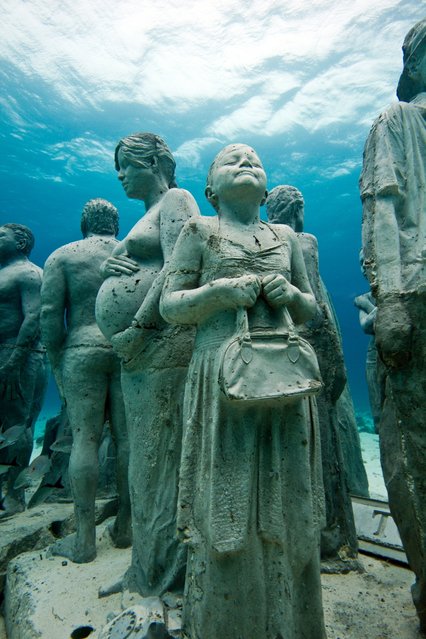
Underwater Sculpture, The Silent Evolution

“Jason deCaires Taylor is an English sculptor specialising in the creation of contemporary underwater sculptures which over time develop into artificial coral reefs. Taylor integrates his skills as a conservationist, underwater photographer and scuba diving instructor to produce unique installations that encourage the habitation and growth of corals and marine life”. – Wikipedia. Photo: “The Silent Evolution”. Underwater Sculpture, Museo Subacuático de Arte, Cancun. (Photo by Jason deCaires Taylor/UnderwaterSculpture)
Details
26 Mar 2014 14:05:00
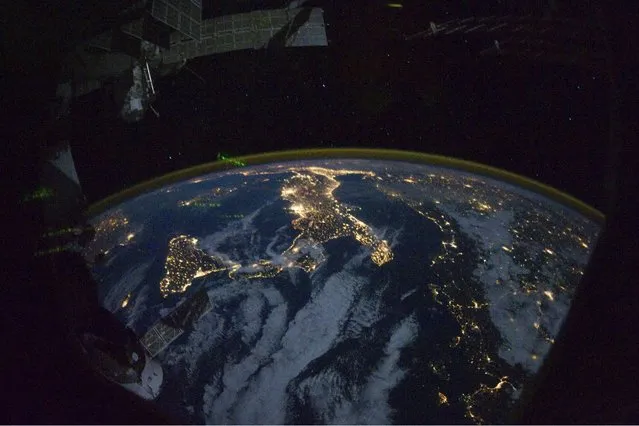
This image provided by NASA shows parts of Europe and Africa very easily recognizable in this night time image shot by one of the Expedition 25 crew members aboard the International Space Station flying 220 miles above Earth on Thursday Oct. 28, 2010. The view “looks” northward over Sicily and the “boot” of Italy, with the Mediterranean Sea representing most of the visible water in the view and the Adriatic Sea to the right of center. Tunisia is partially visible at left. Part of a docked Russian spacecraft and other components of the ISS are in the foreground. (Photo by AP photo/NASA)

This image provided by NASA shows parts of Europe and Africa very easily recognizable in this night time image shot by one of the Expedition 25 crew members aboard the International Space Station flying 220 miles above Earth on Thursday October 28, 2010. The view “looks” northward over Sicily and the “boot” of Italy, with the Mediterranean Sea representing most of the visible water in the view and the Adriatic Sea to the right of center. Tunisia is partially visible at left. Part of a docked Russian spacecraft and other components of the ISS are in the foreground. (Photo by AP Photo/NASA)
Details
11 May 2013 12:29:00
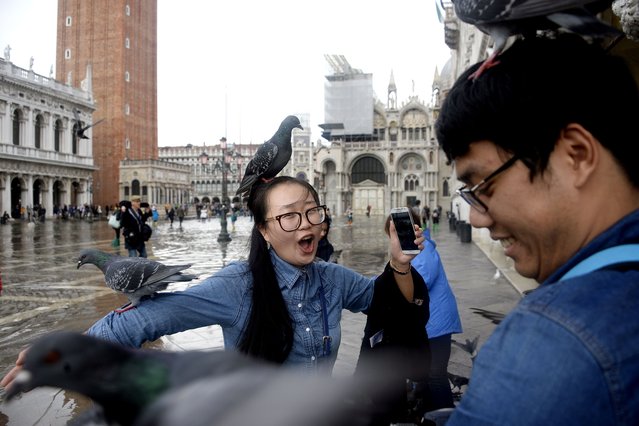
Tourists pose with pigeons in the flooded St. Mark's Square in Venice, on November 7, 2014. The high water, a combination of high tides and a strong Scirocco wind in the Adriatic Sea, stood at 110 centimeters early on November 7. The city has for years been wrestling with the problems posed by the threat of rising sea levels. (Photo by Olivier Morin/AFP Photo)

Tourists pose with pigeons in the flooded St. Mark's Square in Venice, on November 7, 2014. The high water, a combination of high tides and a strong Scirocco wind in the Adriatic Sea, stood at 110 centimeters early on November 7. The city has for years been wrestling with the problems posed by the threat of rising sea levels. (Photo by Olivier Morin/AFP Photo)
Details
08 Nov 2014 13:06:00