Loading...
Done
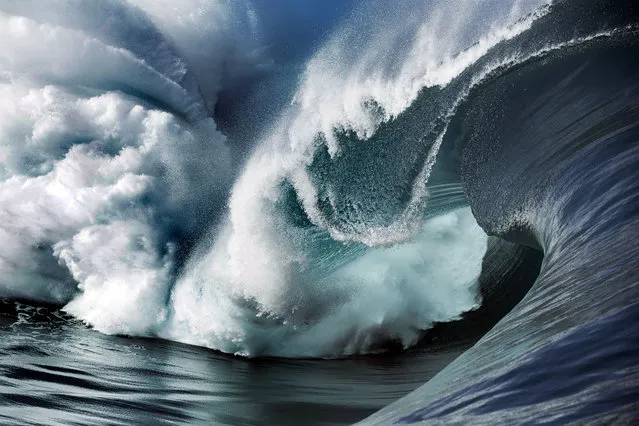
Ben Thouard, 29, regularly dives into the crystal clear waters of Teahupoo, Tahiti's most famous surf break, to snap the empty waves. He stands in the water scouting out particular shapes and the right swell direction and shoots most of his pictures during the golden hours of sunrise and sunset. Here: A shot of a wave crashing down into the ocean in the clear waters of Teahupoo. (Photo by Ben Thouard/Caters News)

Ben Thouard, 29, regularly dives into the crystal clear waters of Teahupoo, Tahiti's most famous surf break, to snap the empty waves. He stands in the water scouting out particular shapes and the right swell direction and shoots most of his pictures during the golden hours of sunrise and sunset. Here: A shot of a wave crashing down into the ocean in the clear waters of Teahupoo. (Photo by Ben Thouard/Caters News)
Details
06 Mar 2016 09:03:00
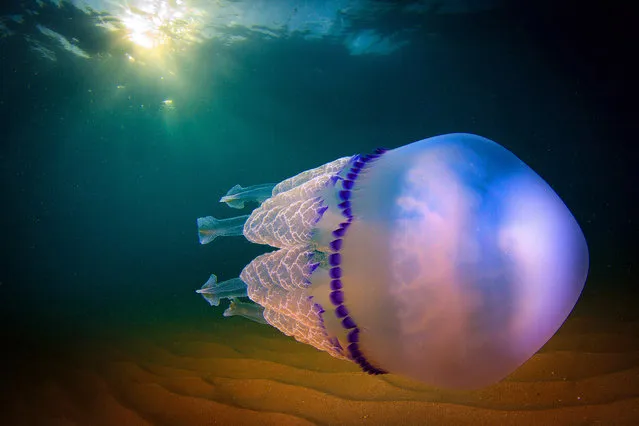
The incredible detail in each photo is thanks to Jordi Benitez Castells, years of experience taking photos while diving. Jordi, 40, from El Vendrell, Spain, was in Catalunya when he took the photos and managed to get the snaps at about three metres below the surface in most cases. While he works full-time in a bank, Jordi dons his wetsuit out of hours to go diving and uses a Canon 7D to get his shots. Here: One of the beautiful jellyfish. (Photo by Jordi Benitez/Caters News)

The incredible detail in each photo is thanks to Jordi Benitez Castells, years of experience taking photos while diving. Jordi, 40, from El Vendrell, Spain, was in Catalunya when he took the photos and managed to get the snaps at about three metres below the surface in most cases. While he works full-time in a bank, Jordi dons his wetsuit out of hours to go diving and uses a Canon 7D to get his shots. Here: One of the beautiful jellyfish. (Photo by Jordi Benitez/Caters News)
Details
08 Mar 2016 13:13:00
Rolando Pujol Rodriguez photographed the Cuban raft exodus in 1994, and twenty years later Enrique de la Osa took portraits of some of the people who made it to the United States, in this story which combines archive and present day images. Here: People put the finishing touches to a makeshift boat on a rooftop before lowering it onto a truck and launching it into the Straits of Florida towards the U.S., on the last day of the 1994 Cuban raft exodus in Havana, in this September 13, 1994 file photo. (Photo by Rolando Pujol Rodriguez/Reuters)

Rolando Pujol Rodriguez photographed the Cuban raft exodus in 1994, and twenty years later Enrique de la Osa took portraits of some of the people who made it to the United States, in this story which combines archive and present day images. Here: People put the finishing touches to a makeshift boat on a rooftop before lowering it onto a truck and launching it into the Straits of Florida towards the U.S., on the last day of the 1994 Cuban raft exodus in Havana, in this September 13, 1994 file photo. (Photo by Rolando Pujol Rodriguez/Reuters)
Details
13 Nov 2014 14:07:00
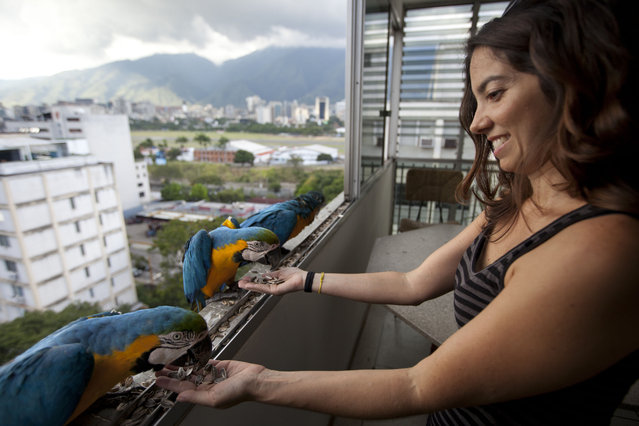
Vanessa Silva, 38, feeds macaws that fly to her apartment window every day looking for food, in Caracas, Venezuela. A group of gold-and-royal blue birds poked their heads through Silva’s window, as if saying “I’m here, is anyone home?” “I’d seen them flying when I was down on the street, and I thought ‘Oh how pretty,’” the 38-year-old said, a macaw eating out of her hand. (Photo by Ariana Cubillos/AP Photo)

Vanessa Silva, 38, feeds macaws that fly to her apartment window every day looking for food, in Caracas, Venezuela, on November 24, 2014. A group of gold-and-royal blue birds poked their heads through Silva’s window, as if saying “I’m here, is anyone home?” “I’d seen them flying when I was down on the street, and I thought ‘Oh how pretty,’” the 38-year-old said, a macaw eating out of her hand. (Photo by Ariana Cubillos/AP Photo)
Details
27 Nov 2014 15:27:00
The rotating updraft base of a supercell thunderstorm, and a rear flank downdraft containing rain and hail, backlit by the setting sun, on May 10, 2014, in Climax, Kansas, United States. To most of us, dark clouds on the horizon usually means rain – but here in Kansas, they can also signal the start of a supercell. The huge formations, also known as rotating thunderstorms, are among the most powerful weather phenomenon found over land. (Photo by Stephen Locke/Barcroft Media)

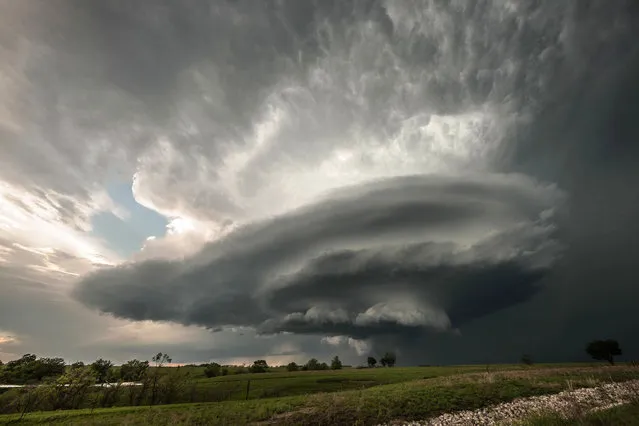
The rotating updraft base of a supercell thunderstorm, and a rear flank downdraft containing rain and hail, backlit by the setting sun, on May 10, 2014, in Climax, Kansas, United States. To most of us, dark clouds on the horizon usually means rain – but here in Kansas, they can also signal the start of a supercell. The huge formations, also known as rotating thunderstorms, are among the most powerful weather phenomenon found over land. They can occur anywhere where the conditions are right, but are normally found in more arid climates. These awe-inspiring supercells were captured south of Climax city by storm chaser Stephen Locke. (Photo by Stephen Locke/Barcroft Media)
Details
18 Jul 2014 12:01:00
This is a photo shoot like youve never seen before  a model in glamorous dresses surrounded by sharks. However, model and shark diver Liz Parkinson decided to take the plunge and get up close and personal with some of the most revered creatures of the deep. Here: Liz swimming with Hammerheads in the Bahamas, Bimini. (Photo by Jeremy Farris/Caters News)

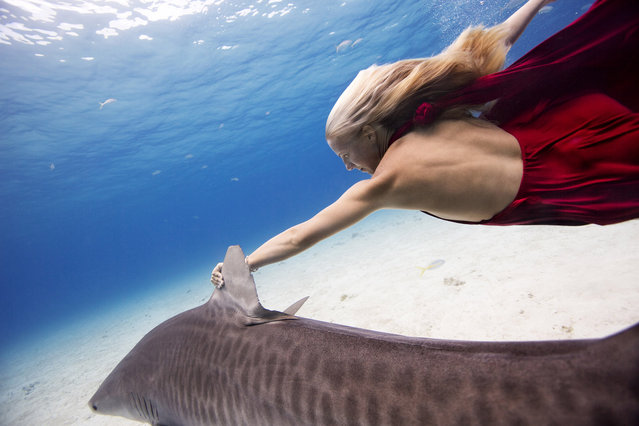
This is a photo shoot like youve never seen before a model in glamorous dresses surrounded by sharks. However, model and shark diver Liz Parkinson decided to take the plunge and get up close and personal with some of the most revered creatures of the deep. She was joined at the depths of the ocean by Australian photographer Jeremy Farris, who travelled around the world to capture this quite stunning collection. In some pictures, Liz is seen hitching a ride on the fins of the placid whale shark whilst in others she is being examined by the vicious tiger shark. Here: Liz swimming with Hammerheads in the Bahamas, Bimini. (Photo by Jeremy Farris/Caters News)
Details
28 Jun 2015 12:34:00
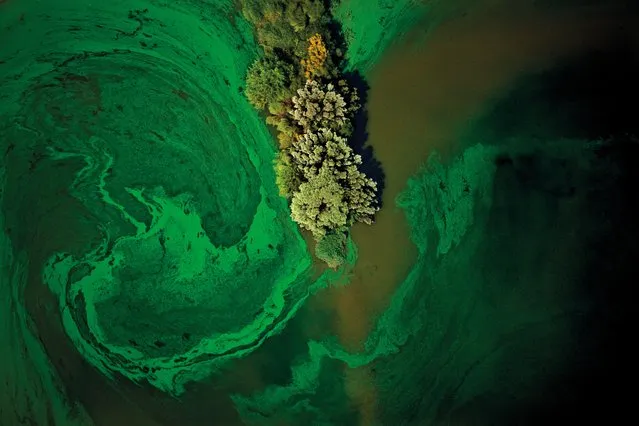
Luling, Louisiana US. New evidence contradicts previous claims of the relative safety of glyphosate, the world’s most widely used herbicide, which is manufactured here. It is often used in conjunction with seeds that have been genetically modified to tolerate its application, meaning that anyone consuming these crops is eating a genetically modified plant, and whatever residue of the pesticide that remains. (Photo by J. Henry Fair/Industrial Scars/Papadakis Publisher)

Luling, Louisiana, US. New evidence contradicts previous claims of the relative safety of glyphosate, the world’s most widely used herbicide, which is manufactured here. It is often used in conjunction with seeds that have been genetically modified to tolerate its application, meaning that anyone consuming these crops is eating a genetically modified plant, and whatever residue of the pesticide that remains. (Photo by J. Henry Fair/Industrial Scars/Papadakis Publisher)
Details
25 Oct 2016 10:40:00
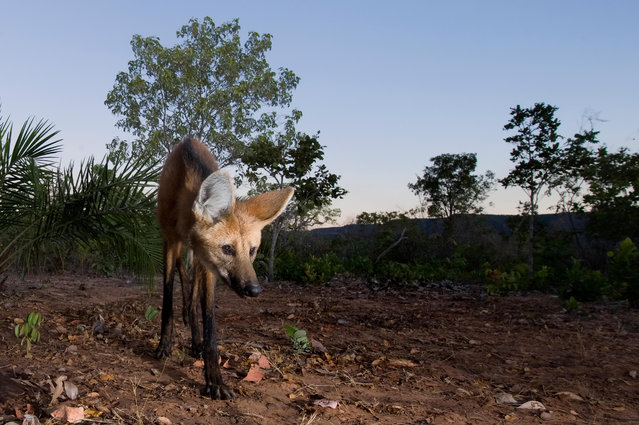
The maned wolf is among the large mammals in the Brazilian Cerrado that are threatened by the increasing conversion of grasslands into farmland for grazing and growing crops. (Photo by Ben Cranke/Nature Picture Library/Alamy Stock Photo)

Global wildlife populations will decline by 67% by 2020 unless urgent action is taken to reduce human impact on species and ecosystems, warns the biennial Living Planet Index report from WWF (World Wide Fund for Nature) and ZSL (Zoological Society of London). From elephants to eels, here are some of the wildlife populations most affected by human activity. Here: The maned wolf is among the large mammals in the Brazilian Cerrado that are threatened by the increasing conversion of grasslands into farmland for grazing and growing crops. (Photo by Ben Cranke/Nature Picture Library/Alamy Stock Photo)
Details
28 Oct 2016 10:47:00