Loading...
Done
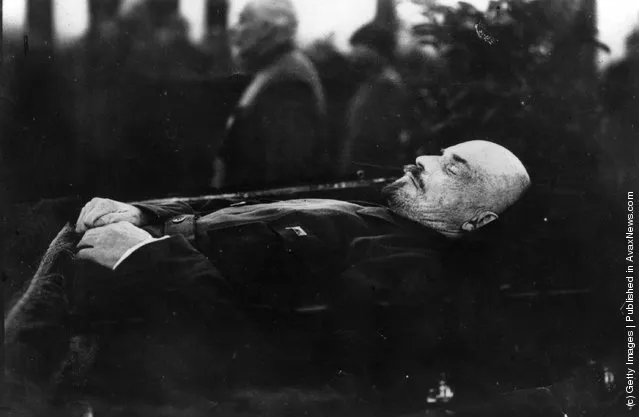
1924:  Vladimir Ilyich Lenin lying in state in the Kremlin

Photo: Vladimir Ilyich Lenin (1870 – 1924) lying in state in the Kremlin. (Photo by Hulton Archive/Getty Images). 1924

Important! For the same article in Russian language click here.

Something quite intriguing is happening within Russian-speaking internet during the last few – should you type a fully academic inquiry (at least, according to Russian academic requirements) in national search engines for "Lenin's mausoleum" – the first thing you get (even in top 10 searches) is website pages talking about black magic and occult. Website authors view this construction differently, but unconditionally agree on one thing: the mausoleum of the "leader of the world proletariat” – the essence of a magical artifact, a sort of “energy vampire”. It was built with a certain purpose: to drain the energy out of miserable Soviet citizens on one hand; and to poison the anthroposphere of one-sixth part of the earth with its vibes (the exact territory that was occupied by the former Soviet Union), depriving the Russian people of will to resist on the other hand. Complete nonsense? No doubt. Nevertheless, an intriguing one. Well, probably because some oddities do exist in mausoleum's history. These oddities are the thing we are going to discuss this time. First, let me refresh you memory on the subject.
Details
16 Oct 2011 11:27:00
A woman loyal to the Houthi movement holds a rifle as she takes part in a parade to show support to the movement in Sanaa, Yemen September 6, 2016. Dressed in the head to toe garments which obscured their faces, the female fighters brandished machine guns, rocket launchers and grenades. The women also wore hats as they showed support for the Shiite Houthi rebels. The Saudi-led Arab coalition launched a military campaign against the Houthis and their allies in March 2015. It was after the rebels closed in on Gulf-backed President Abedrabbo Mansour Hadi in his southern refuge of Aden, forcing him into exile. The female protesters have pledged to remain supportive and do whatever they can to back the ongoing resistance against the kingdom. Yemen is in the grip of its most severe crisis in years, and is on the brink of civil war. (Photo by Khaled Abdullah/Reuters)

A woman loyal to the Houthi movement holds a rifle as she takes part in a parade to show support to the movement in Sanaa, Yemen September 6, 2016. The Saudi-led Arab coalition launched a military campaign against the Huthis and their allies in March 2015, after the rebels closed in on Gulf-backed President Abedrabbo Mansour Hadi in his southern refuge of Aden, forcing him into exile. (Photo by Khaled Abdullah/Reuters)
Details
07 Sep 2016 10:24:00
Ocean voyage

Do you think that history is a science? Well, not exactly. First, and foremost, history is the state's “legend of wars”, it’s official regalia. Of course, public historians are not interested in scientific truth – quite the opposite. In this respect, any attempt to present a state’s history as altruistic and benevolent as possible is welcomed and encouraged – as opposed to any revisionism attempts that may be more accurate. In this matter, Chinese have surpassed us all – they revised in highly creative manner (but rather shamelessly) the technology already invented by Europeans, a process that resulted in oldest state on the planet. Here is an interesting paradox: ask any sinologist about the Middle Kingdom during second century B.C., and he will describe it to you in such a vivid manner as if he has been living there all his life – but as soon as you will ask him to describe Chinese history in the 19-20th centuries… let's say, his eagerness will be greatly diminished. However, we will discuss China in a different article, and in the meantime we will try to understand how exactly historic “legend of wars” is formed and functions – based on a specific and well-known example. A great example is Ferdinand Magellan's first voyage around the world.
Details
14 Nov 2011 09:11:00
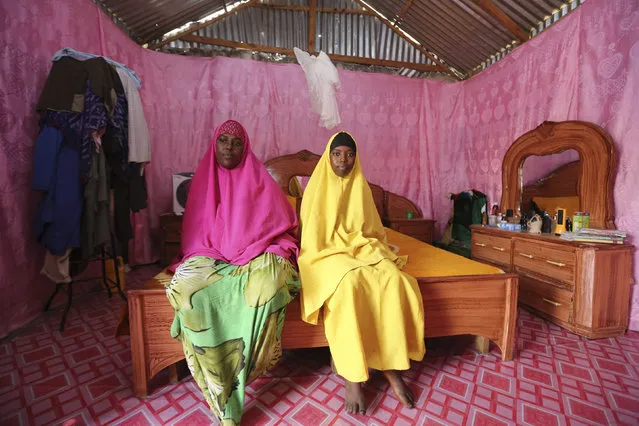
Saciido Sheik Yacquub, 34, poses for a picture with her daughter Faadumo Subeer Mohamed, 13, at their home in Hodan district IDP camp in Mogadishu February 11, 2014. Saciido, who runs a small business, wanted to be a business woman when she was a child. She studied until she was 20. She hopes that Faadumo will become a doctor. Faadumo will finish school in 2017 and hopes to be a doctor when she grows up. (Photo by Feisal Omar/Reuters)

“On March 8th activists celebrate International Women’s Day, which dates back to the early 20th century and has been observed by the United Nations since 1975. In the run-up to the event, Reuters photographers in countries around the globe took a series of portraits of women and their daughters. They asked each mother what her profession was, at what age she had finished education, and what she wanted her daughter to become when she grew up. They also asked each daughter at what age she would finish education and what she wanted to do in the future. The series of images offers an insight into the lives of women and girls around the world”. – Reuters. (Photo by Feisal Omar/Reuters)
Details
09 Mar 2014 04:33:00
Ultra-Orthodox Jews knead dough in a bakery in an Orthodox neighborhood in Jerusalem, 29 March 2015. Matzah, or unleavened bread, is used instead of bread during the week-long Jewish holiday of Passover, commemorating the Jewish exodus from Egypt in Biblical times. (Photo by Abir Sultan/EPA)

Ultra-Orthodox Jews knead dough in a bakery in an Orthodox neighborhood in Jerusalem, 29 March 2015. Matzah, or unleavened bread, is used instead of bread during the week-long Jewish holiday of Passover, commemorating the Jewish exodus from Egypt in Biblical times. (Photo by Abir Sultan/EPA)
Details
01 Apr 2015 11:57:00
A pedestrian carries a shopping bag and looks at his phone while walking past a mural decorating a construction site in central Sydney on November 6, 2023. (Photo by David Gray/AFP Photo)

A pedestrian carries a shopping bag and looks at his phone while walking past a mural decorating a construction site in central Sydney on November 6, 2023. (Photo by David Gray/AFP Photo)
Details
15 Dec 2023 23:54:00
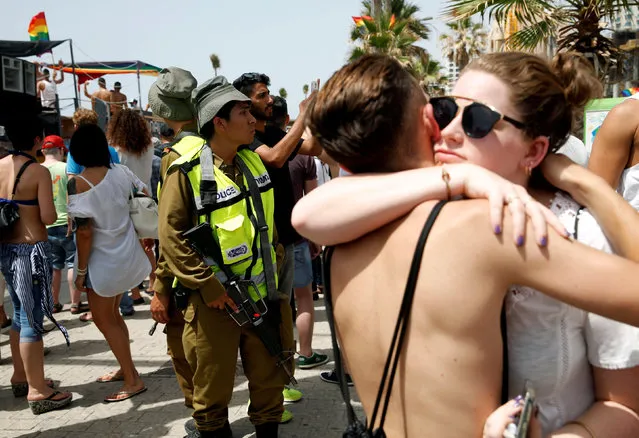
An Israeli soldier watches as revellers take part in a gay pride parade in Tel Aviv, Israel, June 3, 2016. (Photo by Baz Ratner/Reuters)

An Israeli soldier watches as revellers take part in a gay pride parade in Tel Aviv, Israel, June 3, 2016. About 200,000 people from the LGBT community in Israel and abroad attended in Tel Aviv's annual gay pride parade Friday, the largest event of its kind in the Middle East. (Photo by Baz Ratner/Reuters)
Details
04 Jun 2016 12:12:00
A reveller performs during the first night of carnival parade at the Sambadrome in Rio de Janeiro, Brazil on February 23, 2020. (Photo by Carl de Souza/AFP Photo)

A reveller performs during the first night of carnival parade at the Sambadrome in Rio de Janeiro, Brazil on February 23, 2020. (Photo by Carl de Souza/AFP Photo)
Details
27 Feb 2022 04:55:00