Loading...
Done
Inflatable dolls in the shape of ducks are seen in front of the National Congress during a protest against tax increases in Brasilia, Brazil, March 29, 2016. The campaign “I will not pay the Duck” is organized by the Federation of Industries of Sao Paulo (FIESP) and uses the duck symbol in reference to industries that pay high taxes. (Photo by Gregg Newton/Reuters)

Inflatable dolls in the shape of ducks are seen in front of the National Congress during a protest against tax increases in Brasilia, Brazil, March 29, 2016. The campaign “I will not pay the Duck” is organized by the Federation of Industries of Sao Paulo (FIESP) and uses the duck symbol in reference to industries that pay high taxes. (Photo by Gregg Newton/Reuters)
Details
30 Mar 2016 11:27:00
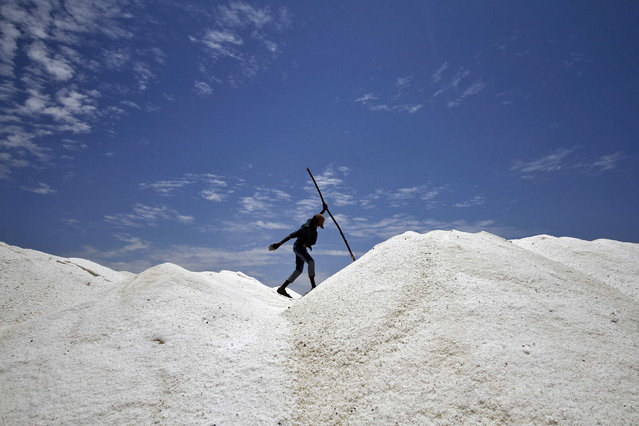
A worker walks through a salt pan on the eve of May Day or Labour Day on the outskirts of the southern Indian city of Chennai April 30, 2014. India is the third largest salt producing country in the world after China and U.S. with global annual production about 230 million tonnes, according to government data. (Photo by Reuters/Babu)

A worker walks through a salt pan on the eve of May Day or Labour Day on the outskirts of the southern Indian city of Chennai April 30, 2014. India is the third largest salt producing country in the world after China and U.S. with global annual production about 230 million tonnes, according to government data. (Photo by Reuters/Babu)
Details
04 May 2014 09:22:00
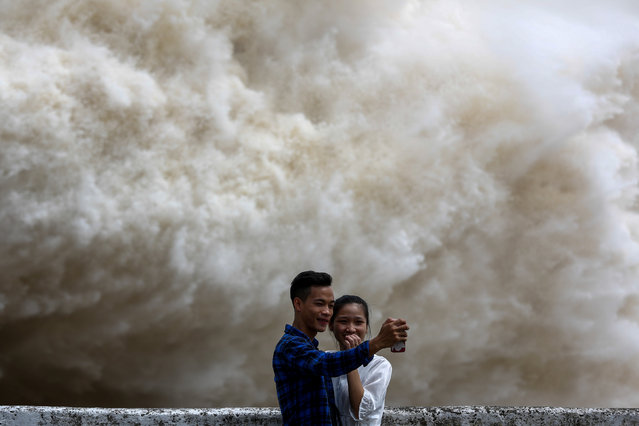
A couple takes a selfie as Hoa Binh hydroelectric power plant opens the flood gates after a heavy rainfall caused by Talas typhoon in Hoa Binh province, outside Hanoi, Vietnam July 20, 2017. (Photo by Reuters/Kham)

A couple takes a selfie as Hoa Binh hydroelectric power plant opens the flood gates after a heavy rainfall caused by Talas typhoon in Hoa Binh province, outside Hanoi, Vietnam July 20, 2017. (Photo by Reuters/Kham)
Details
21 Jul 2017 08:00:00
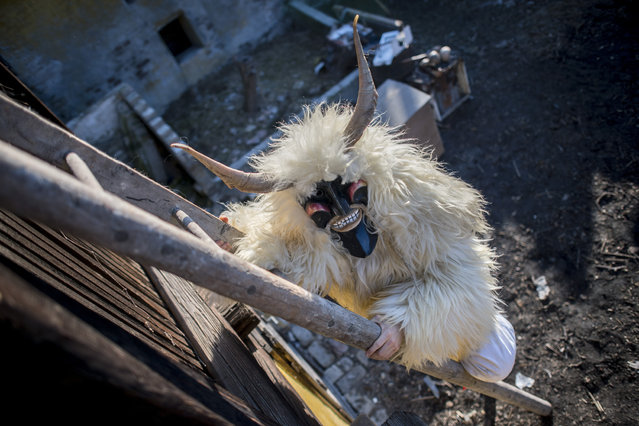
A man wears a busho mask and a costume made of sheep pelt while climbing up a ladder outside a barn in Mohacs, Hungary, 20 February 2020, on the first day of carnival. The traditional Busho carnival, which marks the end of winter, dates back to the 16th century. According to local legend, members of an ethnic South Slavic group living in Mohacs at the time dressed up in similar costumes and wore wooden masks to scare away Ottoman invaders, who mistook them for demons. (Photo by Tamas Soki/EPA/EFE)

A man wears a busho mask and a costume made of sheep pelt while climbing up a ladder outside a barn in Mohacs, Hungary, 20 February 2020, on the first day of carnival. The traditional Busho carnival, which marks the end of winter, dates back to the 16th century. According to local legend, members of an ethnic South Slavic group living in Mohacs at the time dressed up in similar costumes and wore wooden masks to scare away Ottoman invaders, who mistook them for demons. (Photo by Tamas Soki/EPA/EFE)
Details
23 Feb 2020 00:07:00
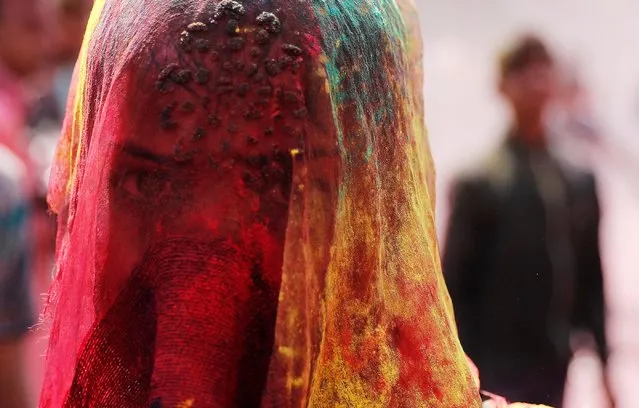
A girl covers her face as she is daubed in colours during the religious festival of Holi inside a temple in Nandgaon village, in the state of Uttar Pradesh, India, March 5, 2020. (Photo by Adnan Abidi/Reuters)

A girl covers her face as she is daubed in colours during the religious festival of Holi inside a temple in Nandgaon village, in the state of Uttar Pradesh, India, March 5, 2020. (Photo by Adnan Abidi/Reuters)
Details
07 Mar 2020 00:05:00
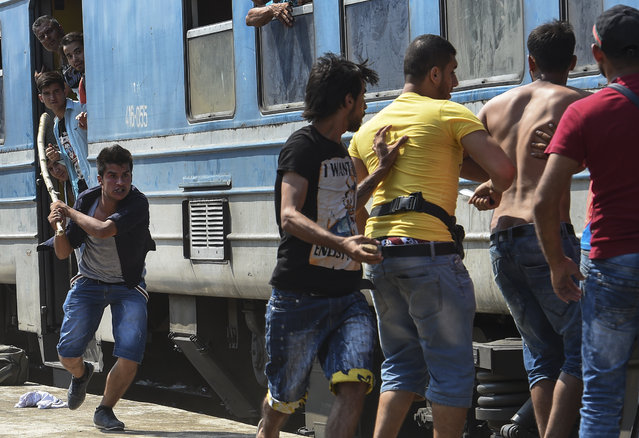
Migrants with a stick, stones and knife fight with each other after a brawl erupted over a place in an overcrowded train heading to the Serbian border at the train station in Gevgelija, The Former Yugoslav Republic of Macedonia, 14 August 2015. The number of migrants passing through Macedonia increases day by day, local sources said. From the beginning of the year to mid-June 2015, nearly 160,000 migrants landed in the southern European countries, mainly Greece and Italy, on their way to wealthier countries in Western and Northern Europe, according to estimates by the International Organization for Migration (IOM). (Photo by Georgi Licovski/EPA/EFE)

Migrants with a stick, stones and knife fight with each other after a brawl erupted over a place in an overcrowded train heading to the Serbian border at the train station in Gevgelija, The Former Yugoslav Republic of Macedonia, 14 August 2015. (Photo by Georgi Licovski/EPA/EFE)
Details
15 Jul 2018 00:05:00
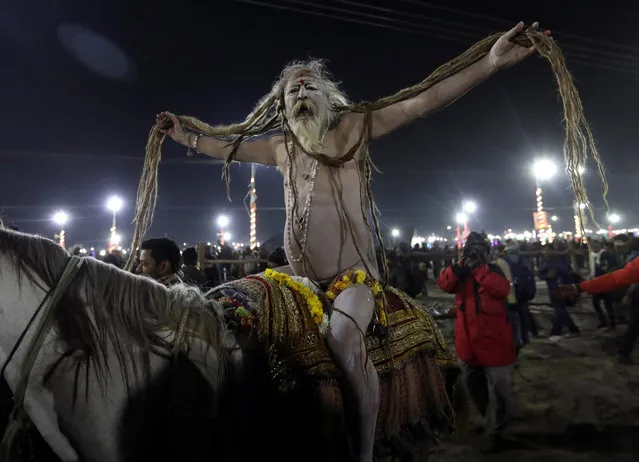
Indian Naga Sadhus, or naked holy men, participate in a procession before taking a “shahi snans”, or holy bath, at the Sangam river, the confluence of three of the holiest rivers in Hindu mythology, the Ganga, the Yamuna and the Saraswati, during Kumbh Mela festival in Allahabad, Uttar Pradesh, India, 15 January 2019. The Hindu festival is one of the biggest in India and will be held from 15 January to 04 March 2019 in Allahabad. (Photo by Rajat Gupta/EPA/EFE)

Indian Naga Sadhus, or naked holy men, participate in a procession before taking a “shahi snans”, or holy bath, at the Sangam river, the confluence of three of the holiest rivers in Hindu mythology, the Ganga, the Yamuna and the Saraswati, during Kumbh Mela festival in Allahabad, Uttar Pradesh, India, 15 January 2019. The Hindu festival is one of the biggest in India and will be held from 15 January to 04 March 2019 in Allahabad. (Photo by Rajat Gupta/EPA/EFE)
Details
26 Jan 2019 00:01:00
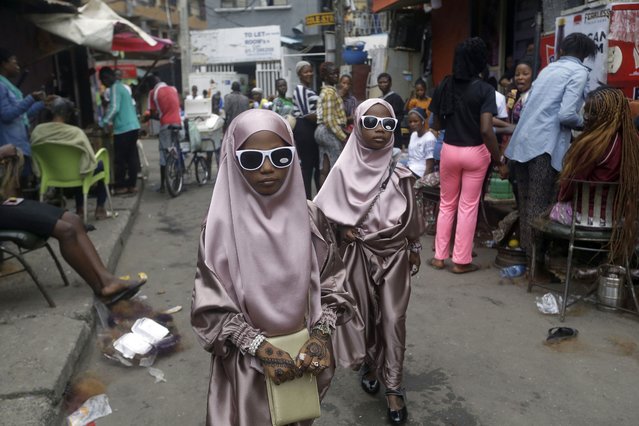
Muslim girls are seen after prayers, in Lagos, Nigeria, Friday, July 31, 2020. Small groups of pilgrims performed one of the final rites of the Islamic hajj on Friday as Muslims worldwide marked the start of the Eid al-Adha holiday amid a global pandemic that has impacted nearly every aspect of this year's pilgrimage and celebrations. The last days of hajj coincide with the four-day Eid al-Adha, or “Feast of Sacrifice”, in which Muslims slaughter livestock and distribute the meat to the poor. (Photo by Sunday Alamba/AP Photo)

Muslim girls are seen after prayers, in Lagos, Nigeria, Friday, July 31, 2020. Small groups of pilgrims performed one of the final rites of the Islamic hajj on Friday as Muslims worldwide marked the start of the Eid al-Adha holiday amid a global pandemic that has impacted nearly every aspect of this year's pilgrimage and celebrations. The last days of hajj coincide with the four-day Eid al-Adha, or “Feast of Sacrifice”, in which Muslims slaughter livestock and distribute the meat to the poor. (Photo by Sunday Alamba/AP Photo)
Details
14 Aug 2020 00:01:00