Loading...
Done
A fan watches the group A World Cup match between Mexico and Brazil via a live broadcast at the FIFA Fan Fest in Sao Paulo, Brazil, Tuesday, June 17, 2014. Forget the French manicure. It’s Brazil during World Cup, and women here want to flaunt their love of the national team with wacky nail designs. (Photo by Dario Lopez-Mills/AP Photo)

A fan watches the group A World Cup match between Mexico and Brazil via a live broadcast at the FIFA Fan Fest in Sao Paulo, Brazil, Tuesday, June 17, 2014. Forget the French manicure. It’s Brazil during World Cup, and women here want to flaunt their love of the national team with wacky nail designs. (Photo by Dario Lopez-Mills/AP Photo)
Details
19 Jun 2014 10:24:00
As the sun rises, Gentoo penguins start their day on Wednesday, February 17, 2016, on Sea Lion Island, Falkland Islands. Sea Lion Island, which lies about 10 miles to the south of mainland East Falkland, is the southern most human-inhabited island of the more than 750 islands and islets of the Falkland Islands. (Photo by Jahi Chikwendiu/The Washington Post)

As the sun rises, Gentoo penguins start their day on Wednesday, February 17, 2016, on Sea Lion Island, Falkland Islands. Sea Lion Island, which lies about 10 miles to the south of mainland East Falkland, is the southern most human-inhabited island of the more than 750 islands and islets of the Falkland Islands. (Photo by Jahi Chikwendiu/The Washington Post)
Details
02 Sep 2016 13:05:00
A staff member demonstrates how she puts on the helmet of a mock space suit at the C-Space Project Mars simulation base in the Gobi Desert outside Jinchang, Gansu Province, China, April 17, 2019. The facility – comprising several interconnected modules including a greenhouse and a mock decompression chamber – opened its doors to the public. (Photo by Thomas Peter/Reuters)

A staff member demonstrates how she puts on the helmet of a mock space suit at the C-Space Project Mars simulation base in the Gobi Desert outside Jinchang, Gansu Province, China, April 17, 2019. The facility – comprising several interconnected modules including a greenhouse and a mock decompression chamber – opened its doors to the public. (Photo by Thomas Peter/Reuters)
Details
19 Apr 2019 00:07:00
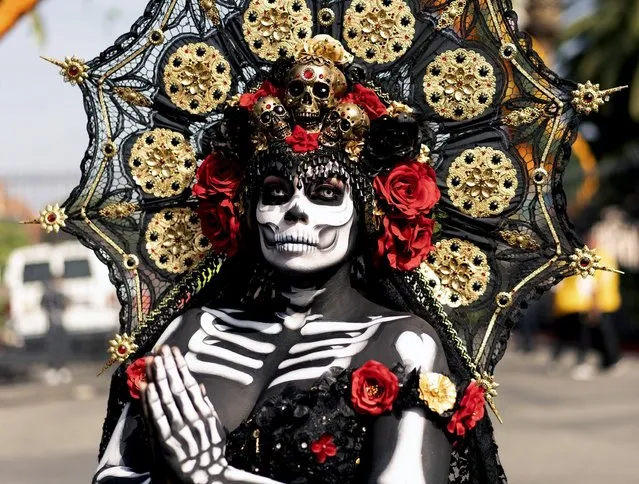
Dressed in traditional make-up and costume a woman participates in the celebration for the Day of the Dead or Día de los Muertos at the Hollywood Forever Cemetery in Los Angeles on Saturday, October 30, 2021. Day of the Dead, is a Mexican holiday where families welcome back the souls of their deceased relatives for a brief reunion that includes food, drink and celebration. (Photo by Richard Vogel/AP Photo)

Dressed in traditional make-up and costume a woman participates in the celebration for the Day of the Dead or Día de los Muertos at the Hollywood Forever Cemetery in Los Angeles on Saturday, October 30, 2021. Day of the Dead, is a Mexican holiday where families welcome back the souls of their deceased relatives for a brief reunion that includes food, drink and celebration. (Photo by Richard Vogel/AP Photo)
Details
09 Nov 2021 07:28:00
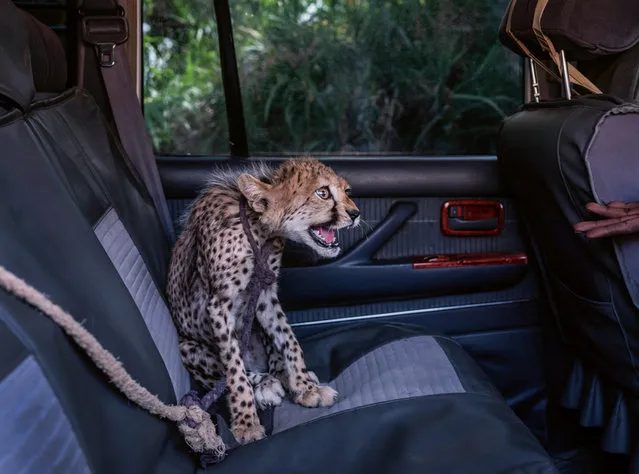
A five-month-old cheetah seated in the back of a Land Cruiser growls at an outstretched hand after being taken from traffickers in Ethiopia and driven to Harirad, Somaliland, in 2020. This photo is part of the work of more than 100 artists in Why We Photograph Animals, a new collection of wildlife photography that aims to help understand why people have photographed animals at different points in history and what it means in the present. (Photo by Nichole Sobecki/Thames & Hudson)

A five-month-old cheetah seated in the back of a Land Cruiser growls at an outstretched hand after being taken from traffickers in Ethiopia and driven to Harirad, Somaliland, in 2020. This photo is part of the work of more than 100 artists in Why We Photograph Animals, a new collection of wildlife photography that aims to help understand why people have photographed animals at different points in history and what it means in the present. (Photo by Nichole Sobecki/Thames & Hudson)
Details
28 Apr 2024 03:15:00
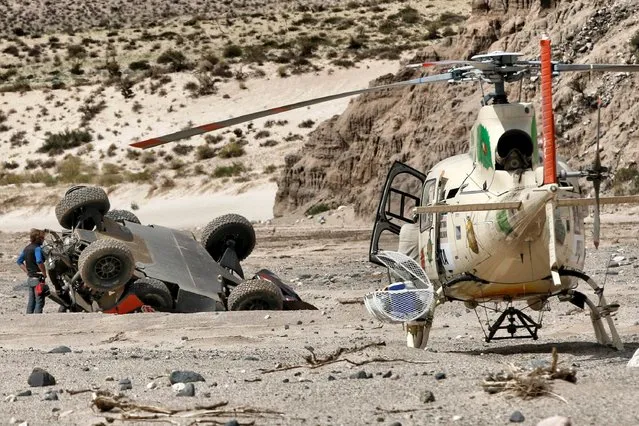
The Peugeot of Sebastien Loeb of France is seen turned over next to a helicopter during the eighth stage in the Dakar Rally 2016 near Belen, Argentina, January 11, 2016. (Photo by Andre Lavadinho/Reuters/World-ASO)

The Peugeot of Sebastien Loeb of France is seen turned over next to a helicopter during the eighth stage in the Dakar Rally 2016 near Belen, Argentina, January 11, 2016. (Photo by Andre Lavadinho/Reuters/World-ASO)
Details
13 Jan 2016 08:03:00
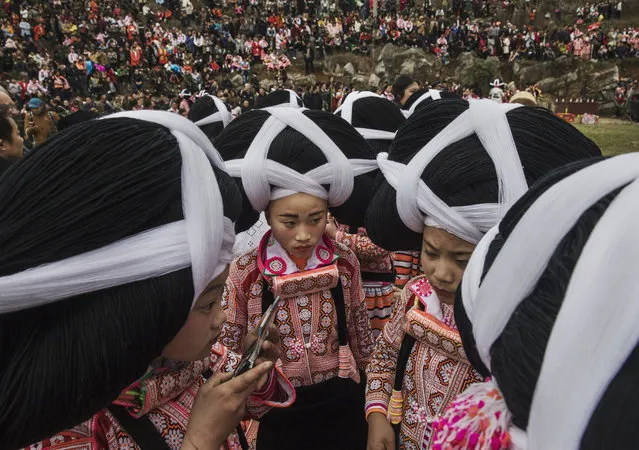
Girls of the Long Horn Miao ethnic minority group wear headdresses as they prepare gather for Tiaohua or Flower Festival as part of the Lunar New Year on February 6, 2017 in Longga village, Guizhou province, southern China. The Long Horn Miao are recognized for their declining practice of wrapping a blend of linen, wool, and the hair of their ancestors around animal horns or a wooden clip to make headdresses. Many young women say they now wear the headdresses only for special occasions and festivals, as the ornaments, which are attached by the horns to their real hair, have proved impractical for modern daily life in a fast changing world. China officially recognizes 56 different ethnic minorities, and statistics show over 7 million Chinese identifying themselves as Miao. But the small Long Horn Miao community counts only around 5000 people living in 12 villages, whose age-old traditions, language, and culture are fading. It is increasingly difficult in a modernizing China, as young people are drawn from remote rural villages to opportunities in bigger cities amongst wide-scale urbanization. Farming and labour remain the mainstays of life for the Long Horn Miao, leaving the area relatively poor in comparison with many parts of China. The government has invested significant amounts into local infrastructure and the tourism industry to try to bolster the local economy. (Photo by Kevin Frayer/Getty Images)

Girls of the Long Horn Miao ethnic minority group wear headdresses as they prepare gather for Tiaohua or Flower Festival as part of the Lunar New Year on February 6, 2017 in Longga village, Guizhou province, southern China. (Photo by Kevin Frayer/Getty Images)
Details
13 Feb 2017 00:01:00


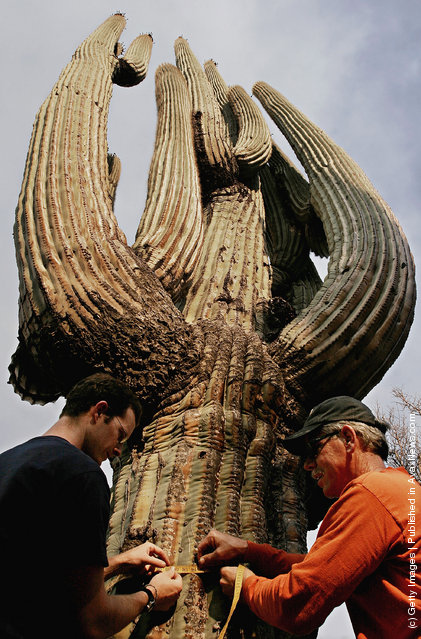
“The saguaro (scientific name Carnegiea gigantea) is a large, tree-sized cactus species in the monotypic genus Carnegiea. It is native to the Sonoran Desert in the U.S. state of Arizona, the Mexican state of Sonora, a small part of Baja California in the San Felipe Desert and an extremely small area of California, U.S. The saguaro blossom is the State Wildflower of Arizona”. – Wikipedia

Photo: Daniel Appel (L), a firefighter with Engine 84 from the Lassen National Forest in California and Mike Hallen, (R), Arizona representative of the National Register of Big Trees, measure the circumference of this Saguaro cactus called the "Grand One," in the Tonto National Forest on July 1, 2005 35 miles north of Phoenix, near Carefree, Arizona. The cactus, estimated to be more than 200 years old, measures a circumference of 7 feet, 10 inches (2.4 meters) and stands 46 feet high (14 meters). The cactus was burned in the Cave Creek Complex fire and may not survive. It was once the largest Saguaro in the world, two others have been found recently that have tied it's measurements. The fire has burned more than 214,000 acres of the Sonoran desert. (Photo by Jeff Topping/Getty Images)

Details
26 Jul 2011 12:27:00