Loading...
Done
A man dressed in traditional clothes tries to pull his opponent over the table at the 40th Alpine Country Championships in Fingerhakeln_finger wrestling_ in Woernsmuehl, Germany, Thursday, May 25, 2017. (Photo by Matthias Schrader/AP Photo)

A man dressed in traditional clothes tries to pull his opponent over the table at the 40th Alpine Country Championships in Fingerhakeln_finger wrestling_ in Woernsmuehl, Germany, Thursday, May 25, 2017. Competitors battled for the title in this traditional rural sport where the winner has to pull his opponent over a marked line on the table. (Photo by Matthias Schrader/AP Photo)
Details
27 May 2017 08:08:00
Stacked stones are pictured during the European Stone Stacking Championships 2018 in Dunbar, Scotland, on April 22, 2018. (Photo by Andy Buchanan/AFP Photo)

Stacked stones are pictured during the European Stone Stacking Championships 2018 in Dunbar, Scotland, on April 22, 2018. The European Stone Stacking Championships are Europe’s largest championships for all Stone Stacking and Rock Balancing artists and practitioners. The overall winner of the European Stone Stacking Championship will receive financial support for flights to the World Stone Balance Championship in Llano, Texas the following year. (Photo by Andy Buchanan/AFP Photo)
Details
25 Apr 2018 00:05:00
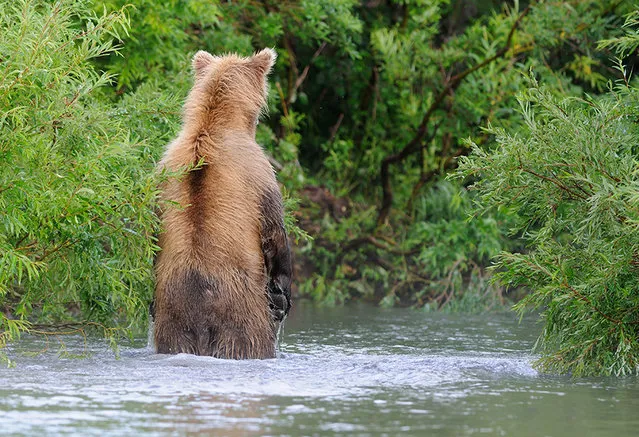
Where's the fish?/n. South Kamchatka Sanctuary<><>South Kamchatka Sanctuary; Kuril Lake; Kamchatka; bear; salmon; spawning

Igor Shpilenok works in the reserve at Kamchatka, Russia. Igor is a fellow of the International League of Conservation Photographers and a winner of the 2006 BBC Wildlife Photographer Competition. Igor’s work has been published in numerous international and Russian magazines, including Smithsonian, National Wildlife, Geo, and BBC Wildlife.

“How does a bear behave when encounter a human? In most cases he runs away. But before running he almost always would rise to stand on his rear feet. And this behavior does not indicate the attack, as many people think...” – Igor Shpilenok. (Photo by Igor Shpilenok via Wildlife Photo Russia)
Details
16 Sep 2012 12:54:00
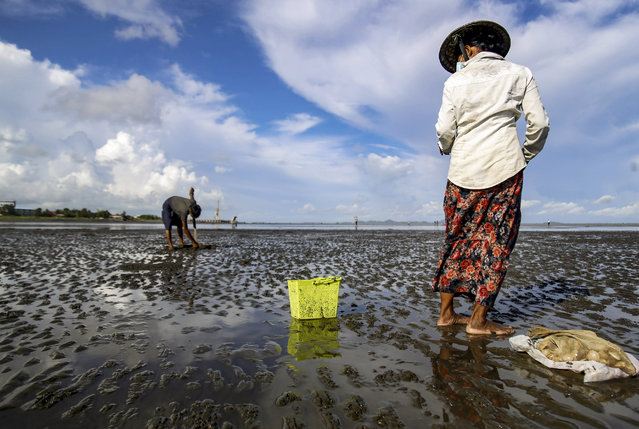
People search for shells on a beach in Sittwe, Rakhine State, Myanmar, 17 September 2020. International Coastal Cleanup Day is observed annually on the third Saturday of September and will occur on 19 September this year. The day was established to encourage global efforts to clean up garbage on beaches and coastal areas and raise awareness on protecting the world's oceans and waterways. According to a report released by the US-based nonprofit environmental advocacy group Ocean Conservancy on 08 September 2020, plastic food packaging topped the list of most common items found in beach trash. Close to five million food wrappers were collected in a single day during the International Coastal Cleanup Day in 2019. An approximate 11 million metric tons of plastic enters the ocean every year according to a 2016 analysis, affecting more than 800 marine species and causing contamination to human food chains and drinking water. (Photo by Nyunt Win/EPA/EFE/Rex Features/Shutterstock)

People search for shells on a beach in Sittwe, Rakhine State, Myanmar, 17 September 2020. International Coastal Cleanup Day is observed annually on the third Saturday of September and will occur on 19 September this year. (Photo by Nyunt Win/EPA/EFE/Rex Features/Shutterstock)
Details
24 Oct 2020 00:05:00
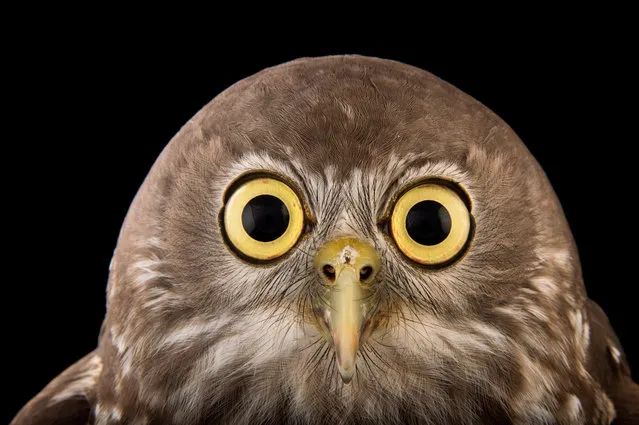
The National Geographic Photo Ark is a travelling exhibition of photographer Joel Sartore’s quest to create a photo archive of biodiversity around the world. So far, Sartore has captured studio portraits of more than 6,000 species – a number that he hopes to double. On 1 July, the ark will open at Melbourne zoo – the first time it has been exhibited in the southern hemisphere. More than 50 portraits will be on display, including many of Australian endangered animals being protected by programs at the zoo itself. These captions have been edited from text supplied by Melbourne zoo. Here: Barking owl. So-named because its call sounds like a barking dog, these birds are native to Australia, Indonesia and Papua New Guinea. In Victoria they are listed as an endangered species, and in 2003 there were estimated to be fewer than 50 breeding pairs. The main threat to the species in Victoria is loss of habitat, especially large trees with hollows in which they can nest and on which many of their prey depend. Apart from a bark, they may utter a chilling scream when they feel threatened. (Photo by Joel Sartore/National Geographic Photo Ark/The Guardian)

The National Geographic Photo Ark is a travelling exhibition of photographer Joel Sartore’s quest to create a photo archive of biodiversity around the world. So far, Sartore has captured studio portraits of more than 6,000 species – a number that he hopes to double. On 1 July, the ark will open at Melbourne zoo – the first time it has been exhibited in the southern hemisphere. More than 50 portraits will be on display, including many of Australian endangered animals being protected by programs at the zoo itself. These captions have been edited from text supplied by Melbourne zoo. Here: Barking owl. (Photo by Joel Sartore/National Geographic Photo Ark/The Guardian)
Details
01 Jul 2017 07:45:00
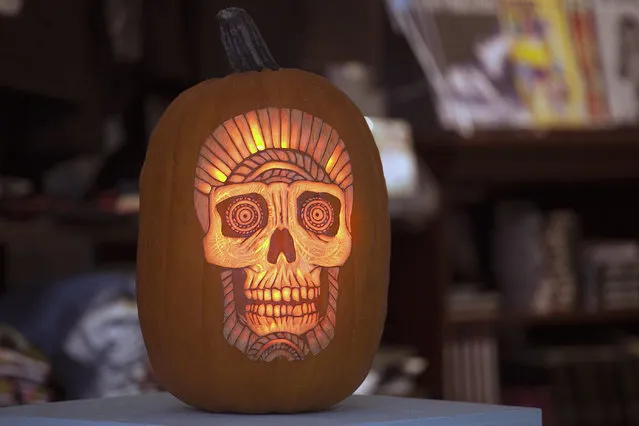
A Tara BONETHROWER pumpkin created by the Maniac Pumpkin Carvers at Cotton Candy Machine in Brooklyn, N.Y. on October 18, 2014. (Photo by Siemond Chan/Yahoo Finance)


In time for Halloween the Maniac Pumpkin Carvers, creative art studio, held the Cotton Candy Machine workshop in Brooklyn, N.Y., demonstrating techniques and tools to create intricate pumpkin art. Maniac Pumpkin Carvers, which focuses on elevating the art of pumpkin carving, were a past winner of the Food Network's Halloween Wars. Their work has been displayed at MOMA, the Whitney Museum and Yankee Stadium. Here: A Tara Bonethrower pumpkin created by the Maniac Pumpkin Carvers at Cotton Candy Machine in Brooklyn, N.Y. on October 18, 2014. (Photo by Siemond Chan/Yahoo Finance)
Details
22 Oct 2014 14:08:00
Participants take part in the world's first “Pokemon Go” competition in Hong Kong, China, August 6, 2016. (Photo by Tyrone Siu/Reuters)

Participants take part in the world's first “Pokemon Go” competition in Hong Kong, China, August 6, 2016. The competition began around 2 in the afternoon local time when organizers began announcing the rules on their Facebook page. Contestants had to take screenshots of 12 specific Pokémon in three different districts. Apart from the 12 key Pokémon, participants could also catch designated rare Pokemons which would take off some minutes from their total time. The winner was 21 year old Frankie Chu. The champ took home roughly three hundred and eighty six dollars that he says he will use to pay his school fees. (Photo by Tyrone Siu/Reuters)
Details
07 Aug 2016 09:05:00
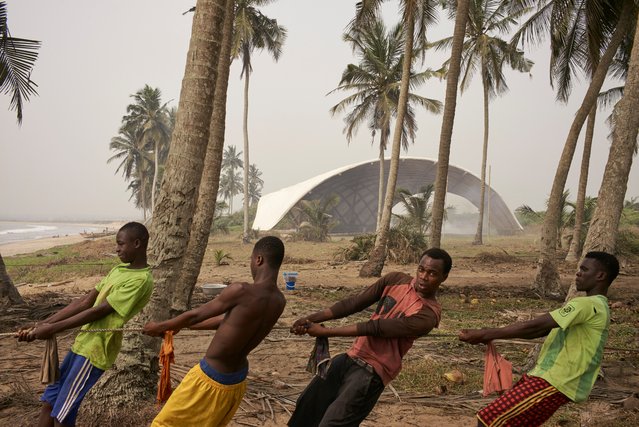
The stage for Haduwa Arts & Culture Institute, Ghana. Architect: (applied) Foreign Affairs. Nominated in the Sense of Place category. The open-air auditorium of this arts institute in Apam, Ghana, is built from ultra-strong curved bamboo. (Photo by Julien Lanoo)

The Arcaid awards highlight the best architectural photographs of the year – pictures of everything from giant arenas to tiny huts. The shortlisted photographs will be exhibited at the World Architecture Festival in Berlin, from 16 to 18 November, with an overall winner announced during the event’s gala dinner. Here: The stage for Haduwa Arts & Culture Institute, Ghana. Architect: (applied) Foreign Affairs. Nominated in the Sense of Place category. The open-air auditorium of this arts institute in Apam, Ghana, is built from ultra-strong curved bamboo. (Photo by Julien Lanoo)
Details
16 Nov 2016 11:03:00