Loading...
Done
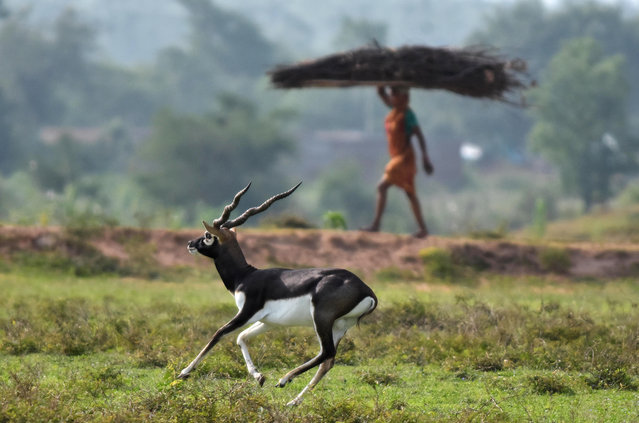
A villager carries wood while a blackbuck runs on a field near Bhetnoi village in Ganjam District, in the Indian eastearn state of Odisha on May 20, 2018. Villagers of Ganjam district due to their traditional religious belief consider blackbucks as incarnations of Lord Vishnu and harbingers of rain. (Photo by Asit Kumar/AFP Photo)

A villager carries wood while a blackbuck runs on a field near Bhetnoi village in Ganjam District, in the Indian eastearn state of Odisha on May 20, 2018. Villagers of Ganjam district due to their traditional religious belief consider blackbucks as incarnations of Lord Vishnu and harbingers of rain. (Photo by Asit Kumar/AFP Photo)
Details
22 May 2018 00:03:00
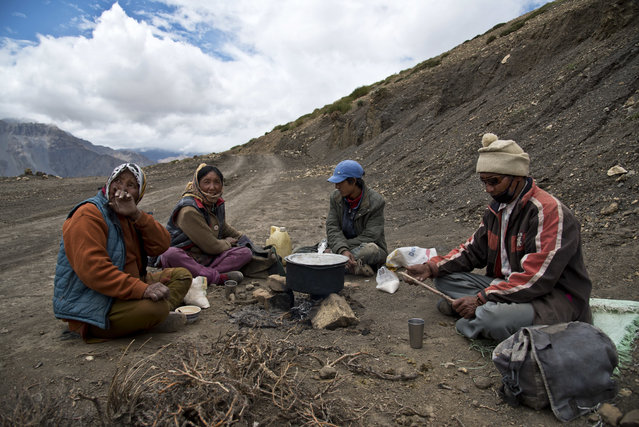
In this August 17, 2016, photo, from left to right, Chhering Chodom, 60, Tashi Yangzom, 50, Lobsang Chhering, 27, and Dorje Tandup, 58, drink milk tea on the side of the road. For centuries, the sleepy valley nestled in the Indian Himalayas remained a hidden Buddhist enclave forbidden to outsiders. Enduring the harsh year-round conditions of the high mountain desert, the people of Spiti Valley lived by a simple communal code – share the Earth's bounty, be hospitable to neighbors, and eschew greed and temptation at all turns. That's all starting to change, for better or worse. Since India began allowing its own citizens as well as outsiders to visit the valley in the early 1990s, tourism and trade have boomed. And the marks of modernization, such as solar panels, asphalt roads and concrete buildings, have begun to appear around some of the villages that dot the remote landscape at altitudes above 4,000 meters (13,000 feet). (Photo by Thomas Cytrynowicz/AP Photo)

In this August 17, 2016, photo, from left to right, Chhering Chodom, 60, Tashi Yangzom, 50, Lobsang Chhering, 27, and Dorje Tandup, 58, drink milk tea on the side of the road. For centuries, the sleepy valley nestled in the Indian Himalayas remained a hidden Buddhist enclave forbidden to outsiders. Enduring the harsh year-round conditions of the high mountain desert, the people of Spiti Valley lived by a simple communal code – share the Earth's bounty, be hospitable to neighbors, and eschew greed and temptation at all turns. That's all starting to change, for better or worse. (Photo by Thomas Cytrynowicz/AP Photo)
Details
15 Sep 2016 09:22:00
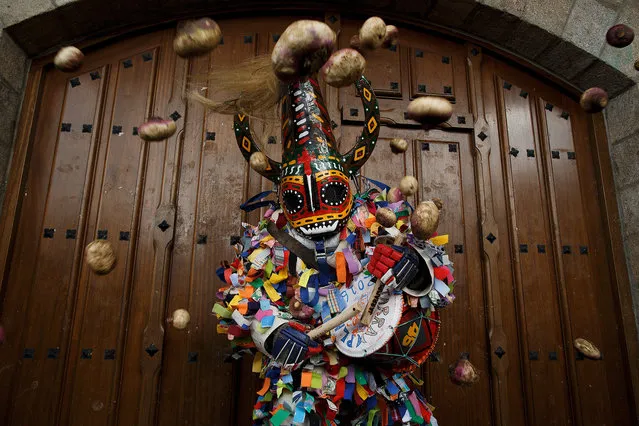
People throw turnips at the Jarramplas as he comes out from the church beating his drum during the Jarramplas Festival on January 20, 2016 in Piornal, Caceres province, Spain. The centuries old Jarramplas festival takes place annually every January 19-20 on Saint Sebastian Day and this year they expect to use more than 20 thousand kilogrames of turnips. Even though the exact origins of the festival are not known, various theories exist including the mythological punishment of Caco by Hercules. (Photo by Pablo Blazquez Dominguez/Getty Images)

People throw turnips at the Jarramplas as he comes out from the church beating his drum during the Jarramplas Festival on January 20, 2016 in Piornal, Caceres province, Spain. The centuries old Jarramplas festival takes place annually every January 19-20 on Saint Sebastian Day and this year they expect to use more than 20 thousand kilogrames of turnips. Even though the exact origins of the festival are not known, various theories exist including the mythological punishment of Caco by Hercules, a relation to ceremonies celebrated by the American Indians that were seen by the first conquerors, to a cattle thief ridiculed and expelled by his village neighbours. It is generally believed to symbolize the expulsion of everything bad. (Photo by Pablo Blazquez Dominguez/Getty Images)
Details
21 Jan 2016 13:21:00
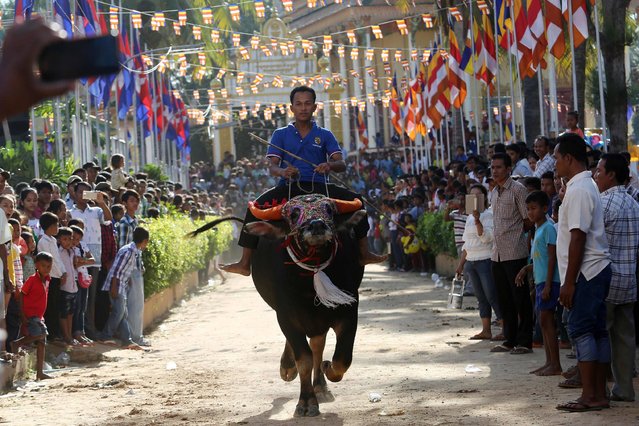
A Cambodian villager rides a buffalo during the Pchum Ben festival, the festival of death, at Vihear Suor village in Kandal province on October 1, 2016. Thousands of Cambodians descended on the small village northeast of the capital on October 1 to cheer on the annual water buffalo race that marks the end of the 15-day festival for the dead. (Photo by Chor Sokunthea/AFP Photo)

A Cambodian villager rides a buffalo during the Pchum Ben festival, the festival of death, at Vihear Suor village in Kandal province on October 1, 2016. Thousands of Cambodians descended on the small village northeast of the capital on October 1 to cheer on the annual water buffalo race that marks the end of the 15-day festival for the dead. (Photo by Chor Sokunthea/AFP Photo)
Details
03 Oct 2016 09:25:00
Carnival revellers dressed as “Peliqueiros” run along a street in the village of Laza, Spain February 11, 2018. “Peliqueiros”, or ancient tax collectors, pursued villagers through the streets ringing their cowbells and hitting villagers with their sticks. (Photo by Miguel Vidal/Reuters)

Carnival revellers dressed as “Peliqueiros” run along a street in the village of Laza, Spain February 11, 2018. “Peliqueiros”, or ancient tax collectors, pursued villagers through the streets ringing their cowbells and hitting villagers with their sticks. (Photo by Miguel Vidal/Reuters)
Details
12 Feb 2018 07:41:00
This picture taken on February 16, 2017 in Fangshan village in China's coastal province Fujians, shows a villager performing the “eating flowers” ritual. Villagers in eastern China have a unique way of washing away the taint of evil spirits – by bathing in a shower of scorching sparks. (Photo by Johannes Eisele/AFP Photo)

This picture taken on February 16, 2017 in Fangshan village in China's coastal province Fujians, shows a villager performing the “eating flowers” ritual. Villagers in eastern China have a unique way of washing away the taint of evil spirits – by bathing in a shower of scorching sparks. (Photo by Johannes Eisele/AFP Photo)
Details
19 Feb 2017 09:55:00
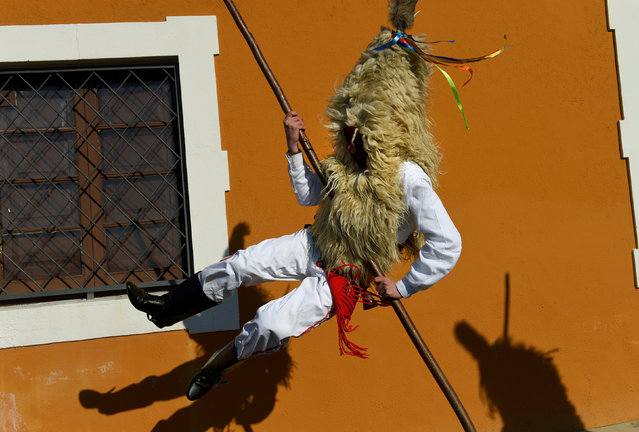
A villager jumps during “Los Sidros y Las Comedias”, a traditional festival in Spain's northern village of Valdesoto, January 8, 2017. (Photo by Eloy Alonso/Reuters)

A villager jumps during “Los Sidros y Las Comedias”, a traditional festival in Spain's northern village of Valdesoto, January 8, 2017. (Photo by Eloy Alonso/Reuters)
Details
10 Jan 2017 13:31:00
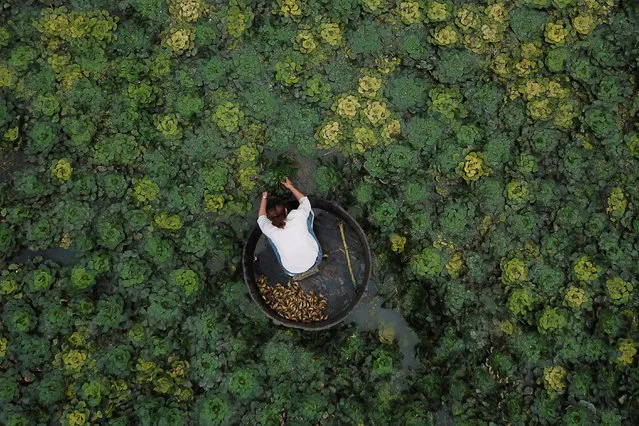
A villager harvests water chestnuts in Feijiadai Village, Zhejiang Province, China on September 20, 2019. (Photo by Huang Zongzhi/Xinhua News Agency/Barcroft Media)

A villager harvests water chestnuts in Feijiadai Village, Zhejiang Province, China on September 20, 2019. (Photo by Huang Zongzhi/Xinhua News Agency/Barcroft Media)
Details
01 Nov 2019 00:01:00