Loading...
Done
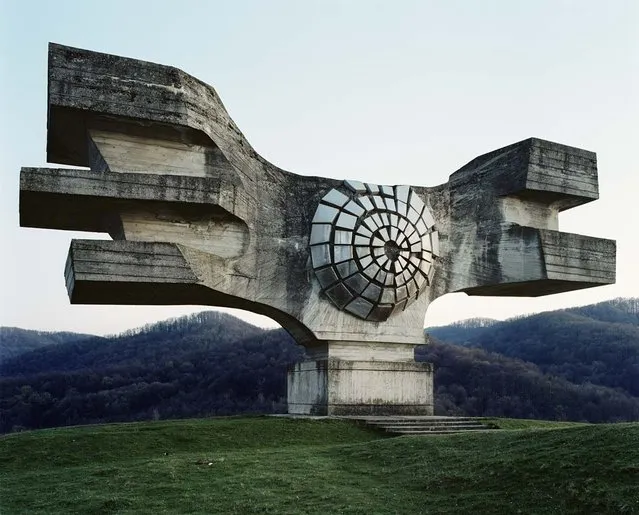
The monument of Ilirska Bistrica was designed by Janez Lenassi and built in 1965. It is dedicated to Slovenian soldiers that fell in World War II. (Photo by Jan Kempenaers)

The brutalist war memorials found throughout the former Yugoslavia were weird enough when they were built in the 1960s and 70s. Today, separated by the end of an architectural movement and the disintegration of the country, they seem almost alien. Belgian photographer Jan Kempenaers treats them purely as artistic objects in his book, “Spomenik”, named for the Serb-Croat word for monument. Known for photographing geographical oddities, Kempenaers was captivated by the spomenik after seeing them in an art encyclopedia. After hearing that many had been destroyed or abandoned, he set out to record what was left. (Photo by Jan Kempenaers)
Details
18 Aug 2014 09:07:00
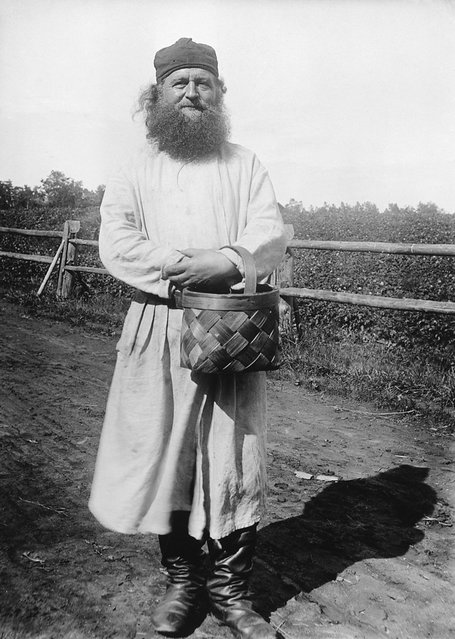
Priest, Valamo Monastery, Karelia, Russia (then Finland), 1930s. Father Venerius with a birchbark basket. (Photo by Einar Erici)

“Einar Erici (1885–1965) was a physician by profession, working at a tuberculosis hospital in Stockholm, even running a private medical practice. He was by then the most renowned Swedish expert of church organs and organ builders, and his archival collection is today held by the Swedish National Heritage Board. This archive includes mostly writings, such as letters and manuscripts for published articles and essays, but also more than 2 000 black and white photos – original prints, glass plates and film negatives”. – Swedish National Heritage Board

Photo: Priest, Valamo Monastery, Karelia, Russia (then Finland), 1930s. Father Venerius with a birchbark basket. (Photo by Einar Erici)
Details
09 Dec 2012 11:41:00
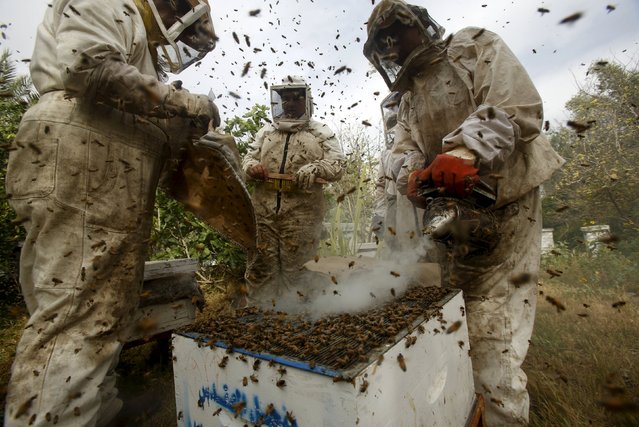
A Palestinian beekeeper uses smoke to calm bees in the process of collecting honey at a farm in Rafah, in the southern Gaza Strip April 11, 2016. (Photo by Suhaib Salem/Reuters)

A Palestinian beekeeper uses smoke to calm bees in the process of collecting honey at a farm in Rafah, in the southern Gaza Strip April 11, 2016. Rateb Samour sees 250 patients a day, whose complaints range from hair loss to cerebral palsy and cancer. He is not a doctor and has never worked in a hospital. Samour inherited the skill of bee-sting therapy from his father. From 2003 the agricultural engineer dedicated all his time to study and develop the alternative-medicine treatment of apitherapy, which uses bee-related products from honey, propolis – or bee glue used to build hives – to venom. (Photo by Suhaib Salem/Reuters)
Details
13 Apr 2016 09:14:00
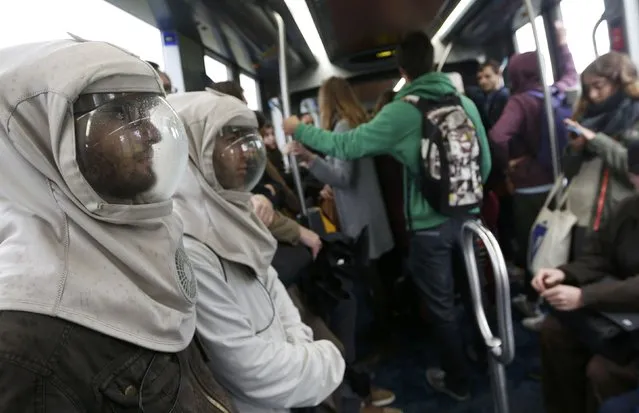
French twins Thomas and Vincent (L) Seris take the tram in Bordeaux, November 12, 2014. Born with Xeroderma Pigmentosum (XP), the twins cannot be exposed to the sun and its ultraviolet (UV) light, which could provoke precocious cancers due to an autosomal recessive genetic disorder of DNA repair. (Photo by Regis Duvignau/Reuters)

French twins Thomas and Vincent (L) Seris take the tram in Bordeaux, November 12, 2014. Born with Xeroderma Pigmentosum (XP), the twins cannot be exposed to the sun and its ultraviolet (UV) light, which could provoke precocious cancers due to an autosomal recessive genetic disorder of DNA repair. Colloquially referred to as Children of the Night (Les Enfants de la Lune) the Seris twins are among 70 to 80 people in France who suffer from the genetic defect. The French association “Les Enfants de la Lune” reports that there are between five and ten thousand such cases in the world. Thomas and Vincent have been testing a new protective mask for the last year which is transparent and ventilated and developed by several hospitals in France. (Photo by Regis Duvignau/Reuters)
Details
01 Feb 2015 10:27:00
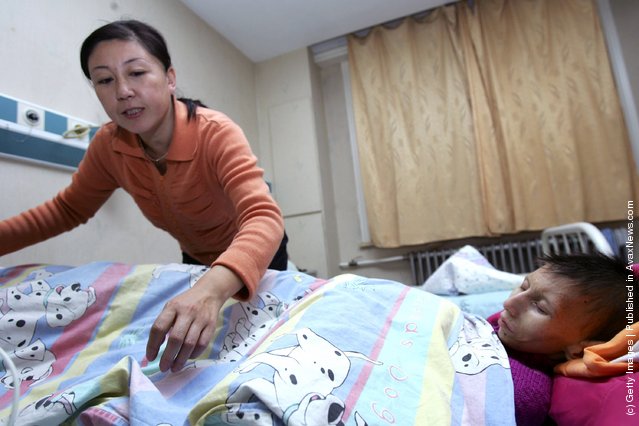
12-year-old Chinese girl Sun Yangyang suffering from Cockayne syndrome

“Cockayne syndrome (also called Weber-Cockayne syndrome, or Neill-Dingwall Syndrome) is a rare autosomal recessive congenital disorder characterized by growth failure, impaired development of the nervous system, abnormal sensitivity to sunlight (photosensitivity), and premature aging. Hearing loss and eye abnormalities (pigmentary retinopathy) are other common features, but problems with any or all of the internal organs are possible. It is associated with a group of disorders called leukodystrophies. The underlying disorder is a defect in a DNA repair mechanism. It is named after English physician Edward Alfred Cockayne (1880–1956)”. – Wikipedia

Photo: Mother of 12-year-old Chinese girl Sun Yangyang suffering from Cockayne syndrome, tends her at the First Affiliated Hospital of Jilin University on November 11, 2006 in Changchun of Jilin Province, China. The disease results in the senile appearance of Yangyang and also causes eyesight, hearing weakness and other problems. Doctors failed to cure the girl... (Photo by China Photos/Getty Images)
Details
08 Aug 2011 11:17:00
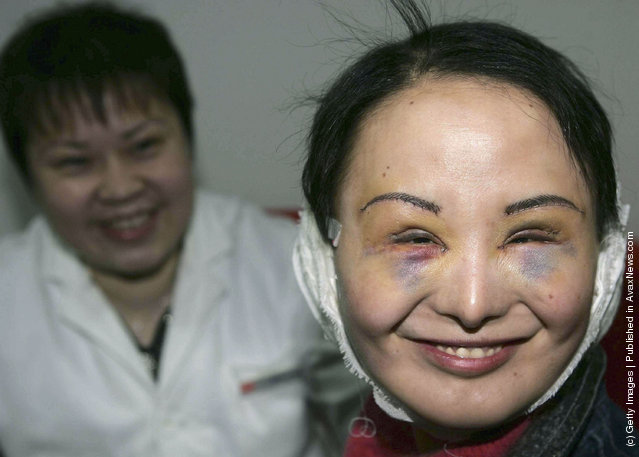
Ugly Girl

Chinese woman Zhang Jing, known as the “Ugly Girl” smiles after doctors removed the stitches from her fourth session of cosmetic surgery at a hospital on March 23, 2005 in Shanghai, China. Zhang Jing, 26 years old, from Tianjin Municipality, was forced to leave school because her classmates sneered at her appearance during her teenage years. After leaving junior high school, Zhang found herself still unacceptable by society, she struggled to look for a job, but was turned down by one thousand job applications in ten years. Zhang's story was widely reported by the media in 2003, this helped her find a job and get three chances of free plastic surgery. (Photo by China Photos/Getty Images)
Details
31 Aug 2011 10:11:00
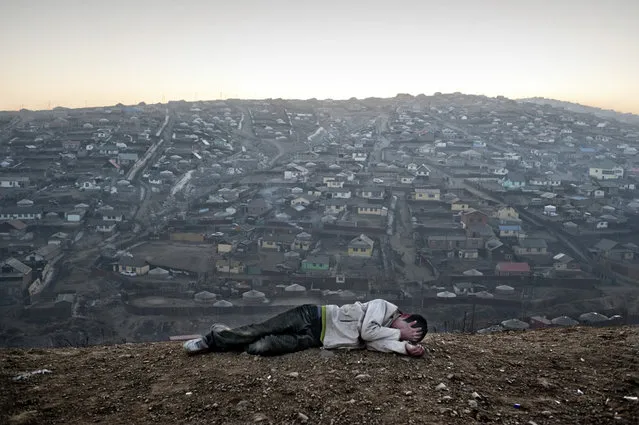
Asia, Mongolia, March 27, 2011. A view of Ulaan Baator over the shoulder of a slumbering drunk. Alcoholism is a huge problem in the city, home to almost half of Mongolia's people. The capital's population has doubled in the past two years, expanding outward in a haphazard sprawl, and many inhabitants live in slums known as the “Gher District”. (Photo by Alessandro Grassani)

“Environmental Migrants: The Last Illusion” by photographer Alessandro Grassani, documents the life of people in Kenya, Mongolia and Bangladesh who migrate to escape environmental stresses to the city of their own countries in hopes for a better life. Here: Asia, Mongolia, March 27, 2011. A view of Ulaan Baator over the shoulder of a slumbering drunk. Alcoholism is a huge problem in the city, home to almost half of Mongolia's people. The capital's population has doubled in the past two years. High levels of unemployment and poverty await herders who abandon rural areas and arrive in the city, illiterate and untrained in any skills necessary for urban jobs. (Photo by Alessandro Grassani)
Details
21 Jul 2015 10:10:00
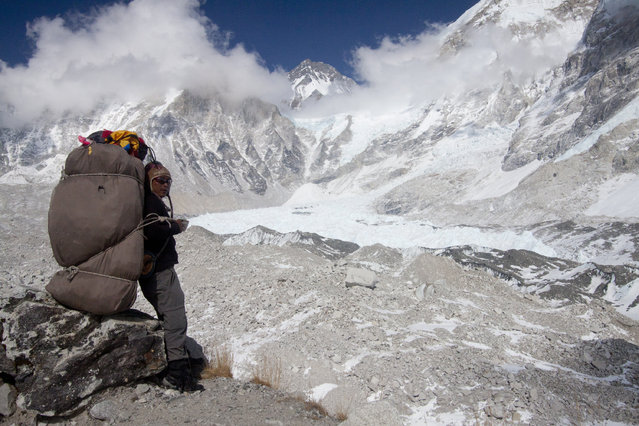
In this  Saturday, March 21, 2015 photo, a porter rests carrying supplies for the upcoming climbing season, near the Everest Base camp, Nepal. (Photo by Tashi Sherpa/AP Photo)

In this Saturday, March 21, 2015 photo, a porter rests carrying supplies for the upcoming climbing season, near the Everest Base camp, Nepal. Nepal has cleared more than 300 mountaineers to climb Mount Everest after they had to abandon last year's efforts when an ice avalanche killed 16 guides in the mountain's deadliest disaster, an official said on March 20. The three-month climbing season for Everest, the world's tallest mountain, begins in March. (Photo by Tashi Sherpa/AP Photo)
Details
29 Mar 2015 12:16:00