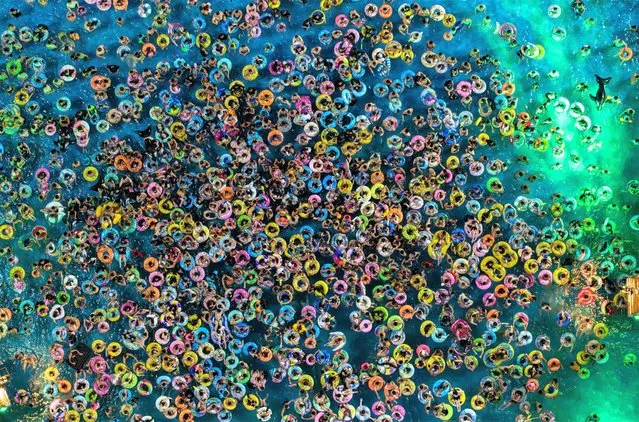
People are cooling off at a water park in Nanjing, East China's Jiangsu province, on July 8, 2023. (Photo by Costfoto/NurPhoto/Rex Features/Shutterstock)
“Pivo”, Nissan's concept car is introduced at Nissan's Gallery on September 30, 2005 in Tokyo, Japan. “Pivo” is an electric car in which the direction of the cabin moves 180 degrees, therefore, when making a turn in a different direction, it simply needs to move the cabin without moving the car. (Photo by Koichi Kamoshida/Getty Images)
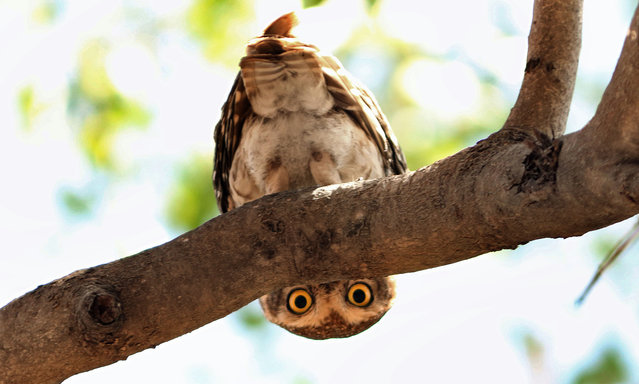
A spotted owlet appears to be playing peek-a-boo near Rancharda Lake in Ahmedabad, India on February 9, 2016. The species is common across the Indian subcontinent. (Photo by Caters News Agency)
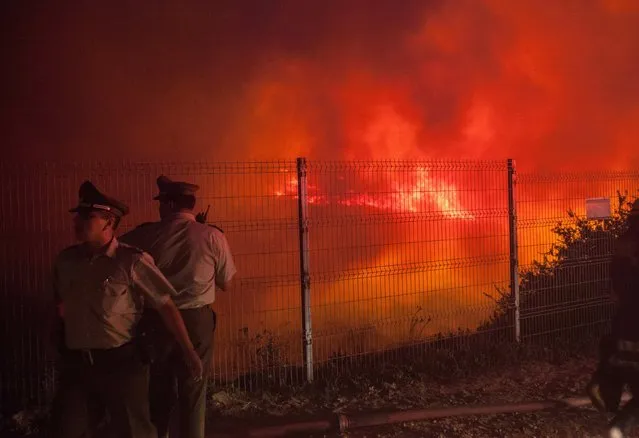
Police officers standby while a forest fire burns the hills of Valparaiso city, northwest of Santiago, March 13, 2015. Several hectares of land has been burned due to forest fires near Valparaiso city, with no report of deaths or injuries, local authorities said. (Photo by Lucas Galvez/Reuters)
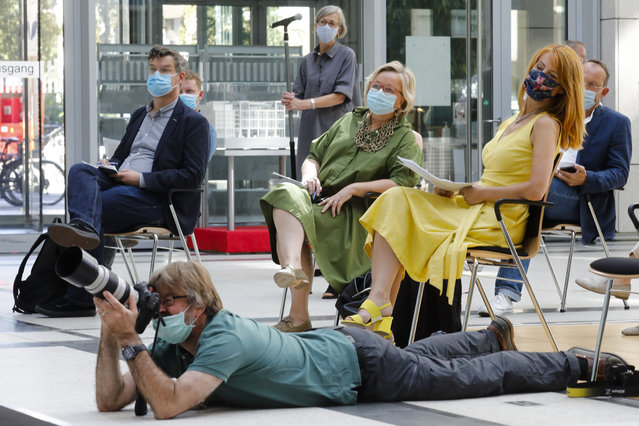
Journalists wear face mask and keep distance as they attend news conference by German Health Minister Jens Spahn about the developing of the coronavirus crisis test strategy in Berlin, Germany, Thursday, August 6, 2020. (Photo by Markus Schreiber/AP Photo)
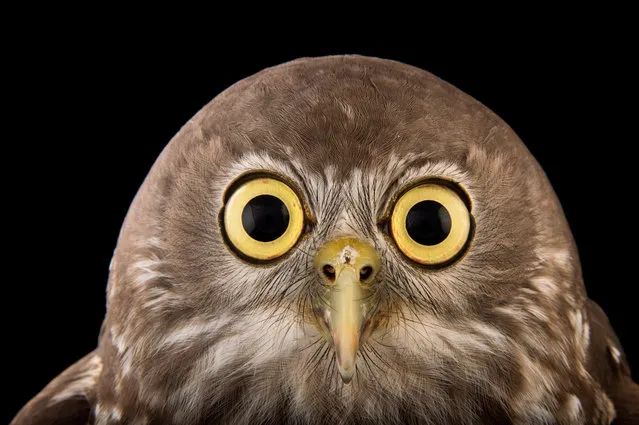
The National Geographic Photo Ark is a travelling exhibition of photographer Joel Sartore’s quest to create a photo archive of biodiversity around the world. So far, Sartore has captured studio portraits of more than 6,000 species – a number that he hopes to double. On 1 July, the ark will open at Melbourne zoo – the first time it has been exhibited in the southern hemisphere. More than 50 portraits will be on display, including many of Australian endangered animals being protected by programs at the zoo itself. These captions have been edited from text supplied by Melbourne zoo. Here: Barking owl. (Photo by Joel Sartore/National Geographic Photo Ark/The Guardian)