Loading...
Done
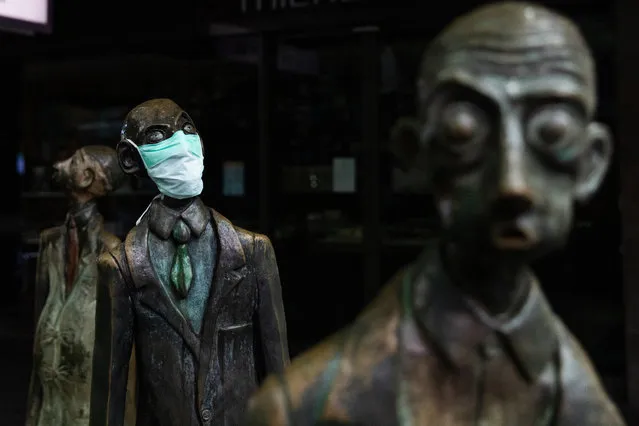
A face mask is placed on one of the 'Three business men who brought lunch' statues on Swanston street on March 29, 2020 in Melbourne, Australia. All international arrivals into Australia from midnight on Saturday will be placed into mandatory quarantine in hotels for 14 days as the Federal Government increases restrictions to stop the spread of COVID-19. All libraries, museums, galleries, beauty salons, tattoo parlours, shopping centre food courts, auctions, open houses, amusement parks, arcades, indoor and outdoor play centres, swimming pools are closed and indoor exercise activities are now banned. This is in addition to the closure of bars, pubs and nightclubs which came into effect on Monday. Restaurants and cafes are restricted to providing takeaway only. Weddings will now be restricted to five people including the couple while funerals are limited to 10 mourners. All Australians are now expected to stay at home except for essential outings such as work, grocery shopping and medical appointments. Exercising outdoors alone is still permitted. Australia now has more than 3,600 confirmed cases of COVID-19 while the death toll now stands at 16. (Photo by Asanka Ratnayake/Getty Images)

A face mask is placed on one of the 'Three business men who brought lunch' statues on Swanston street on March 29, 2020 in Melbourne, Australia. All international arrivals into Australia from midnight on Saturday will be placed into mandatory quarantine in hotels for 14 days as the Federal Government increases restrictions to stop the spread of COVID-19. (Photo by Asanka Ratnayake/Getty Images)
Details
31 Mar 2020 00:07:00
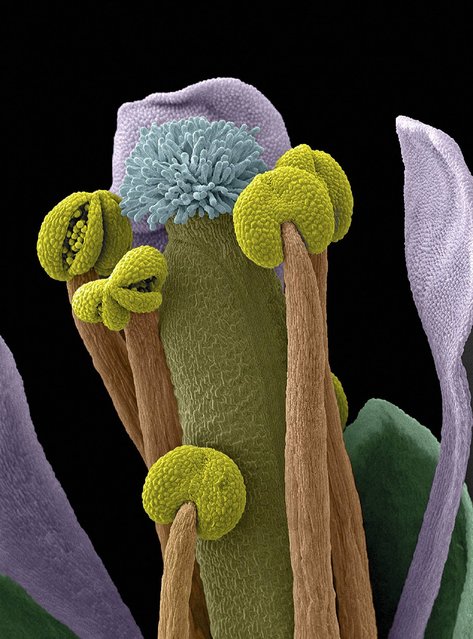
Scanning electron micrograph (SEM) of an Arabidopsis thaliana flower, also commonly known as thale cress. Some of the anthers are open, revealing pollen grains ready for dispersal. Arabidopsis was the first plant to have its entire genome sequenced and is widely used as a model organism in molecular and plant biology. Horizontal width of image is 1200 microns. Magnification 100x. (Photo by Stefan Eberhard/Wellcome Images)

Beautiful, strange and occasionally alarming pictures from the shortlist for this year’s Wellcome image awards – which celebrate the very best in science photography and imaging – from an x-ray of a bat to a micrograph of a kidney stone. The exhibition opens on 12 March at three science centres and the Museum of Science and Industry in Manchester. Photo: Scanning electron micrograph (SEM) of an Arabidopsis thaliana flower, also commonly known as thale cress. Some of the anthers are open, revealing pollen grains ready for dispersal. Arabidopsis was the first plant to have its entire genome sequenced and is widely used as a model organism in molecular and plant biology. Horizontal width of image is 1200 microns. Magnification 100x. (Photo by Stefan Eberhard/Wellcome Images)
Details
11 Mar 2014 05:58:00
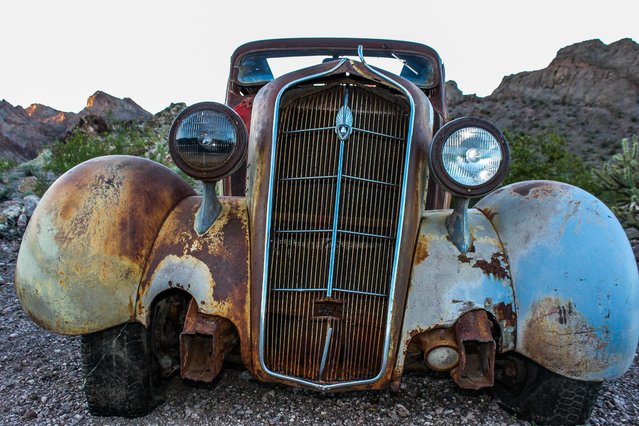
Images of an American ghost town that was home to gold mines and features a plane which crashed during the filming of 3000 Miles to Graceland starring Kevin Costner and Kurt Russell reveal the remnants of the once thriving location. An assortment of rusted vehicles which include a canary yellow bus, caravans and cars have all been left behind in the desert. Other pictures of Nelson, Nevada show its desolate surroundings with only a couple of houses and museums scattered around the area. In one shot, a derelict petrol pump stands still after making its final sale years ago. The stunning photographs were taken by an American photographer known as Abandoned Southeast on a visit to Nelson, Nevada. The area was called Eldorado by the Spaniards who made the original discoveries of gold in the town. The notorious Techatticup gold and silver mine which was associated with crime and murders ran in the area from 1861 to 1942. It was the richest mine in Southern Nevada. (Photo by Abandoned Southeast/Mediadrumworld.com)

Images of an American ghost town that was home to gold mines and features a plane which crashed during the filming of 3000 Miles to Graceland starring Kevin Costner and Kurt Russell reveal the remnants of the once thriving location. An assortment of rusted vehicles which include a canary yellow bus, caravans and cars have all been left behind in the desert. (Photo by Abandoned Southeast/Mediadrumworld.com)
Details
25 Dec 2016 09:25:00
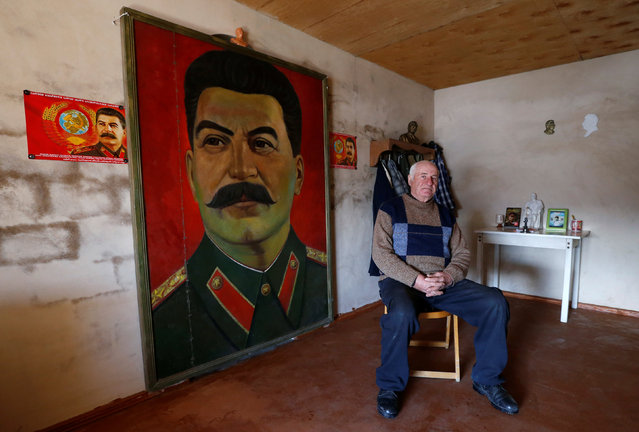
Retired builder Vasili Sidamonidze, 70, poses for a portrait at his home in Gori, Georgia, December 6, 2016. “Unfortunately, Stalin is not popular nowadays. Our people don't respect him. Only we, members of the (Communist) Party, respect him”, Sidamonidze said. “I always try to attend Stalin's birthday anniversaries in Gori. Unfortunately many people don't want to join us even if they live nearby. They look at us from their windows”. Stalin, who was born in Gori in 1878 and died in 1953, is largely reviled today in Georgia, which regained its independence during the 1991 collapse of the Soviet Union. Over the years, his memorials have been dismantled, most recently in 2010 when authorities removed a statue of the dictator from Gori's central square. But Stalin is still revered by a small group of mainly elderly supporters who stress his role in the industrialisation of the Soviet Union and in defeating Nazi Germany in World War Two. Each Dec. 21, a few dozen people mark his birthday by gathering outside a Gori museum dedicated to Stalin, where they make speeches and walk to the square where a 6-meter-high bronze statue of him once stood, calling for it to be reinstated. Opponents say it was a symbol of Moscow's still lingering shadow. In 2008, Russia fought a brief war with Georgia and recognised its breakaway regions of Abkhazia and South Ossetia as independent states. (Photo by David Mdzinarishvili/Reuters)

Retired builder Vasili Sidamonidze, 70, poses for a portrait at his home in Gori, Georgia, December 6, 2016. “Unfortunately, Stalin is not popular nowadays. Our people don't respect him. Only we, members of the (Communist) Party, respect him”, Sidamonidze said. “I always try to attend Stalin's birthday anniversaries in Gori. Unfortunately many people don't want to join us even if they live nearby. They look at us from their windows”. (Photo by David Mdzinarishvili/Reuters)
Details
17 Dec 2016 07:59:00
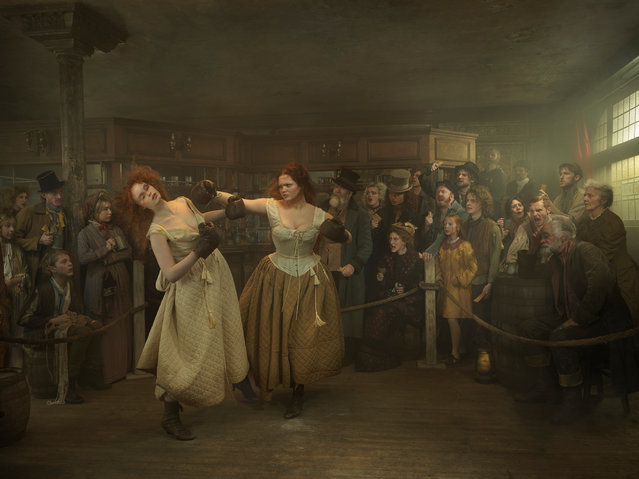
«Female Boxers», 2024. Julia Fullerton-Batten is a fine art photographer renowned for her cinematic visual storytelling. Her large-scale projects are based around specific themes, each image embellishing her subject matter in a series of thought-provoking “stories” using staged tableaux and sophisticated lighting techniques. (Photo by Julia Fullerton-Batten)

«Female Boxers», 2024. Julia Fullerton-Batten is a fine art photographer renowned for her cinematic visual storytelling. Her large-scale projects are based around specific themes, each image embellishing her subject matter in a series of thought-provoking “stories” using staged tableaux and sophisticated lighting techniques. (Photo by Julia Fullerton-Batten)
Details
25 May 2025 03:42:00
Russia's Maria Sharapova carries the torch during the opening ceremony of the 2014 Winter Olympics in Sochi, Russia, Friday, February 7, 2014. (Photo by Matt Dunham/Associated Press)

Russia's Maria Sharapova carries the torch during the opening ceremony of the 2014 Winter Olympics in Sochi, Russia, Friday, February 7, 2014. (Photo by Matt Dunham/Associated Press)
Details
08 Feb 2014 15:10:00
A visitor holds an Israeli-made rifle during the 8th International Land and Naval Defense system exhibition, in New Delhi, India, on February 6, 2014. (Photo by Anindito Mukherjee/Reuters)

A visitor holds an Israeli-made rifle during the 8th International Land and Naval Defense system exhibition, in New Delhi, India, on February 6, 2014. (Photo by Anindito Mukherjee/Reuters)
Details
08 Feb 2014 15:38:00
In this Sunday, June 27, 2010 file photo two men compete in an ostrich race at Highgate ostrich farm in Oudtshoorn, South Africa. Clambering onto an ostrich for a ride used to be popular among tourists in a South African town of  Oudtshoorn known of  as the  “ostrich capital of the world”. Not so much anymore. Two major ostrich farms in Oudtshoorn have stopped offering ostrich rides to tourists, responding to concerns about the birds’ welfare. A third farm is sticking with the feature, saying it is regulated and that ostriches do not experience discomfort.. The Highgate farm, however, continues to offer ostrich rides. (Photo by Shuji Kajiyama/AP Photo)

In this Sunday, June 27, 2010 file photo two men compete in an ostrich race at Highgate ostrich farm in Oudtshoorn, South Africa. Clambering onto an ostrich for a ride used to be popular among tourists in a South African town of Oudtshoorn known of as the “ostrich capital of the world”. Not so much anymore. Two major ostrich farms in Oudtshoorn have stopped offering ostrich rides to tourists, responding to concerns about the birds’ welfare. A third farm is sticking with the feature, saying it is regulated and that ostriches do not experience discomfort. The Highgate farm, however, continues to offer ostrich rides. (Photo by Shuji Kajiyama/AP Photo)
Details
20 Jun 2017 07:23:00