Loading...
Done
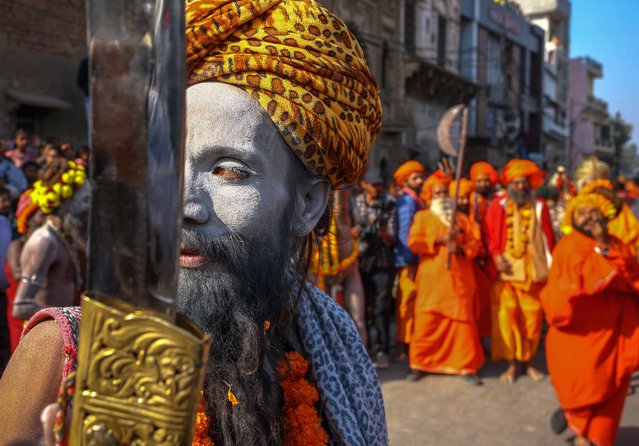
Sadhus take part in a religious roadshow ( Peshwai )  on December 14, 2024 in Allahabad, India. Kumbh Mela in 2025 is a Maha Kumbh, which is a significant Hindu festival celebrated once every 144 years at Prayagraj (Allahabad). Scheduled from January 13 to February 26, 2025, it attracts millions of devotees for ritual bathing at the confluence of the Ganges, Yamuna, and the mythical Saraswati rivers, marking a unique spiritual occasion with enhanced significance compared to regular Kumbh Mela. (Photo by Ritesh Shukla/Getty Images)

Sadhus take part in a religious roadshow (Peshwai) on December 14, 2024 in Allahabad, India. Kumbh Mela in 2025 is a Maha Kumbh, which is a significant Hindu festival celebrated once every 144 years at Prayagraj (Allahabad). Scheduled from January 13 to February 26, 2025, it attracts millions of devotees for ritual bathing at the confluence of the Ganges, Yamuna, and the mythical Saraswati rivers, marking a unique spiritual occasion with enhanced significance compared to regular Kumbh Mela. (Photo by Ritesh Shukla/Getty Images)
Details
26 Dec 2024 01:40:00
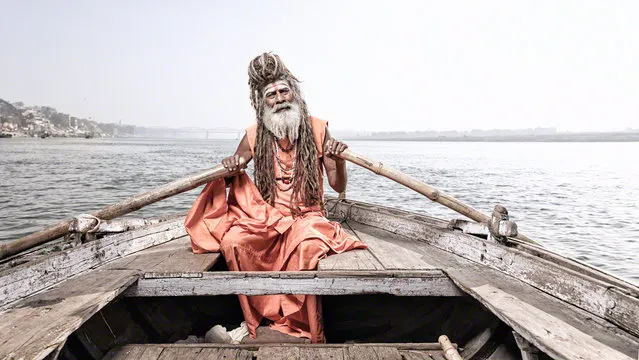
Varanasi: India's City of Death and Life

Varanasi is a city on the banks of the Ganges in Uttar Pradesh, 320 kilometres (200 mi) southeast of the state capital, Lucknow. It is holiest of the seven sacred cities (Sapta Puri) in Hinduism and Jainism. Hindus believe that death at Varanasi brings salvation. It is one of the oldest continuously inhabited cities in the world and the oldest in India.
Details
02 May 2013 12:41:00
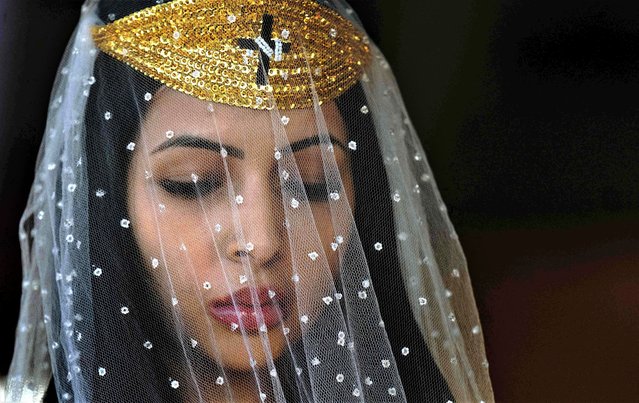
A Nymph or female devotee of the Vale do Amanhecer religious community, prays at their temple complex in Vale do Amanhecer (Sunrise Valley), a community on the outskirts of Planaltina, 50 km from the Brazilian capital, Brasilia, on April 29, 2023. This eclectic community holds its most important ritual of the year on Labour Day to honour the mediums who communicate with good and bad spirits. The group combines a range of religious practices, including Christian and Hindu, with symbols borrowed from the Incas and Mayans, as well as a belief in extraterrestrial life and intergalactic travel. The religion claims hundred temples throughout Brazil, Portugal and other countries. (Photo by Carl de Souza/AFP Photo)

A Nymph or female devotee of the Vale do Amanhecer religious community, prays at their temple complex in Vale do Amanhecer (Sunrise Valley), a community on the outskirts of Planaltina, 50 km from the Brazilian capital, Brasilia, on April 29, 2023. This eclectic community holds its most important ritual of the year on Labour Day to honour the mediums who communicate with good and bad spirits. The group combines a range of religious practices, including Christian and Hindu, with symbols borrowed from the Incas and Mayans, as well as a belief in extraterrestrial life and intergalactic travel. The religion claims hundred temples throughout Brazil, Portugal and other countries. (Photo by Carl de Souza/AFP Photo)
Details
08 Aug 2024 05:51:00
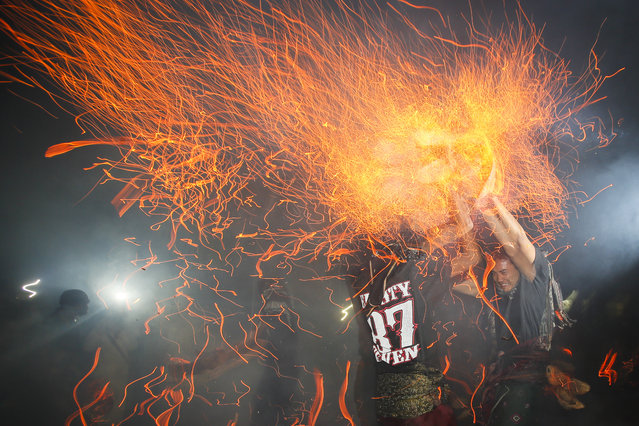
Balinese men throw fire on each other during a sacred ritual called “Mesabatan Api” or a fire fight at a temple in Tuban, Bali, Indonesia, 09 October 2014. October 9, 2014. (Photo by Made Nagi/EPA)

Balinese men throw fire on each other during a sacred ritual called “Mesabatan Api” or a fire fight at a temple in Tuban, Bali, Indonesia, 9 October 2014. October 9, 2014. During the ritual Balinese Hindu men took the blazing coconut husks barehanded, swinging and throwing them each other. Balinese believe that fire can destroy evil, and the ritual is aimed to get rid of the negative forces. (Photo by Made Nagi/EPA)
Details
12 Oct 2014 12:32:00
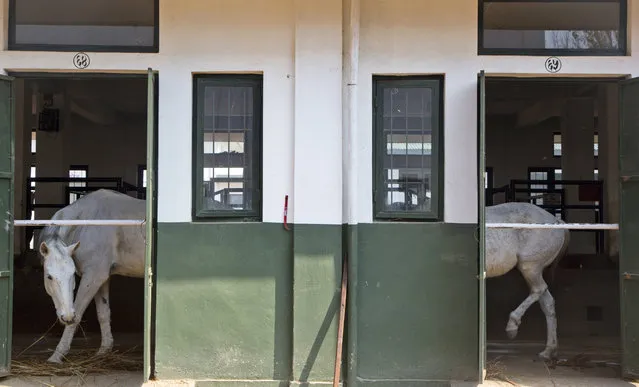
In this April 3, 2019, photo, horses from Nepal cavalry rest in a stable after morning practice for Ghode Jatra festival in Kathmandu, Nepal. (Photo by Niranjan Shrestha/AP Photo)

In this April 3, 2019, photo, horses from Nepal cavalry rest in a stable after morning practice for Ghode Jatra festival in Kathmandu, Nepal. The “Ghode Jatra” is an annual horse festival celebrated on the Nepal Cavalry grounds in Kathmandu, which marks the defeat of a Hindu demon. (Photo by Niranjan Shrestha/AP Photo)
Details
09 Apr 2019 00:03:00
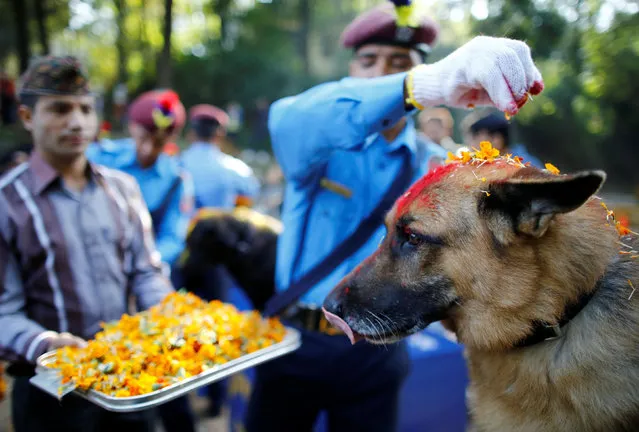
Nepalese police officers worship a dog during the dog festival as part of Tihar celebrations, also called Diwali, at the Central Police Dog Training School in Kathmandu, Nepal October 29, 2016. (Photo by Navesh Chitrakar/Reuters)

Nepalese police officers worship a dog during the dog festival as part of Tihar celebrations, also called Diwali, at the Central Police Dog Training School in Kathmandu, Nepal October 29, 2016. Dogs are worshipped to acknowledge their role in providing security during Tihar festival, one of the most important Hindu festivals that is also dedicated to the worship of the goddess of wealth Laxmi. (Photo by Navesh Chitrakar/Reuters)
Details
30 Oct 2016 11:20:00
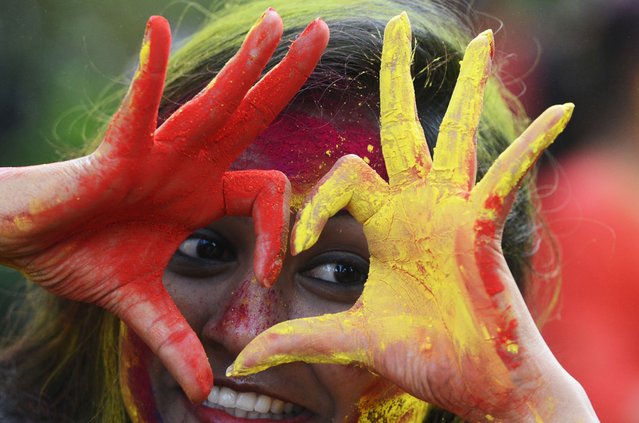
Indian students play with coloured powders as they celebrate “holi” or the “festival of colours” during a special function in Kolkata on March 12, 2017. (Photo by Dibyangshu Sarkar/AFP Photo)

Indian students play with coloured powders as they celebrate “holi” or the “festival of colours” during a special function in Kolkata on March 12, 2017. Holi, the popular Hindu spring festival of colours, is observed in India at the end of the winter season on the last full moon of the lunar month, and will be celebrated on March 13 this year. (Photo by Dibyangshu Sarkar/AFP Photo)
Details
14 Mar 2017 00:06:00
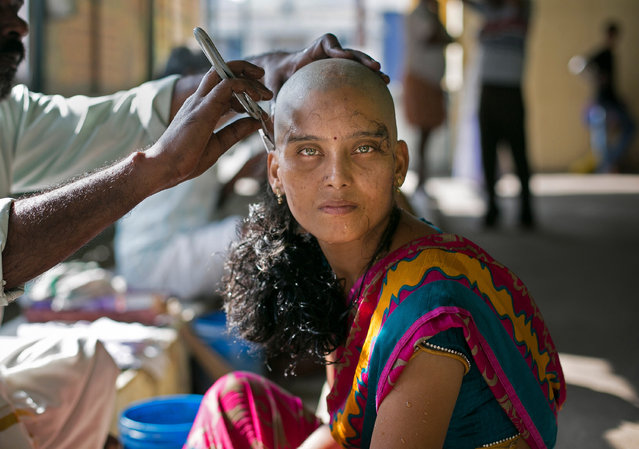
28 year old Rupa has her hair shaven to donate to the Gods at the Thiruthani Murugan Temple November 10, 2016 in Thiruttani, India. Rupa donated her hair with the wish that her daughter's illness is cured. The process of shaving ones hair and donating it to the Gods is known as tonsuring. It is common for Hindu believers to tonsure their hair at a temple as a young child, and also to celebrate a wish coming true, such as the birth of a baby or the curing of an illness. The “temple hair”, as it's known, is then auctioned off to a processing plant and then sold as pricey wigs and weaves in the US, Europe and Africa. (Photo by Allison Joyce/Getty Images)

28 year old Rupa has her hair shaven to donate to the Gods at the Thiruthani Murugan Temple November 10, 2016 in Thiruttani, India. Rupa donated her hair with the wish that her daughter's illness is cured. The process of shaving ones hair and donating it to the Gods is known as tonsuring. It is common for Hindu believers to tonsure their hair at a temple as a young child, and also to celebrate a wish coming true, such as the birth of a baby or the curing of an illness. The “temple hair”, as it's known, is then auctioned off to a processing plant and then sold as pricey wigs and weaves in the US, Europe and Africa. (Photo by Allison Joyce/Getty Images)
Details
21 Nov 2016 10:30:00