Loading...
Done
Water is seen on part of the glacial ice sheet that covers about 80 percent of the country is seen on July 17, 2013 on the Glacial Ice Sheet, Greenland. (Photo by Joe Raedle/Getty Images via The Atlantic)

Water is seen on part of the glacial ice sheet that covers about 80 percent of the country is seen on July 17, 2013 on the Glacial Ice Sheet, Greenland. As the sea levels around the globe rise, researchers affilitated with the National Science Foundation and other organizations are studying the phenomena of the melting glaciers and its long-term ramifications. The warmer temperatures that have had an effect on the glaciers in Greenland also have altered the ways in which the local populace farm, fish, hunt and even travel across land. In recent years, sea level rise in places such as Miami Beach has led to increased street flooding and prompted leaders such as New York City Mayor Michael Bloomberg to propose a $19.5 billion plan to boost the citys capacity to withstand future extreme weather events by, among other things, devising mechanisms to withstand flooding. (Photo by Joe Raedle)
Details
02 Aug 2013 10:51:00
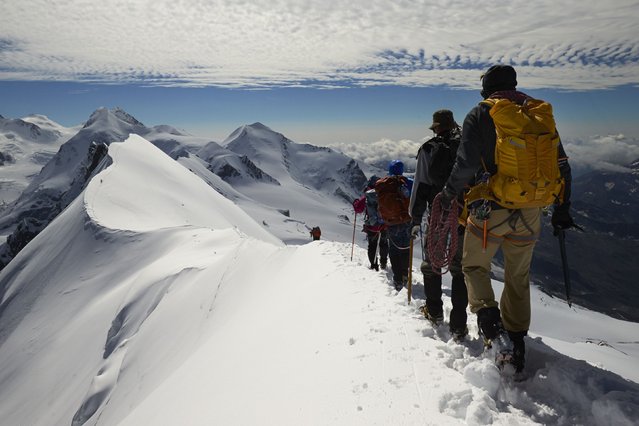
Roped up climbers leave the summit of Breithorn at 4,164 metres (13,661 feet) on the ridge marking the border with Switzerland (left) and Italy in the Alpine resort of Zermatt August 4, 2014. Switzerland will vote on November 30 on an initiative from the group Ecopop which proposes a cap on the number of immigrants. (Photo by Denis Balibouse/Reuters)

Roped up climbers leave the summit of Breithorn at 4,164 metres (13,661 feet) on the ridge marking the border with Switzerland (left) and Italy in the Alpine resort of Zermatt August 4, 2014. Switzerland will vote on November 30 on an initiative from the group Ecopop which proposes a cap on the number of immigrants. The group says it is motivated by concerns about a lack of living space exerting too much pressure on the land and natural resources, rather than by opposition to foreigners. (Photo by Denis Balibouse/Reuters)
Details
04 Nov 2014 14:29:00


“US Airways Flight 1549 was US Airways' scheduled domestic commercial passenger flight from LaGuardia Airport in New York City to Charlotte/Douglas International Airport, Charlotte, North Carolina. On January 15, 2009, the aircraft flying this route, an Airbus A320-214, was successfully ditched in the Hudson River adjacent to midtown Manhattan six minutes after takeoff from LaGuardia Airport after being disabled by striking a flock of Canada Geese during its initial climb out. The incident became known as the «Miracle On The Hudson»”. – Wikipedia

Photo: The Airbus jet that pilot Chesley “Sully” Sullenberger landed on the Hudson River is pulled along Yorkmont Road as it makes its way to the Carolinas Aviation Museum June 10, 2011 in Charlotte, North Carolina. An official unveiling of the plane, which will be on display at the Carolinas Avaiation Museum, will take place on Saturday, June 11. (Photo by Davis Turner/Getty Images)
Details
11 Jun 2011 12:38:00
A Ka'apor Indian warrior (L) chases a logger who tried to escape after they captured him during a jungle expedition to search for and expel loggers from the Alto Turiacu Indian territory, near the Centro do Guilherme municipality in the northeast of Maranhao state in the Amazon basin, August 7, 2014. (Photo by Lunae Parracho/Reuters)

A Ka'apor Indian warrior (L) chases a logger who tried to escape after they captured him during a jungle expedition to search for and expel loggers from the Alto Turiacu Indian territory, near the Centro do Guilherme municipality in the northeast of Maranhao state in the Amazon basin, August 7, 2014. Tired of what they say is a lack of sufficient government assistance in keeping loggers off their land, the Ka'apor Indians, who along with four other tribes are the legal inhabitants and caretakers of the territory, have sent their warriors out to expel all loggers they find and set up monitoring camps in the areas that are being illegally exploited. (Photo by Lunae Parracho/Reuters)
Details
05 Sep 2014 11:41:00
On August 31, 2012, a long filament of solar material that had been hovering in the sun's atmosphere, the corona, erupted out into space at 4:36 p.m. EDT. The coronal mass ejection, or CME, traveled at over 900 miles per second. The CME did not travel directly toward Earth, but did connect with Earth's magnetic environment, or magnetosphere, causing aurora to appear on the night of Monday, September 3. (Photo by NASA/GSFC/SDO)

On August 31, 2012, a long filament of solar material that had been hovering in the sun's atmosphere, the corona, erupted out into space at 4:36 p.m. EDT. The coronal mass ejection, or CME, traveled at over 900 miles per second. The CME did not travel directly toward Earth, but did connect with Earth's magnetic environment, or magnetosphere, causing aurora to appear on the night of Monday, September 3. (Photo by NASA/GSFC/SDO via The Atlantic)
Details
14 Sep 2012 09:01:00
Hamar women dance before a bull jumping ceremony in Ethiopia's southern Omo Valley region near Turmi on September 19, 2016. The Hamar are a Nilotic ethnic group in Ethiopia. The construction of the Gibe III dam, the third largest hydroelectric plant in Africa, and large areas of very “thirsty” cotton and sugar plantations and factories along the Omo river are impacting heavily on the lives of tribes living in the Omo Valley who depend on the river for their survival and way of life. Human rights groups fear for the future of the tribes if they are forced to scatter, give up traditional ways through loss of land or ability to keep cattle as globalisation and development increases. (Photo by Carl De Souza/AFP Photo)

Hamar women dance before a bull jumping ceremony in Ethiopia's southern Omo Valley region near Turmi on September 19, 2016. The Hamar are a Nilotic ethnic group in Ethiopia. The construction of the Gibe III dam, the third largest hydroelectric plant in Africa, and large areas of very “thirsty” cotton and sugar plantations and factories along the Omo river are impacting heavily on the lives of tribes living in the Omo Valley who depend on the river for their survival and way of life. (Photo by Carl De Souza/AFP Photo)
Details
02 Oct 2016 08:45:00
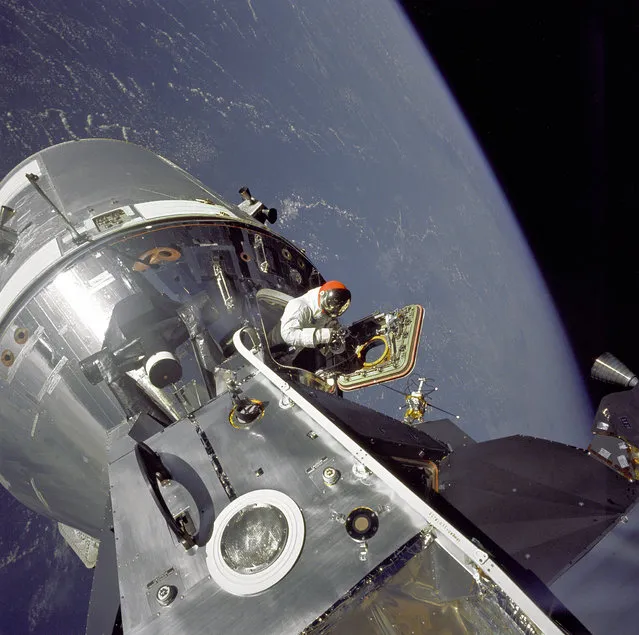
Apollo 9 Command/Service Modules (CSM) nicknamed “Gumdrop” and Lunar Module (LM), nicknamed “Spider” are shown docked together as Command Module pilot David R. Scott stands in the open hatch. Astronaut Russell L. Schweickart, Lunar Module pilot, took this photograph of Scott during his EVA as he stood on the porch outside the Lunar Module. Apollo 9 was an Earth orbital mission designed to test docking procedures between the CSM and LM as well as test fly the Lunar Module in the relative safe confines of Earth orbit. (Photo by NASA)

Apollo 9 Command/Service Modules (CSM) nicknamed “Gumdrop” and Lunar Module (LM), nicknamed “Spider” are shown docked together as Command Module pilot David R. Scott stands in the open hatch. Astronaut Russell L. Schweickart, Lunar Module pilot, took this photograph of Scott during his EVA as he stood on the porch outside the Lunar Module. Apollo 9 was an Earth orbital mission designed to test docking procedures between the CSM and LM as well as test fly the Lunar Module in the relative safe confines of Earth orbit. (Photo by NASA)
Details
20 Jul 2014 11:47:00
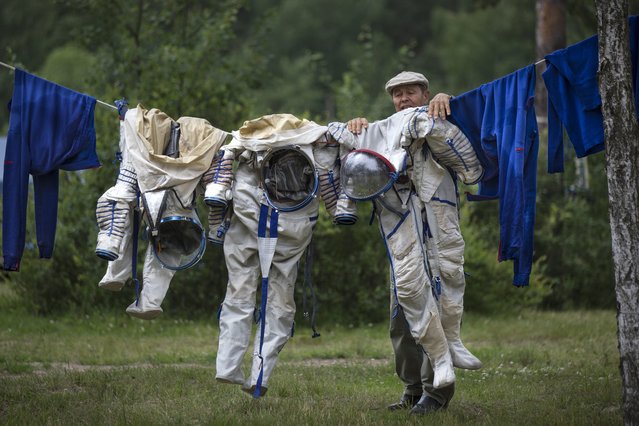
An employe of Russian Space Training Center hangs out to dry space suits of Russian cosmonaut Anatoly Ivanishin, NASA's U.S. flight engineer Kathleen Rubins, and Japanese space agency's flight engineer Takuya Onishi, right, after their undergoing  training near in Noginsk, 60 km (38 miles) east of Moscow, Russia, Wednesday, July 2, 2014. (Photo by Alexander Zemlianichenko/AP Photo)

An employe of Russian Space Training Center hangs out to dry space suits of Russian cosmonaut Anatoly Ivanishin, NASA's U.S. flight engineer Kathleen Rubins, and Japanese space agency's flight engineer Takuya Onishi, right, after their undergoing training near in Noginsk, 60 km (38 miles) east of Moscow, Russia, Wednesday, July 2, 2014. The training was intended to simulate the capsule landing on water. Russian cosmonaut Anatoly Ivanishin, Japanese space agency's flight engineer Takuya Onishi, and NASA's U.S. flight engineer Kathleen Rubins are being trained for a future mission to the International Space Station. (Photo by Alexander Zemlianichenko/AP Photo)
Details
05 Jul 2014 11:47:00