Loading...
Done
Kite Aerial By Seeing The World From New Heights

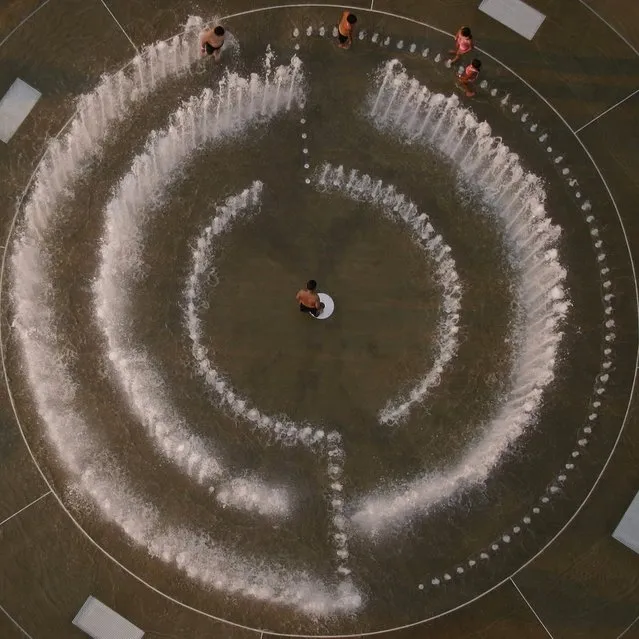
Kite Aerial photography (KAP) is a hobby and a type of photography. A camera is lifted using a kite and is triggered either remotely or automatically to take aerial photographs. The camera rigs can range from the extremely simple, consisting of a trigger mechanism with a disposable camera, to complex apparatus using radio control and digital cameras. On some occasions it can be a good alternative to other forms of aerial photography.
Details
17 Jan 2014 13:22:00
Niue Pokemon Legal Coins

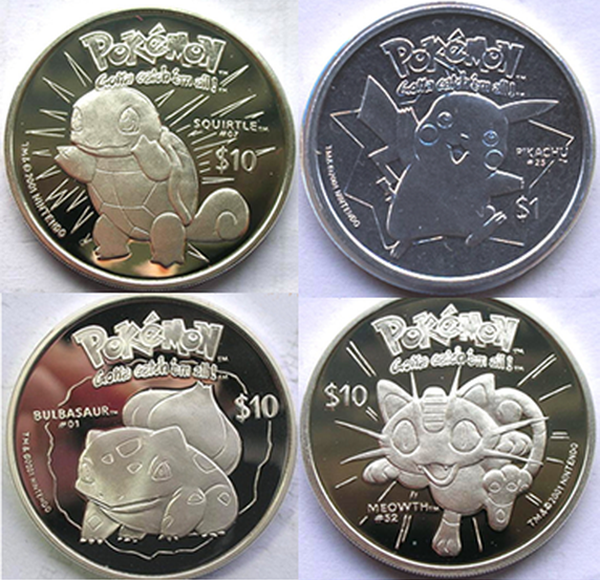
Niue is a dependency of New Zealand and before the introduction of the New Zealand dollar they used to use Pound Sterling as their legal tender. In 2001 Niue government issued a set of 5 “Pokemon” coins, the famous was the “Pikachu” $1 dollar coin which made headlines as “Pokemon” enthusiast hotly suit after their currency!
Details
16 Jan 2014 13:08:00
Hikaru Cho believes that we should challenge our imaginations to create new work using traditional tools, not fancy computers and software. (Photo by Jim Marks/PA Wire)

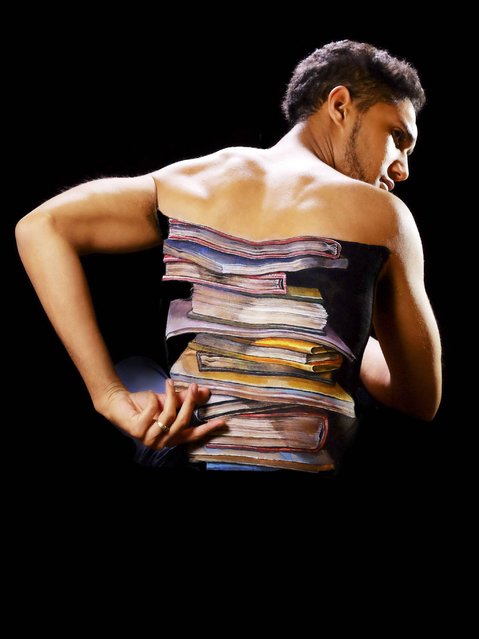
Hikaru Cho believes that we should challenge our imaginations to create new work using traditional tools, not fancy computers and software. (Photo by Jim Marks/PA Wire)
Details
06 Mar 2014 10:06:00
A member of the musuem team attends to a Aston Martin DB5 used in the James Bond film Goldfinger and being displayed at the Bond In Motion exhibition

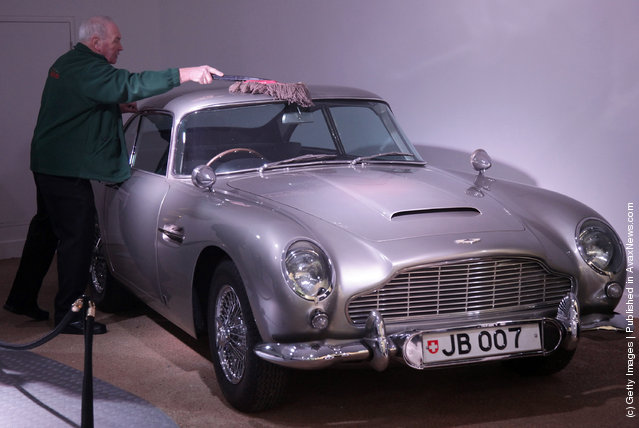
A member of the musuem team attends to a Aston Martin DB5 used in the James Bond film Goldfinger and being displayed at the Bond In Motion exhibition at National Motor Museum on January 17, 2012 in Beaulieu, England. (Photo by Matt Cardy/Getty Images)
Details
18 Jan 2012 08:29:00
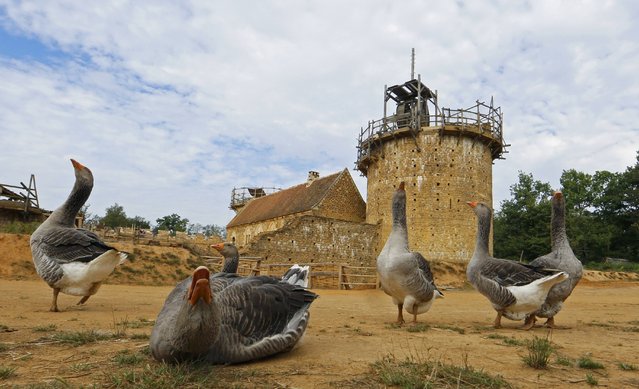
A view of the construction site of the Chateau de Guedelon near Treigny in the Burgundy region of France, September 13, 2016. Blacksmiths, stonemasons and quarry men are hard at work in a Burgundy forest building a 13th-century-style castle using the most basic tools and materials, replicating the methods used hundreds of years ago to better understand them. Forgoing all modern technology, workers use hammers to break stones and forge iron, operate wooden wheels to hoist their materials up to where they are needed, and rely on a quarry for stone, clay and sand as they build up a castle from scratch. Construction on Guedelon Castle in central France began in 1997 after an archaeological survey revealed a medieval fortress hidden inside the walls of nearby Chateau de Saint-Fargeau. Those behind the project hope to answer questions about medieval construction and provide lessons on sustainable building. (Photo by Jacky Naegelen/Reuters)

A view of the construction site of the Chateau de Guedelon near Treigny in the Burgundy region of France, September 13, 2016. Blacksmiths, stonemasons and quarry men are hard at work in a Burgundy forest building a 13th-century-style castle using the most basic tools and materials, replicating the methods used hundreds of years ago to better understand them. (Photo by Jacky Naegelen/Reuters)
Details
15 Sep 2016 09:43:00
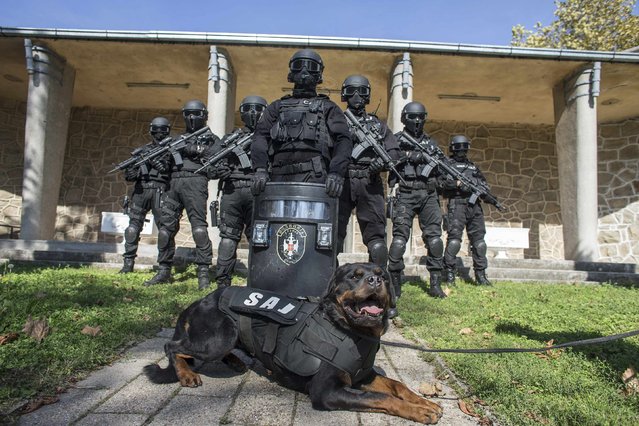
Serbian police officers of the Special Anti-Terrorist Unit pose for a picture in their base outside Belgrade October 8, 2014. (Photo by Marko Djurica/Reuters)

Serbian police officers of the Special Anti-Terrorist Unit pose for a picture in their base outside Belgrade October 8, 2014. When the killing of an unarmed black teenager by a white policeman in Ferguson, Missouri, in August sparked sometimes violent protests, the response of police in camouflage gear and armoured vehicles wielding stun grenades and assault rifles seemed more like a combat operation than a public order measure. Some U.S. police departments have recently acquired U.S. military-surplus hardware from wars abroad, but there are many law enforcers around the world whose rules of engagement also allow the use of lethal force with relatively few restrictions. But for every regulation that gives police wide scope to use firearms, there is another code that sharply limits their use. In Serbia, police may use measures ranging from batons to special vehicles, water cannon and tear gas on groups of people who have gathered illegally and are behaving in a way that is violent or could cause violence, but they may use firearms only when life is endangered. (Photo by Marko Djurica/Reuters)
Details
27 Nov 2014 14:53:00


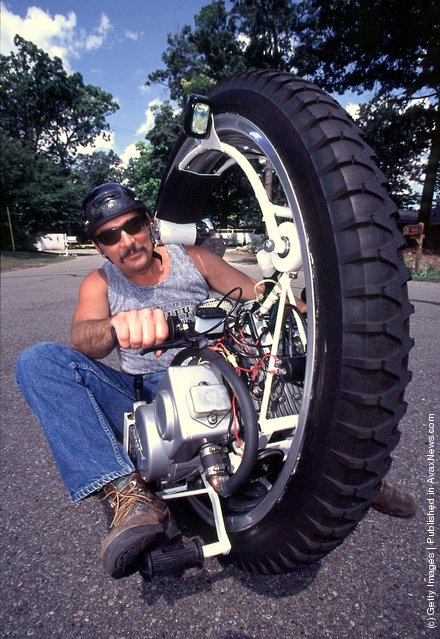
“A monowheel is a one-wheeled single-track vehicle similar to a unicycle. However, instead of sitting above the wheel, the rider sits either within it or next to it. The wheel is a ring, usually driven by smaller wheels pressing against its inner rim. Most are single-passenger vehicles, though multi-passenger models have been built.

Pedal-powered monowheels were built in the late 19th century; most built in the 20th century have been motorized. Some modern builders refer to these vehicles as monocycles, though that term is also sometimes used to describe motorized unicycles. Today, monowheels are generally built and used for fun and entertainment purposes, though from the 1860s through to the 1930s, they were proposed for use as serious transportation”. – Wikipedia

Photo: Cycle inventor Kerry McLean poses for the photographer 2000 in Walled Lake, Michigan. The “Monocycle” is equipped with a 40-horsepower engine, 4ft tire and is expected to reach speeds upwards of 100 mph. (Photo by Bill Pugliano/Liaison)

Details
02 Jul 2011 12:24:00
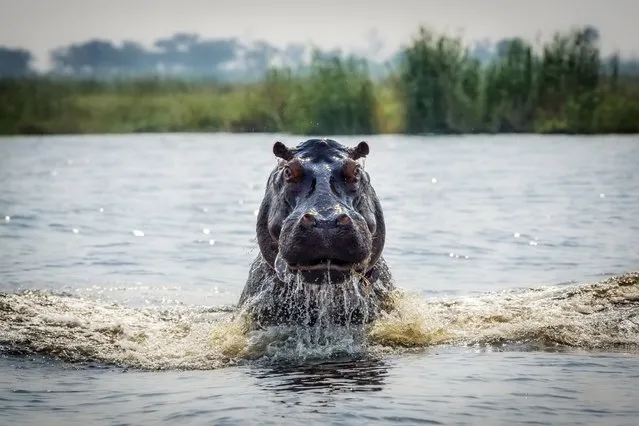
“Hippo Chase”. As we approached the camp the Selinda Reserve of northern Botswana our boat passed by a hippo resting in the water. I turned around to look back at the boat's wake and saw the hippo charging after us! The hippo must've been tired from an all-nighter because he was angry. (Photo and caption by Curtis Simmons/National Geographic Photo Contest)

“Hippo Chase”. As we approached the camp the Selinda Reserve of northern Botswana our boat passed by a hippo resting in the water. I turned around to look back at the boat's wake and saw the hippo charging after us! The hippo must've been tired from an all-nighter because he was angry. He rose way up out of the water three times trying to chase our boat! He was coming at us with such force that he created a wake of his own. Photo location: Selinda Reserve of northern Botswana. (Photo and caption by Curtis Simmons/National Geographic Photo Contest)
Details
06 Nov 2014 08:59:00