Loading...
Done
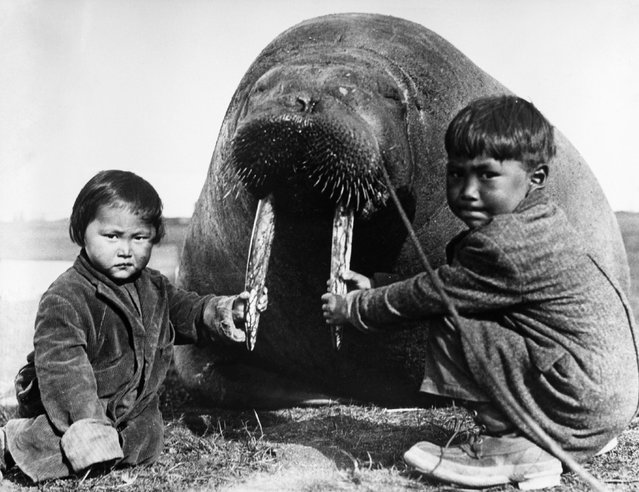
Two Inuit children at Point Barrow, Alaska, holding the tusks of a large walrus, probably killed for food, circa 1930. (Photo by General Photographic Agency/Getty Images)

Two Inuit children at Point Barrow, Alaska, holding the tusks of a large walrus, probably killed for food, circa 1930. (Photo by General Photographic Agency/Getty Images)
Details
04 Feb 2017 01:02:00
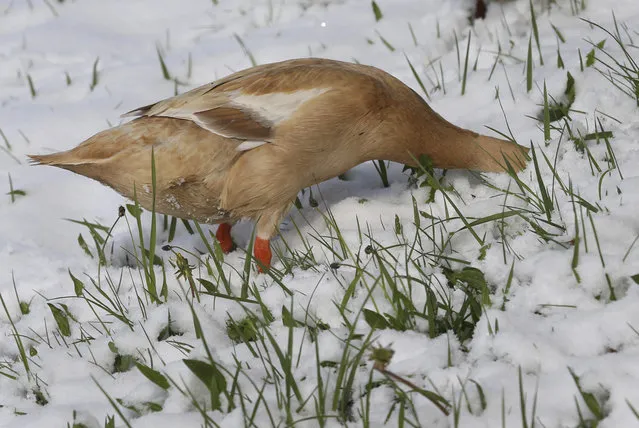
An Indian Runner duck searches for food on a snow-covered meadow in Aitrang, southern Germany, Wednesday. April 19, 2017. (Photo by Karl-Josef Hildenbrand/DPA via AP Photo)

An Indian Runner duck searches for food on a snow-covered meadow in Aitrang, southern Germany, Wednesday. April 19, 2017. (Photo by Karl-Josef Hildenbrand/DPA via AP Photo)
Details
23 Apr 2017 08:45:00
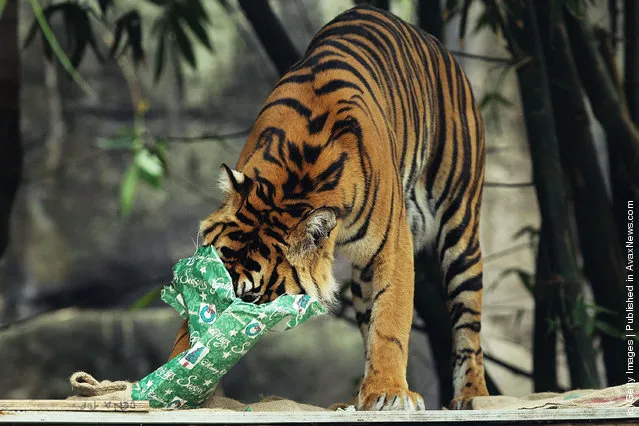
A Sumatran Tiger tears apart a wrapped Christmas present at Taronga Zoo

A Sumatran Tiger tears apart a wrapped Christmas present at Taronga Zoo on December 21, 2011 in Sydney, Australia. Animals received Christmas themed enrichment foods as part of the Zoo's regular program to encourage the animals to forage for food and help improve hunting abilities. (Photo by Brendon Thorne/Getty Images)
Details
21 Dec 2011 14:40:00
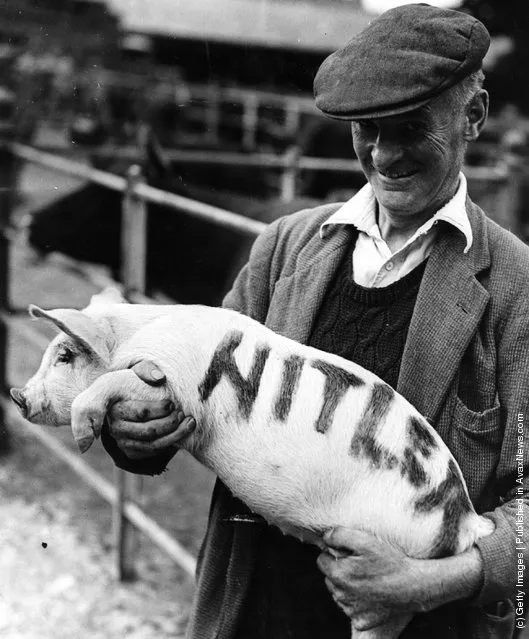
This greedy piglet was isolated from the rest of its litter by the farmer who named it Hitler after it tried to grab all the food at feeding time, 1942

This greedy piglet was isolated from the rest of its litter by the farmer who named it Hitler after it tried to grab all the food at feeding time. (Photo by R J Lewis/Getty Images). 1942
Details
08 Mar 2012 12:02:00
People carry an empty coffin past a street food vendor into the shop that is buying it to repair and sell in Port-au-Prince, Haiti, Friday, September 13, 2024. (Photo by Odelyn Joseph/AP Photo)

People carry an empty coffin past a street food vendor into the shop that is buying it to repair and sell in Port-au-Prince, Haiti, Friday, September 13, 2024. (Photo by Odelyn Joseph/AP Photo)
Details
27 Sep 2024 03:57:00
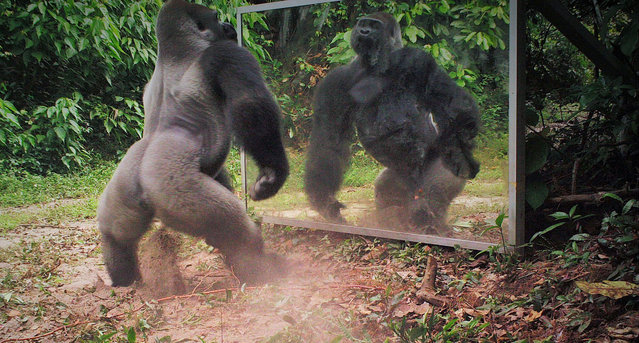
Camera trapper Xavier Hubert-Brierre put this large mirror on the side of a road through the jungle in Gabon and left a camera there to record how the animals would respond to their own reflections. A silverback gorilla thought it was seeing another silverback and responded by trying to scare off the potential challenger… (Photo by Xavier Hubert-Brierre/Johns Hopkins University Press)

Camera trapper Xavier Hubert-Brierre put this large mirror on the side of a road through the jungle in Gabon and left a camera there to record how the animals would respond to their own reflections. A silverback gorilla thought it was seeing another silverback and responded by trying to scare off the potential challenger… (Photo by Xavier Hubert-Brierre/Johns Hopkins University Press)
Details
03 May 2016 13:04:00
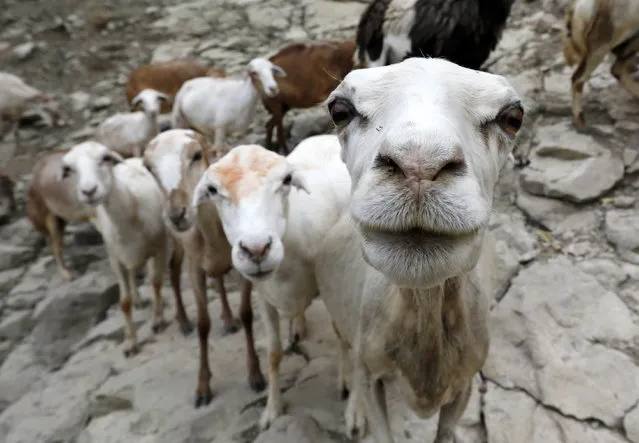
A flock of sheep and goats is led by shepherds to pastures at a mountain village on the outskirts of Sana'a, Yemen, 27 July 2023. At least eight million sheep and goats from about 470,000 pastoralist and agro pastoralist households across Yemen will be treated and vaccinated over the two years 2023 and 2024, in an effort to reduce livestock losses, improve production efficiency, and household income generation amid an acute food insecurity, the UN Food and Agriculture Organization (FAO) has reported. Livestock production in Yemen is a main income-generating activity for many rural and poor households. Yemen remains one of the worst humanitarian crises in the world with over 17 million people out of its 30-million population are food insecure due to a combination of prolonged conflicts and economic crisis. (Photo by Yahya Arhab/EPA)

A flock of sheep and goats is led by shepherds to pastures at a mountain village on the outskirts of Sana'a, Yemen, 27 July 2023. At least eight million sheep and goats from about 470,000 pastoralist and agro pastoralist households across Yemen will be treated and vaccinated over the two years 2023 and 2024, in an effort to reduce livestock losses, improve production efficiency, and household income generation amid an acute food insecurity, the UN Food and Agriculture Organization (FAO) has reported. (Photo by Yahya Arhab/EPA)
Details
01 Aug 2023 03:44:00


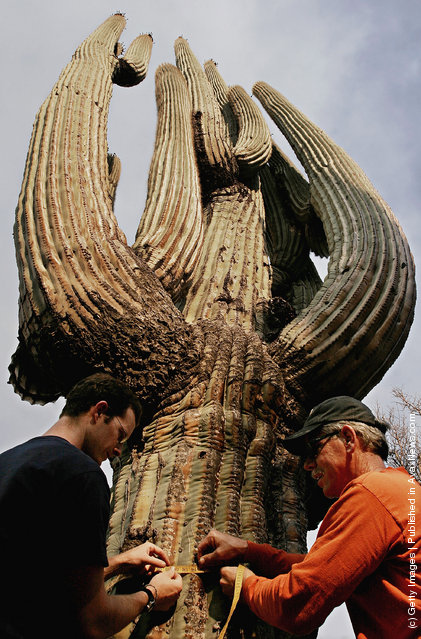
“The saguaro (scientific name Carnegiea gigantea) is a large, tree-sized cactus species in the monotypic genus Carnegiea. It is native to the Sonoran Desert in the U.S. state of Arizona, the Mexican state of Sonora, a small part of Baja California in the San Felipe Desert and an extremely small area of California, U.S. The saguaro blossom is the State Wildflower of Arizona”. – Wikipedia

Photo: Daniel Appel (L), a firefighter with Engine 84 from the Lassen National Forest in California and Mike Hallen, (R), Arizona representative of the National Register of Big Trees, measure the circumference of this Saguaro cactus called the "Grand One," in the Tonto National Forest on July 1, 2005 35 miles north of Phoenix, near Carefree, Arizona. The cactus, estimated to be more than 200 years old, measures a circumference of 7 feet, 10 inches (2.4 meters) and stands 46 feet high (14 meters). The cactus was burned in the Cave Creek Complex fire and may not survive. It was once the largest Saguaro in the world, two others have been found recently that have tied it's measurements. The fire has burned more than 214,000 acres of the Sonoran desert. (Photo by Jeff Topping/Getty Images)
Details
26 Jul 2011 12:27:00