Loading...
Done
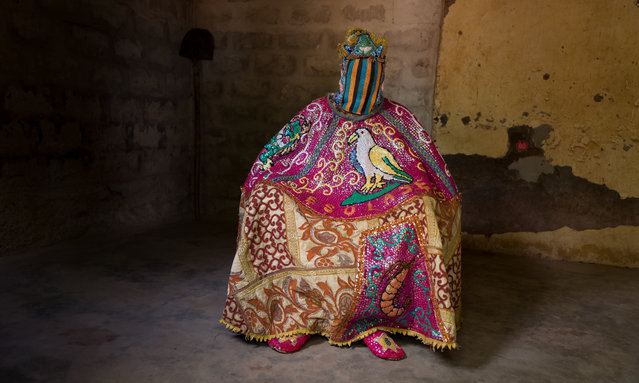
A member of an Egungun masquerade group, his identity obscured under his ornate costume in Ouidah, Benin on March 13, 2019. The exclusively male practitioners, found across Yoruba culture, use dance and spinning in the belief that they will summon the spirits of ancestors. (Photo by Massimo Rumi/Barcroft Images)

A member of an Egungun masquerade group, his identity obscured under his ornate costume in Ouidah, Benin on March 13, 2019. The exclusively male practitioners, found across Yoruba culture, use dance and spinning in the belief that they will summon the spirits of ancestors. (Photo by Massimo Rumi/Barcroft Images)
Details
26 Mar 2019 00:01:00
A picture taken on March 16, 2017 shows women dressed up as mermaids posing by a pool at a mermaid training school in Moscow. Russian women who have dreamt of becoming a mermaid since their youngest years, start turning their fantasies into reality with a new type of fitness – mermaid swimming. (Photo by Natalia Kolesnikova/AFP Photo)

A picture taken on March 16, 2017 shows women dressed up as mermaids posing by a pool at a mermaid training school in Moscow. Russian women who have dreamt of becoming a mermaid since their youngest years, start turning their fantasies into reality with a new type of fitness – mermaid swimming. (Photo by Natalia Kolesnikova/AFP Photo)
Details
18 Mar 2017 11:17:00
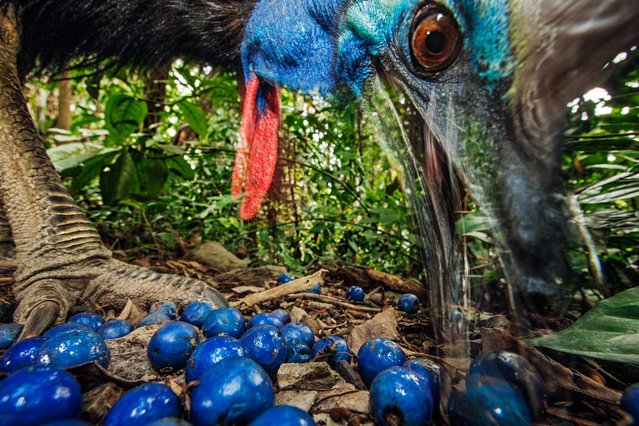
“Cassowaries are large, flightless birds related to emus and (more distantly) to ostriches, rheas, and kiwis”, writes Olivia Judson in the September issue of National Geographic magazine. (Photo by Christian Ziegler/National Geographic)

“Cassowaries are large, flightless birds related to emus and (more distantly) to ostriches, rheas, and kiwis”, writes Olivia Judson in the September issue of National Geographic magazine. How large? People-size: Adult males stand well over five foot five and top 110 pounds. Females are even taller, and can weigh more than 160 pounds. Dangerous when roused, they’re shy and peaceable when left alone. But even birds this big and tough are prey to habitat loss. The dense New Guinea and Australia rain forests where they live have dwindled. Today cassowaries might number 1,500 to 2,000. And because they help shape those same forests – by moving seeds from one place to another – “if they vanish”, Judson writes, “the structure of the forest would gradually change” too. (Photo by Christian Ziegler/National Geographic)

Details
06 Jan 2014 12:21:00
People spray water in the street ahead of “Songkran”, the annual Thai New Year water-throwing festival, in Kowloon City, Hong Kong, China, 09 April 2017. The pouring of water is a key element in the festival as it represents purification and the washing away of one's sins and bad luck for the year. The event also includes a “Miss Songkran” pageant where contestants are clothed in traditional Thai dress, and a winner is crowned. This year's “Songkran” will begin in Thailand on 13 April 2017. (Photo by Alex Hofford/EPA)

People spray water in the street ahead of “Songkran”, the annual Thai New Year water-throwing festival, in Kowloon City, Hong Kong, China, 09 April 2017. The pouring of water is a key element in the festival as it represents purification and the washing away of one's sins and bad luck for the year. The event also includes a “Miss Songkran” pageant where contestants are clothed in traditional Thai dress, and a winner is crowned. This year's “Songkran” will begin in Thailand on 13 April 2017. (Photo by Alex Hofford/EPA)
Details
10 Apr 2017 09:05:00
An armed man herds his cattle close to the village of Nimini in northern South Sudan, February 8, 2017. (Photo by Siegfried Modola/Reuters)

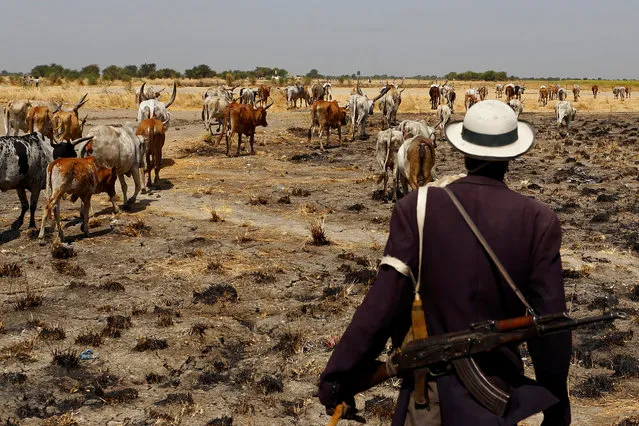
An armed man herds his cattle close to the village of Nimini in northern South Sudan, February 8, 2017. In the chaos of South Sudan's civil war, it took three years for Nyagonga Machul to find her lost children. Machul had traveled from her village to the capital when President Salva Kiir, an ethnic Dinka, fired his deputy Riek Machar, a Nuer, in 2013. (Photo by Siegfried Modola/Reuters)
Details
19 Feb 2017 00:04:00
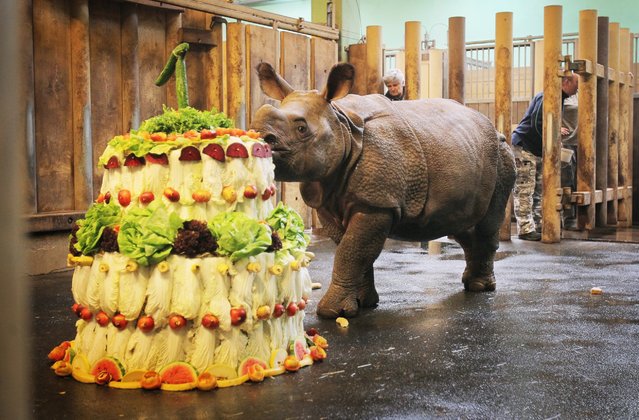
A female Indian rhinoceros called Maruska eats a vegetable birthday cake on her first birthday celebration at the Plzen Zoo on February 3, 2015 in Plzen, Czech Republic. (Photo by Ladislav Nemec/Isifa)

A female Indian rhinoceros called Maruska eats a vegetable birthday cake on her first birthday celebration at the Plzen Zoo on February 3, 2015 in Plzen, Czech Republic. (Photo by Ladislav Nemec/Isifa)
Details
07 Feb 2015 14:55:00
A five-week-old orphaned Southern Sea Otter pup rests on a rubber mat after arriving at the Shedd Aquarium's Abbott Oceanarium in Chicago, Illinois October 28, 2014 in this handout photo provided to Reuters on November 5, 2014. The stranded pup was found on September 30 on Coastways Beach in California and was rescued the next day to be brought back to health at the Monterey Bay Aquarium. (Photo by Brenna Hernandez/Reuters/Shedd Aquarium)

A five-week-old orphaned Southern Sea Otter pup rests on a rubber mat after arriving at the Shedd Aquarium's Abbott Oceanarium in Chicago, Illinois October 28, 2014 in this handout photo provided to Reuters on November 5, 2014. The stranded pup was found on September 30 on Coastways Beach in California and was rescued the next day to be brought back to health at the Monterey Bay Aquarium. Southern sea otters were listed as “threatened” under the U.S. Endangered Species Act in 1977. (Photo by Brenna Hernandez/Reuters/Shedd Aquarium)
Details
08 Nov 2014 13:15:00
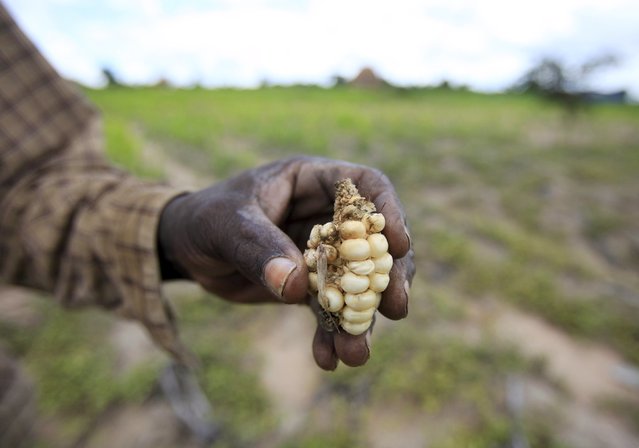
A Zimbabwean subsistence farmer holds a stunted maize cob in his field outside Harare, January 20, 2016. About 14 million people face hunger in Southern Africa because of a drought that has been exacerbated by an El Nino weather pattern, the United Nations World Food Programme (WFP) said on Monday. In Zimbabwe, 1.5 million people, more than 10 percent of the population, face hunger, WFP said. (Photo by Philimon Bulawayo/Reuters)

A Zimbabwean subsistence farmer holds a stunted maize cob in his field outside Harare, January 20, 2016. About 14 million people face hunger in Southern Africa because of a drought that has been exacerbated by an El Nino weather pattern, the United Nations World Food Programme (WFP) said on Monday. In Zimbabwe, 1.5 million people, more than 10 percent of the population, face hunger, WFP said. (Photo by Philimon Bulawayo/Reuters)
Details
22 Jan 2016 10:06:00