Loading...
Done
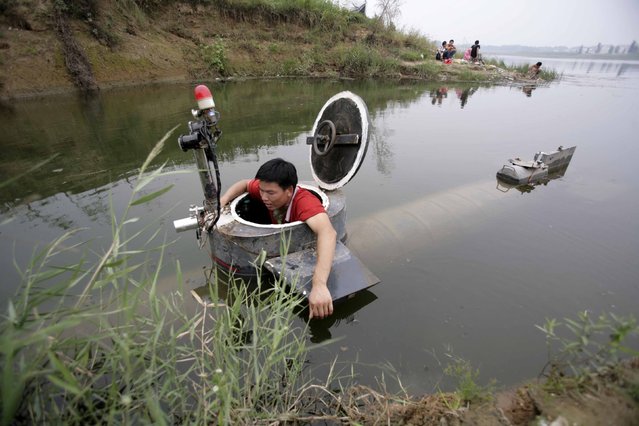
Tao Xiangli gets out of his homemade submarine after operating it in a lake on the outskirts of Beijing September 3, 2009. Amateur inventor Tao, 34,  made a fully functional submarine, which has a periscope, depth control tanks, electric motors, manometer, and two propellers, from old oil barrels and tools which he bought at a second-hand market. He took 2 years to invent and test the submarine which costs 30,000 yuan ($4,385). (Photo by Christina Hu/Reuters)

Tao Xiangli gets out of his homemade submarine after operating it in a lake on the outskirts of Beijing September 3, 2009. Amateur inventor Tao, 34, made a fully functional submarine, which has a periscope, depth control tanks, electric motors, manometer, and two propellers, from old oil barrels and tools which he bought at a second-hand market. He took 2 years to invent and test the submarine which costs 30,000 yuan ($4,385). (Photo by Christina Hu/Reuters)
Details
05 May 2013 12:06:00
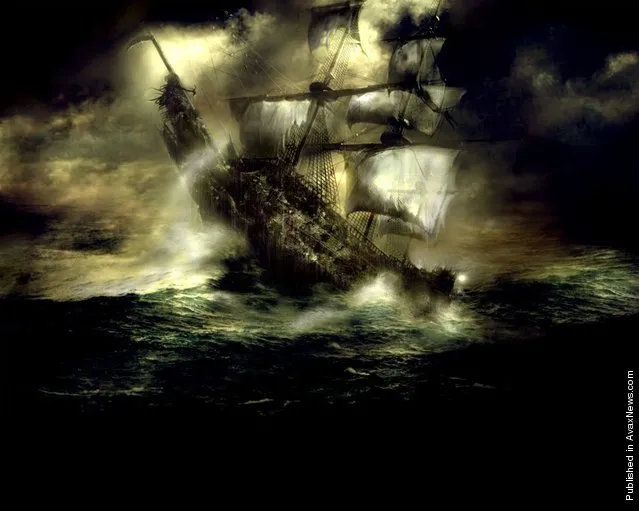
Ocean voyage

Do you think that history is a science? Well, not exactly. First, and foremost, history is the state's “legend of wars”, it’s official regalia. Of course, public historians are not interested in scientific truth – quite the opposite. In this respect, any attempt to present a state’s history as altruistic and benevolent as possible is welcomed and encouraged – as opposed to any revisionism attempts that may be more accurate. In this matter, Chinese have surpassed us all – they revised in highly creative manner (but rather shamelessly) the technology already invented by Europeans, a process that resulted in oldest state on the planet. Here is an interesting paradox: ask any sinologist about the Middle Kingdom during second century B.C., and he will describe it to you in such a vivid manner as if he has been living there all his life – but as soon as you will ask him to describe Chinese history in the 19-20th centuries… let's say, his eagerness will be greatly diminished. However, we will discuss China in a different article, and in the meantime we will try to understand how exactly historic “legend of wars” is formed and functions – based on a specific and well-known example. A great example is Ferdinand Magellan's first voyage around the world.

Details
14 Nov 2011 09:11:00
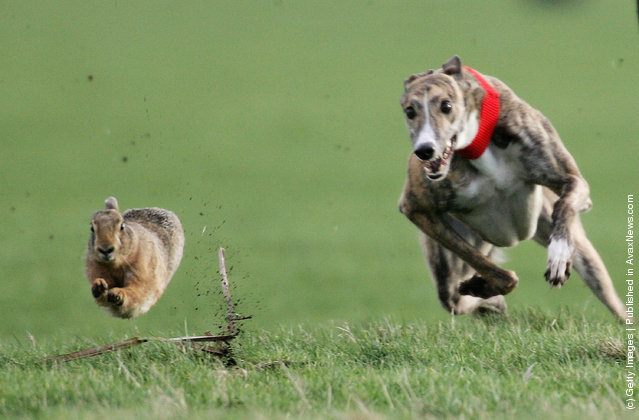
Greyhounds race after a Hare at the last Waterloo Cup Hare coursing event

“The Waterloo Cup was a coursing event. The three day event was run annually at Great Altcar in Lancashire, England from 1836 to 2005 and it used to attract tens of thousands of spectators to watch and gamble on the coursing matches. It was founded by William Philip Molyneux, 2nd Earl of Sefton, and, originally, was supported by his patronage”. – Wikipedia

Photo: A Greyhound races after Hare at the last Waterloo Cup Hare coursing event, February 14, 2005, near Liverpool, England. (Photo by Christopher Furlong/Getty Images)
Details
18 Feb 2012 11:26:00
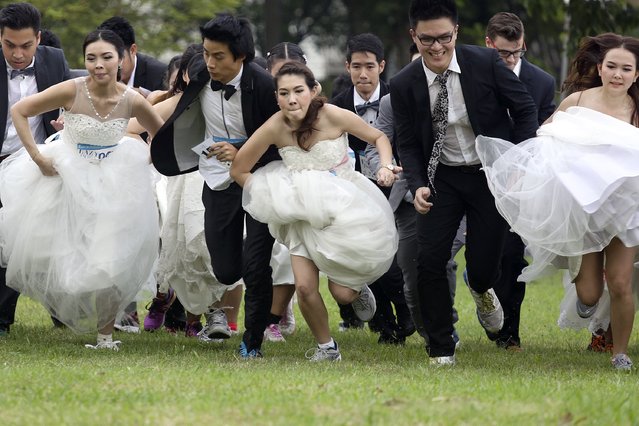
Couples participate in the “Running of the Brides” race in a park in Bangkok November 29, 2014. (Photo by Damir Sagolj/Reuters)

Couples participate in the “Running of the Brides” race in a park in Bangkok November 29, 2014. Seventy-five husbands and wives-to-be wore their wedding dresses and running shoes and competed in an event for a combined prize worth 1 million Thai baht ($30,460). (Photo by Damir Sagolj/Reuters)
Details
30 Nov 2014 12:41:00
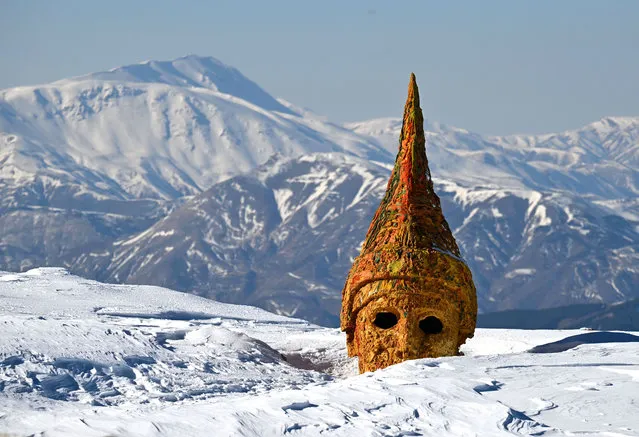
A view of snow blanketed ancient giant statues and remains, dating back to 2.000-year-old Commagene Kingdom, located in the 2.150-meter-altitude Mount Nemrut, which is listed in the UNESCO's World Heritage List, in Kahta district of Adiyaman, Turkiye on February 02, 2024. (Photo by Ozkan Bilgin/Anadolu via Getty Images)

A view of snow blanketed ancient giant statues and remains, dating back to 2.000-year-old Commagene Kingdom, located in the 2.150-meter-altitude Mount Nemrut, which is listed in the UNESCO's World Heritage List, in Kahta district of Adiyaman, Turkiye on February 02, 2024. (Photo by Ozkan Bilgin/Anadolu via Getty Images)
Details
17 Feb 2024 06:45:00
Andrey Karr from Western Riders Slacklines at sunset above big waves in Nazare, Portugal on December 27, 2017. (Photo by Aidan Williams/National Geographic Travel Photographer of the Year Contest)

Andrey Karr from Western Riders Slacklines at sunset above big waves in Nazare, Portugal on December 27, 2017. (Photo by Aidan Williams/National Geographic Travel Photographer of the Year Contest)
Details
14 May 2018 00:03:00
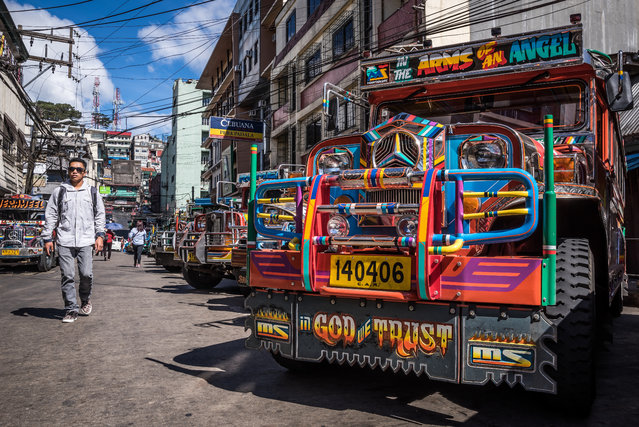
A jeepney waits for departure at Baguio (North Luzon). (Photo by Claudio Sieber/Barcroft Media)

These Filipino icons of ingenuity were originally re-crafted from abandoned US army jeeps after the second world war, and helped to establish a new system of urban transportation. Jeepneys are being phased to help ease city congestion, but the move will also cause unemployment for experienced drivers – and higher fares for commuters. (Photo by Claudio Sieber/Barcroft Media)
Details
30 May 2019 00:01:00
A visitor wears an outfit as she watches the St. George NextGen show for Fashion Week in Sydney on May 16, 2017. (Photo by Peter Parks/AFP Photo)

A visitor wears an outfit as she watches the St. George NextGen show for Fashion Week in Sydney on May 16, 2017. (Photo by Peter Parks/AFP Photo)
Details
17 May 2017 08:34:00