Loading...
Done
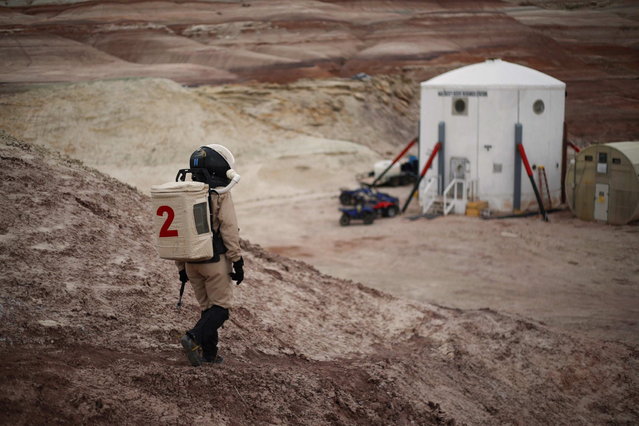
Csilla Orgel, a geologist of Crew 125 EuroMoonMars B mission, makes her way back to the Mars Desert Research Station (MDRS) in the Utah desert March 3, 2013. (Photo by Jim Urquhart/Reuters)

NASA says it could be another 20 years before humans touch down on Mars, but in a sense, the Mars Society has been exploring the red planet for more than a decade – in Utah. Photo: Csilla Orgel, a geologist of Crew 125 EuroMoonMars B mission, makes her way back to the Mars Desert Research Station (MDRS) in the Utah desert March 3, 2013. The MDRS aims to investigate the feasibility of a human exploration of Mars and uses the Utah desert's Mars-like terrain to simulate working conditions on the red planet. Scientists, students and enthusiasts work together developing field tactics and studying the terrain. All outdoor exploration is done wearing simulated spacesuits and carrying air supply packs and crews live together in a small communication base with limited amounts of electricity, food, oxygen and water. Everything needed to survive must be produced, fixed and replaced on site. (Photo by Jim Urquhart/Reuters)
Details
14 Mar 2013 12:11:00
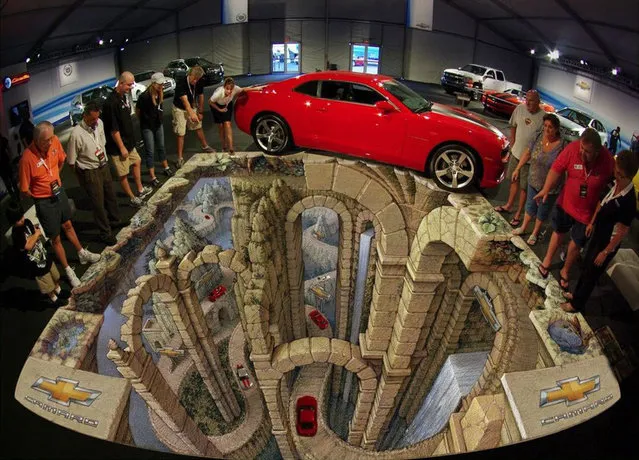
3d Street Art Kurt Wenner

American artist Kurt Wenner creates unparalleled three-dimensional drawings on asphalt streets and of floor. Kurt – A former employee of NASA, which is the love of the art of the Renaissance left the space agency and left to raise the artistic skills in Rome. Has a variety of awards in the arts. Here is a selection of his works made in different cities around the world.
Details
05 Jun 2014 22:01:00
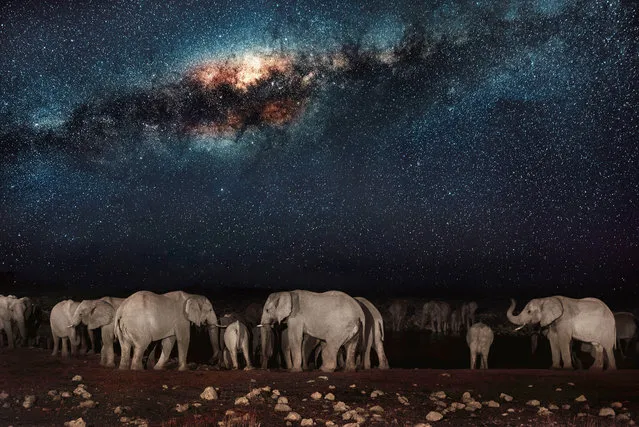
This watering hole is the social hub of the veldt; the scrubby grasslands that stretch across Namibia. The scorched earth supports sometimes fragile populations of magnificent wildlife – from endangered predators to plentiful herds of game. But these gentle giraffes and elephants need to be careful: lions don’t sleep at night, they hunt! The spectacular starscape above southern Africa is unchanged since explorers first mapped the continent. The photographer, Pietro Olivetta from Italy, said he had to be patient to capture these shots – but it was worth the wait. (Photo by Pietro Olivetta/Caters News)

This watering hole is the social hub of the veldt; the scrubby grasslands that stretch across Namibia. The scorched earth supports sometimes fragile populations of magnificent wildlife – from endangered predators to plentiful herds of game. But these gentle giraffes and elephants need to be careful: lions don’t sleep at night, they hunt! The spectacular starscape above southern Africa is unchanged since explorers first mapped the continent. The photographer, Pietro Olivetta from Italy, said he had to be patient to capture these shots – but it was worth the wait. (Photo by Pietro Olivetta/Caters News)
Details
20 Feb 2017 00:05:00
On August 31, 2012, a long filament of solar material that had been hovering in the sun's atmosphere, the corona, erupted out into space at 4:36 p.m. EDT. The coronal mass ejection, or CME, traveled at over 900 miles per second. The CME did not travel directly toward Earth, but did connect with Earth's magnetic environment, or magnetosphere, causing aurora to appear on the night of Monday, September 3. (Photo by NASA/GSFC/SDO)

On August 31, 2012, a long filament of solar material that had been hovering in the sun's atmosphere, the corona, erupted out into space at 4:36 p.m. EDT. The coronal mass ejection, or CME, traveled at over 900 miles per second. The CME did not travel directly toward Earth, but did connect with Earth's magnetic environment, or magnetosphere, causing aurora to appear on the night of Monday, September 3. (Photo by NASA/GSFC/SDO via The Atlantic)
Details
14 Sep 2012 09:01:00
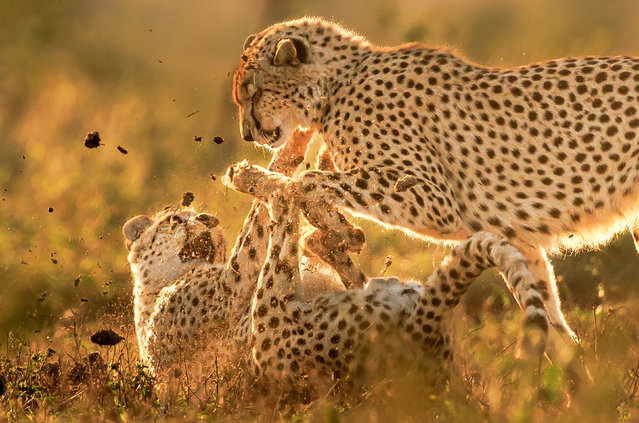
Play-fighting cheetah siblings at the Zimanga game reserve in South Africa in the second decade of November 2024 were spotted by Gavin Bickerton-Jones, an amateur photographer, who said: “It is a bit scary at first being so close, but also a privilege for them to let you share their space”. (Photo by Gavin Bickerton-Jones/Solent News)

Play-fighting cheetah siblings at the Zimanga game reserve in South Africa in the second decade of November 2024 were spotted by Gavin Bickerton-Jones, an amateur photographer, who said: “It is a bit scary at first being so close, but also a privilege for them to let you share their space”. (Photo by Gavin Bickerton-Jones/Solent News)
Details
24 Nov 2024 03:43:00
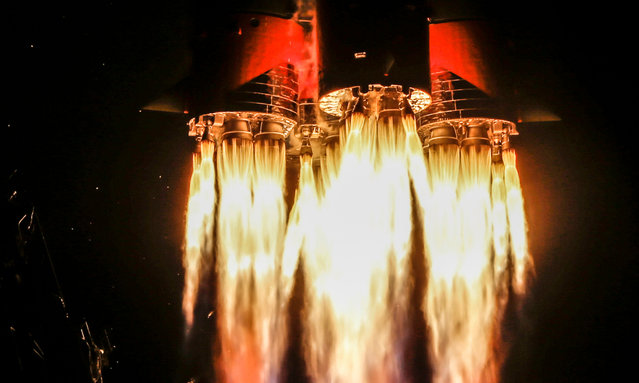
Soyuz MS-12 spacecraft with crew members of Expedition 59/60 Russian cosmonaut Alexey Ovchinin, NASA astronauts Christina Koch and Nick Hague lifts off from the launch pad at the Russian leased Baikonur cosmodrome, Kazakhstan, 15 March 2019. Hague, Koch, and Ovchinin will spend six-and-a-half months living and working aboard the International Space Station. (Photo by Sergei Ilnitsky/EPA/EFE)

Soyuz MS-12 spacecraft with crew members of Expedition 59/60 Russian cosmonaut Alexey Ovchinin, NASA astronauts Christina Koch and Nick Hague lifts off from the launch pad at the Russian leased Baikonur cosmodrome, Kazakhstan, 15 March 2019. Hague, Koch, and Ovchinin will spend six-and-a-half months living and working aboard the International Space Station. (Photo by Sergei Ilnitsky/EPA/EFE)
Details
11 Apr 2019 00:03:00
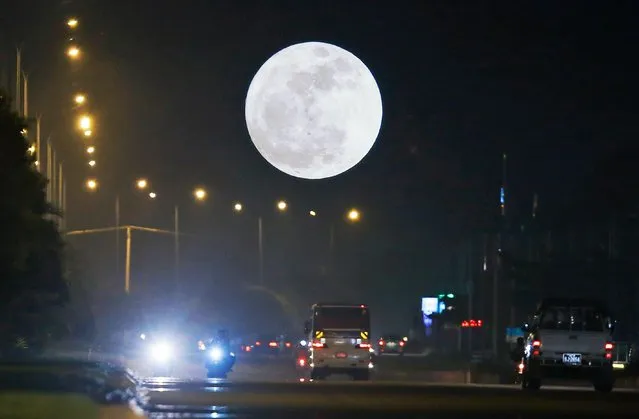
A so-called “Supermoon” dominates the sky while traffic rolls in the streets in Naypyitaw, Myanmar, 03 December 2017. According to the National Aeronautics and Space Administration (NASA) a series of three “Supermoons” – dubbed the “Supermoon trilogy” – will appear in the sky on 03 December 2017, on 01 January 2018 and and 31 January 2018. A 'Supermoon' commonly is a full moon at its closest distance to the earth with the moon appearing larger than usual. (Photo by Hein Htet/EPA/EFE)

A so-called “Supermoon” dominates the sky while traffic rolls in the streets in Naypyitaw, Myanmar, 03 December 2017. According to the National Aeronautics and Space Administration (NASA) a series of three “Supermoons” – dubbed the “Supermoon trilogy” – will appear in the sky on 03 December 2017, on 01 January 2018 and and 31 January 2018. A “Supermoon” commonly is a full moon at its closest distance to the earth with the moon appearing larger than usual. (Photo by Hein Htet/EPA/EFE)
Details
05 Dec 2017 07:45:00
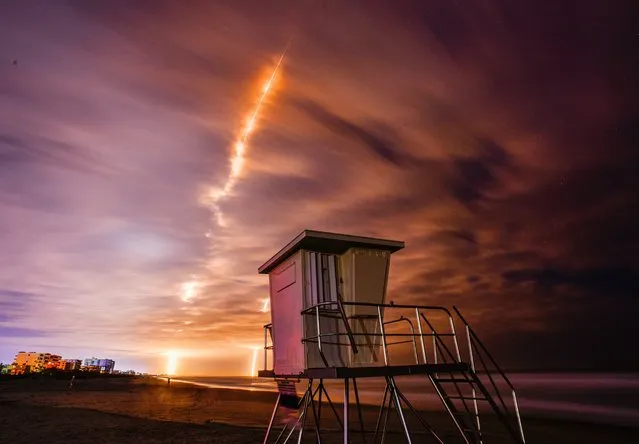
SpaceX and NASA Launch of the PACE spacecraft atop a Falcon 9 rocket from Launch Complex 40 at Cape Canaveral Space Force Station in Brevard County, Florida on February 8, 2024. Photo shows launch and booster landing back at CCSFS about 7 minutes 30 seconds after launch. In the foreground is one the new modular lifeguard stands at Minuteman Causeway, replacing the old wooden tower. (Photo by Malcolm Denemark/Florida Today via USA Today Network)

SpaceX and NASA Launch of the PACE spacecraft atop a Falcon 9 rocket from Launch Complex 40 at Cape Canaveral Space Force Station in Brevard County, Florida on February 8, 2024. Photo shows launch and booster landing back at CCSFS about 7 minutes 30 seconds after launch. In the foreground is one the new modular lifeguard stands at Minuteman Causeway, replacing the old wooden tower. (Photo by Malcolm Denemark/Florida Today via USA Today Network)
Details
19 Feb 2024 08:45:00