Loading...
Done
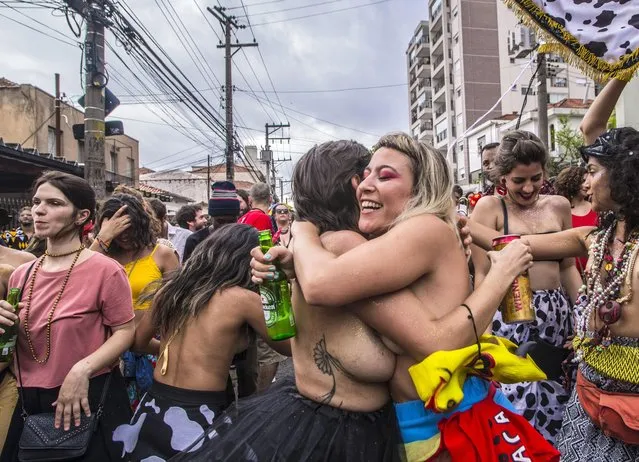
People enjoy carnival while shouting slogans of female empowerment and anti harrassment in Sao Paulo, Brazil on January 28, 2018. The carnival is marked by a lot of fun, but also has space to talk about more serious things – without losing the good mood. Parading for the first time in São Paulo, the Vaca Profana block proposed a reflection on sieges and machismo. With the breasts on display singing not only frevos but, mainly, shouting words of disorder, in order to stimulate female empowerment and against harassment. Our body is our struggle. The preservation of our physical integrity, our freedom of choice. Nude or clothed, we demand respect. (Photo by Cris Faga/Rex Features/Shutterstock)

People enjoy carnival while shouting slogans of female empowerment and anti harrassment in Sao Paulo, Brazil on January 28, 2018. The carnival is marked by a lot of fun, but also has space to talk about more serious things – without losing the good mood. Parading for the first time in São Paulo, the Vaca Profana block proposed a reflection on sieges and machismo. (Photo by Cris Faga/Rex Features/Shutterstock)
Details
29 Jan 2018 08:29:00
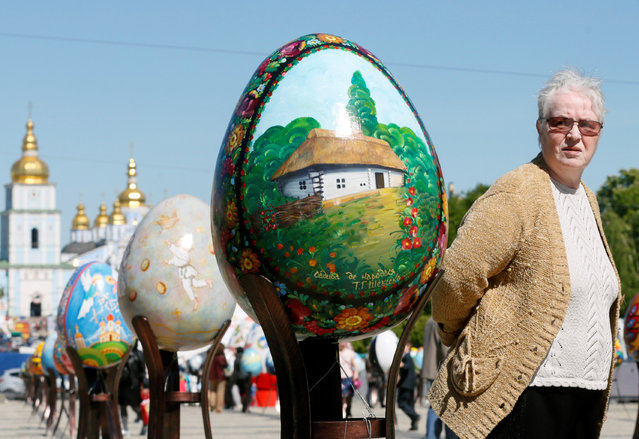
A woman looks at traditional Ukrainian Easter eggs “Pysanka”, installed as part of the upcoming celebrations of Easter, in central Kiev, Ukraine, April 29, 2016. A pysanka is a Ukrainian Easter egg, decorated with traditional Ukrainian folk designs using a wax-resist (batik) method. The word pysanka comes from the verb pysaty, “to write”, as the designs are not painted on, but written with beeswax. Many other eastern European ethnic groups decorate eggs using wax resist for Easter. These include the Belarusians, Bulgarians, Croats, Czechs, Hungarians, Lithuanians, Poles, Romanians, Serbs, Slovaks, Slovenes and Sorbs. (Photo by Valentyn Ogirenko/Reuters)

A woman looks at traditional Ukrainian Easter eggs “Pysanka”, installed as part of the upcoming celebrations of Easter, in central Kiev, Ukraine, April 29, 2016. A pysanka is a Ukrainian Easter egg, decorated with traditional Ukrainian folk designs using a wax-resist (batik) method. The word pysanka comes from the verb pysaty, “to write”, as the designs are not painted on, but written with beeswax. Many other eastern European ethnic groups decorate eggs using wax resist for Easter. These include the Belarusians, Bulgarians, Croats, Czechs, Hungarians, Lithuanians, Poles, Romanians, Serbs, Slovaks, Slovenes and Sorbs. (Photo by Valentyn Ogirenko/Reuters)
Details
30 Apr 2016 09:00:00
Garrison Ireland Leigon member John O'Dwyer dressed as the character Darth Vader looks out towards Skellig Michael island on May 4, 2019 in Portmagee, Ireland. The latest Star Wars movies such as The Last Jedi have featured the famous Skellig Michael islands situated off the coast of the small Irish fishing village. The May the Fourth Star Wars festival is taking place in the small County Kerry village for the second year running as millions of fans worldwide celebrate the science fiction series. The quiet costal setting has seen a sharp rise in the number of tourists and fans visiting the area. (Photo by Charles McQuillan/Getty Images)

Garrison Ireland Leigon member John O'Dwyer dressed as the character Darth Vader looks out towards Skellig Michael island on May 4, 2019 in Portmagee, Ireland. The latest Star Wars movies such as The Last Jedi have featured the famous Skellig Michael islands situated off the coast of the small Irish fishing village. The May the Fourth Star Wars festival is taking place in the small County Kerry village for the second year running as millions of fans worldwide celebrate the science fiction series. The quiet costal setting has seen a sharp rise in the number of tourists and fans visiting the area. (Photo by Charles McQuillan/Getty Images)
Details
07 May 2019 00:07:00
“For a bouquet of flowers”. Photographs made ​​in the last hours of the day. A goat is directed by a dangerous way to eat a small bouquet of flowers. Location: España, Barcelona, Montserrat. (Photo and caption by Renato Lopez Baldo/National Geographic Traveler Photo Contest)

“For a bouquet of flowers”. Photographs made ​​in the last hours of the day. A goat is directed by a dangerous way to eat a small bouquet of flowers. Location: España, Barcelona, Montserrat. (Photo and caption by Renato Lopez Baldo/National Geographic Traveler Photo Contest)

ATTENTION! All pictures are presented in high resolution. To see Hi-Res images – just TWICE click on any picture. In other words, click small picture – opens the BIG picture. Click BIG picture – opens VERY BIG picture.
Details
25 Jun 2013 12:51:00
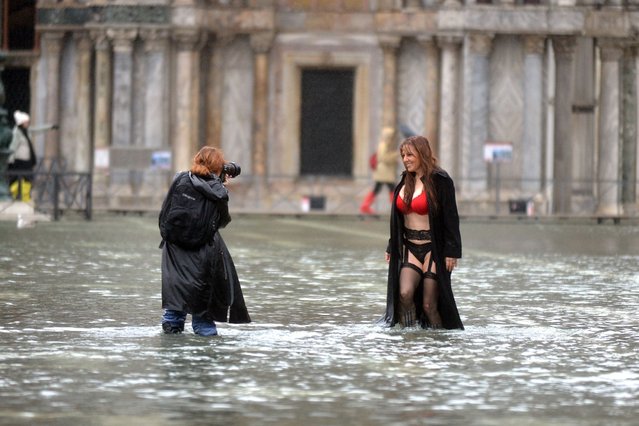
A woman poses on the flooded St. Mark's square during an acqua-alta (high-water) alert in Venice, on November 19, 2013. (Photo by Andrea Pattaro/AFP Photo)

A woman poses on the flooded St. Mark's square during an acqua-alta (high-water) alert in Venice, on November 19, 2013. (Photo by Andrea Pattaro/AFP Photo)

P.S. All pictures, as usual, are presented in high resolution. To see Hi-Res images – just TWICE click on any picture. In other words, click small picture – opens the BIG picture. Click BIG picture – opens VERY BIG picture (if available; this principle works anywhere on the site AvaxNews).
Details
23 Nov 2013 11:21:00
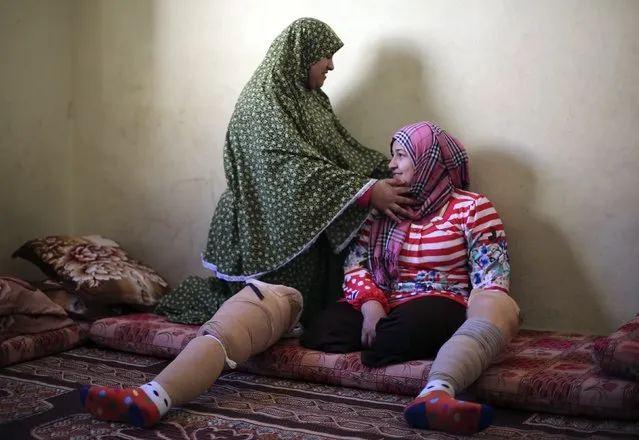
Palestinian girl Manar Al-Shinbari (R), 15, who lost her both legs by what medics said was Israeli shelling at a UN-run school where she was taking refuge during the 50-day war last summer, is helped by her sister to put on her headscarf in an apartment in Jabaliya refugee camp in the northern Gaza Strip January 13, 2015. (Photo by Mohammed Salem/Reuters)

Palestinian girl Manar Al-Shinbari (R), 15, who lost her both legs by what medics said was Israeli shelling at a UN-run school where she was taking refuge during the 50-day war last summer, is helped by her sister to put on her headscarf in an apartment in Jabaliya refugee camp in the northern Gaza Strip January 13, 2015. Manar's mother and three of her brothers were killed in the same incident. The girl's family house was destroyed by Israeli shelling during the war. (Photo by Mohammed Salem/Reuters)
Details
14 Jan 2015 12:34:00
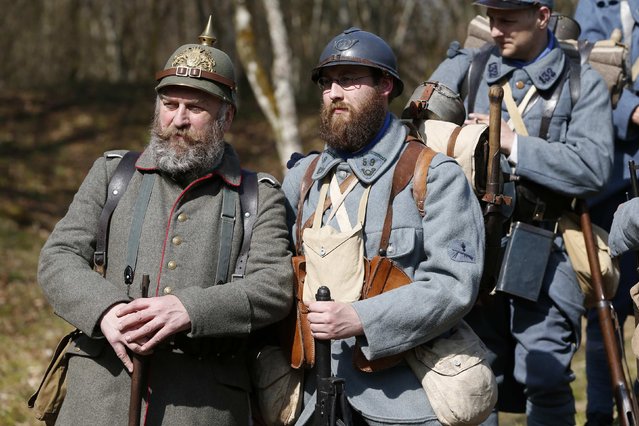
Wolfgang (L), member of World War One historical association “Darstellungsgruppe Suddeutsches Militar 1870-1918” (DSM 18), from Munich, Germany, and Florent, member of French association “Le Poilu de la Marne”, dressed in vintage army uniforms, visit the Bezonvaux bunker in the national forest of Verdun, eastern France, March 29, 2014. (Photo by Charles Platiau/Reuters)

Wolfgang (L), member of World War One historical association “Darstellungsgruppe Suddeutsches Militar 1870-1918” (DSM 18), from Munich, Germany, and Florent, member of French association “Le Poilu de la Marne”, dressed in vintage army uniforms, visit the Bezonvaux bunker in the national forest of Verdun, eastern France, March 29, 2014. Members of French and German historical associations, who gather annually, together visited the battlefield of Verdun in France, the site of a bloody World War One battle that dragged on for around 10 months in 1916, claiming hundreds of thousands of lives and destroying many villages. (Photo by Charles Platiau/Reuters)
Details
10 Apr 2014 10:49:00
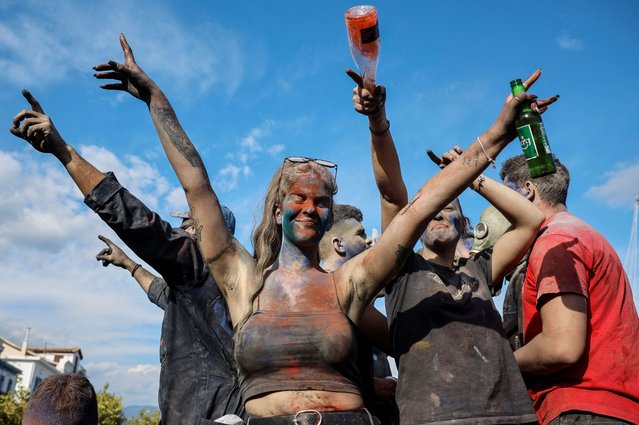
Revellers participate in a colourful “flour war”, celebrating the “Ash Monday” or “Clean Monday”, a traditional festivity marking the end of the carnival season and the start of the 40-day Lent period until the Orthodox Easter, in the town of Galaxidi, Greece, on March 18, 2024. (Photo by Louisa Gouliamaki/Reuters)

Revellers participate in a colourful “flour war”, celebrating the “Ash Monday” or “Clean Monday”, a traditional festivity marking the end of the carnival season and the start of the 40-day Lent period until the Orthodox Easter, in the town of Galaxidi, Greece, on March 18, 2024. (Photo by Louisa Gouliamaki/Reuters)
Details
12 Jun 2025 03:41:00