Loading...
Done
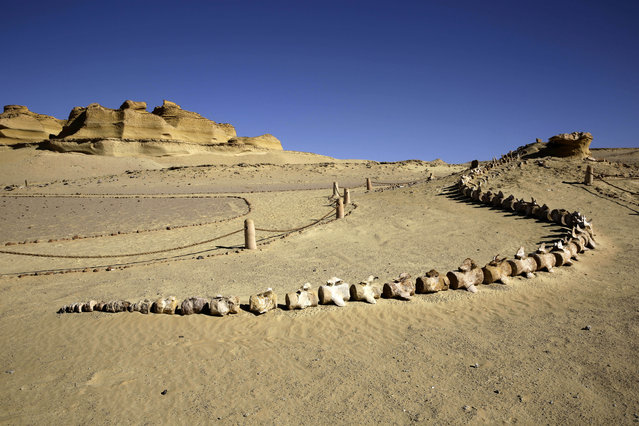
Fossilized whale bones are on display  outside the Wati El Hitan Fossils and Climate Change Museum, a UNESCO natural World Heritage site, on the opening day, in the Fayoum oasis, Egypt, Thursday, January 14, 2016. Egypt has cut the ribbon on the Middle East's first fossil museum housing the world's largest intact skeleton of a "walking whale" in an attempt to attract much-needed tourists driven off by recent militant attacks. The construction of the much-hyped Fossils and Climate Change Museum was covered a 2 billion euros (2. 17 billion dollars) grant from Italy, according to Italian Ambassador Maurizio Massari. (Photo by Thomas Hartwell/AP Photo)

Fossilized whale bones are on display outside the Wati El Hitan Fossils and Climate Change Museum, a UNESCO natural World Heritage site, on the opening day, in the Fayoum oasis, Egypt, Thursday, January 14, 2016. Egypt has cut the ribbon on the Middle East's first fossil museum housing the world's largest intact skeleton of a "walking whale" in an attempt to attract much-needed tourists driven off by recent militant attacks. The construction of the much-hyped Fossils and Climate Change Museum was covered a 2 billion euros (2. 17 billion dollars) grant from Italy, according to Italian Ambassador Maurizio Massari. Its centerpiece is an intact, 37-million-year-old and 20-meter-long skeleton of a legged form of whale that testifies to how modern-day whales evolved from land mammals. The sand-colored, dome-shaped museum is barely discernible in the breathtaking desert landscape that stretches all around. (Photo by Thomas Hartwell/AP Photo)
Details
16 Jan 2016 08:06:00
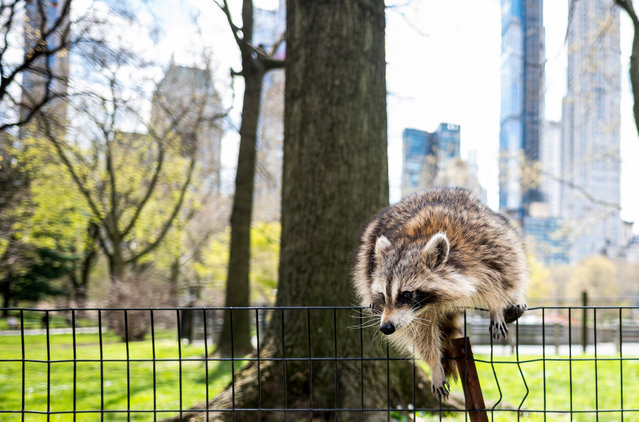
A racoon jumps over a fence in almost deserted Central Park in Manhattan on April 16, 2020 in New York City. Gone are the softball games, horse-drawn carriages and hordes of tourists. In their place, pronounced birdsong, solitary walks and renewed appreciation for Central Park's beauty during New York's coronavirus lockdown. The 843-acre (341-hectare) park – arguably the world's most famous urban green space – normally bustles with human activity as winter turns to spring, but this year due to Covid-19 it's the wildlife that is coming out to play. (Photo by Johannes Eisele/AFP Photo)

A racoon jumps over a fence in almost deserted Central Park in Manhattan on April 16, 2020 in New York City. Gone are the softball games, horse-drawn carriages and hordes of tourists. In their place, pronounced birdsong, solitary walks and renewed appreciation for Central Park's beauty during New York's coronavirus lockdown. The 843-acre (341-hectare) park – arguably the world's most famous urban green space – normally bustles with human activity as winter turns to spring, but this year due to Covid-19 it's the wildlife that is coming out to play. (Photo by Johannes Eisele/AFP Photo)
Details
14 Dec 2025 07:04:00
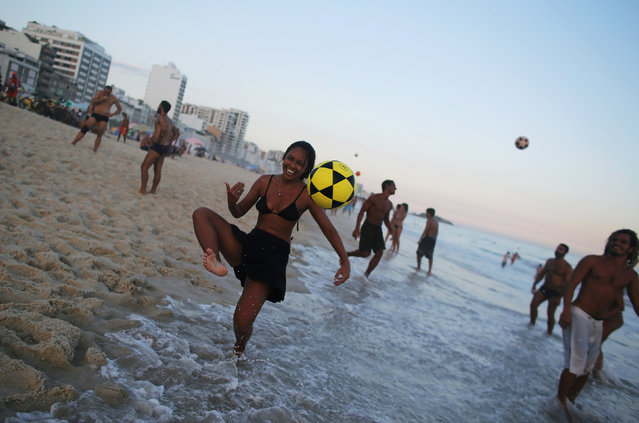
A woman controls a ball on Ipanema beach in Rio de Janeiro, Brazil, April 14, 2016. (Photo by Nacho Doce/Reuters)

A woman controls a ball on Ipanema beach in Rio de Janeiro, Brazil, April 14, 2016. As hundreds of thousands of tourists begin descending on Rio de Janeiro for the Olympics that start August 5, the headlines have focused on the street violence, the Zika virus, the water pollution and the rush to finish venues and transport. But Rio, known by Brazilians as the “Marvelous City”, glistens despite it all. The beach is a way of life here. (Photo by Nacho Doce/Reuters)
Details
19 Jul 2016 13:10:00
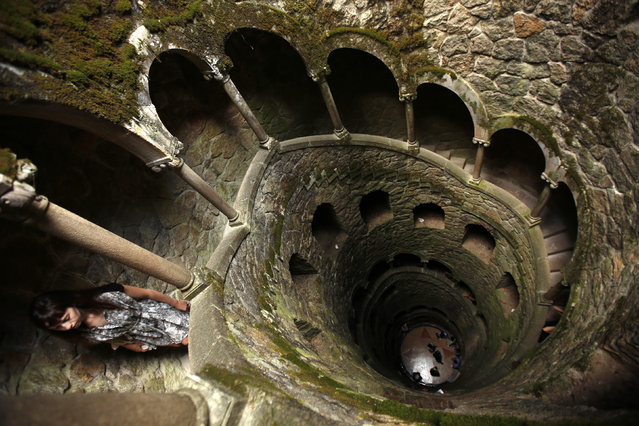
A visitor walks inside the initiation well at Quinta da Regaleira in Sintra October 6, 2014. (Photo by Rafael Marchante/Reuters)

A visitor walks inside the initiation well at Quinta da Regaleira in Sintra October 6, 2014. Sintra became the first centre of European Romantic architecture in the 19th century, which influenced the development of landscape architecture throughout Europe. It was classified as a World Heritage Site by UNESCO in 1995. Its monuments are visited by more than 1.5 million of tourists every year, according to local media. (Photo by Rafael Marchante/Reuters)
Details
28 Oct 2014 12:35:00
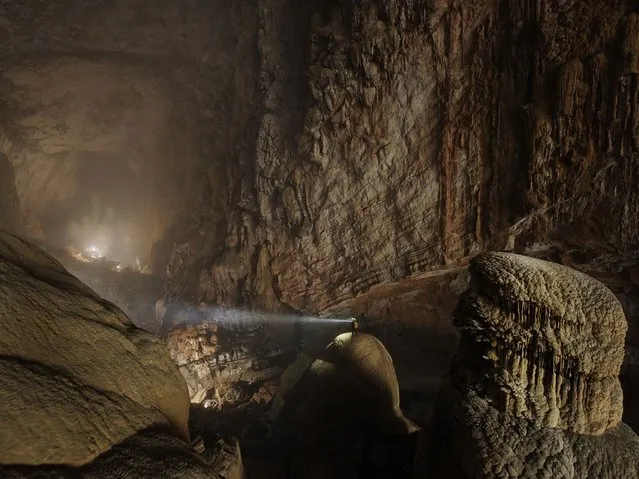
Son Doong Cave

Son doong cave is a cave in Phong Nha-Kẻ Bàng National Park, Bố Trạch district, Quảng Bình Province, Vietnam. Currently the biggest known cave in the world, the cave is located near the Laos-Vietnam border. Inside is a large, fast-flowing underground river.
In early August 2013, the first tourist group explored the cave on a guided tour at a cost of US$3,000 each. The group had six members from Australia, Norway, Russia and USA and spent 7 days and 6 nights for the tour. Next exploration trips will be arranged.
Details
22 Sep 2013 12:30:00
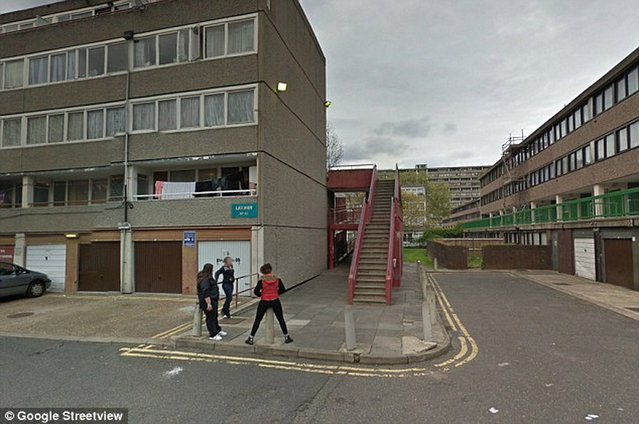
Bad Part of Town By Google Street View

Take a walk on the wild side around some of the most down right dangerous places in the world - and all without leaving your desk, courtesy of Google Street View. Since 2007, Google's amazing technology has given people the chance to visit the Eiffel Tower, peer out over San Francisco's Golden Gate Bridge or walk along a beach in the Bahamas. But as well as mapping the tourist-friendly hotspots, Google also ventured into places you really wouldn't want to find yourself. Here is a collection of some the most notorious areas captured by the infamous roaming camera cars from around the UK and the world.
Details
03 Oct 2013 11:05:00
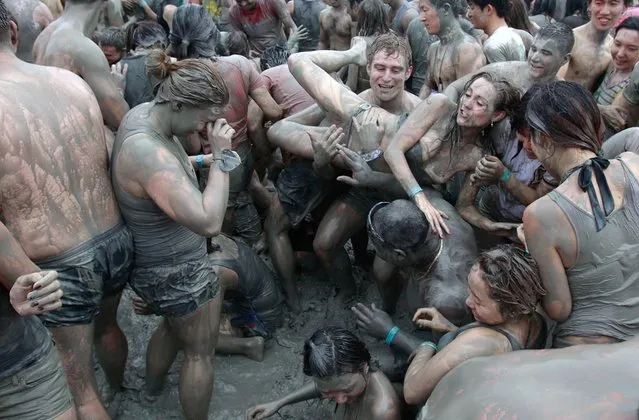
Festival goers plays in mud during the 15th Annual Boryeong Mud Festival at Daecheon beach in Boryeong, southwest of Seoul

Festival goers plays in mud during the 15th Annual Boryeong Mud Festival at Daecheon beach in Boryeong, about 190 km (118 miles) southwest of Seoul, July 15, 2012. About 2 to 3 million domestic and international tourists visit the beach during the annual mud festival, according to the festival organisation. (Photo by Chung Sung-Jun)
Details
16 Jul 2012 08:45:00
A child looks up to his partner as she stands above the crowd with the support of an elaborate rig of hidden metal rods, during the Bun Festival parade at Cheung Chau island in Hong Kong on May 22, 2018. (Photo by Bobby Yip/Reuters)

A child looks up to his partner as she stands above the crowd with the support of an elaborate rig of hidden metal rods, during the Bun Festival parade at Cheung Chau island in Hong Kong on May 22, 2018. Thousands of local residents and tourists flocked to an outlying island in Hong Kong to celebrate a local bun festival on Tuesday despite the recording-breaking heat. (Photo by Bobby Yip/Reuters)
Details
24 May 2018 00:05:00