Loading...
Done
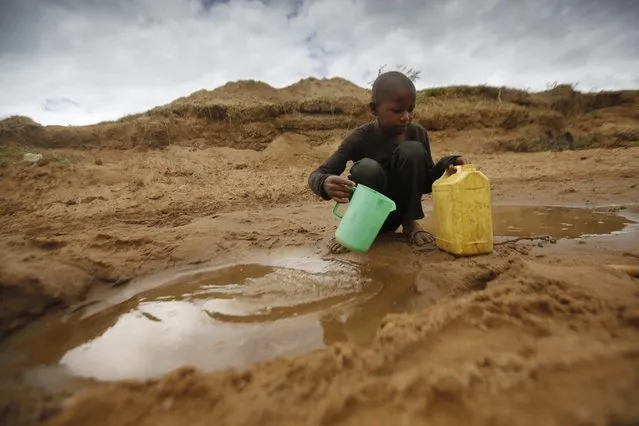
A young boy scoops water from a hand-dug well in the dry riverbed near Matinyani, in the semi-arid Kitui County in southeastern Kenya, 22 March 2015, the World Water Day. Residents of Kitui County and other arid and semi-arid areas of the country have been hard-hit by extremely poor rainfall this year while the government said in previous month that some 1.6 million people countrywide are facing acute starvation due to the drought and will need relief food over the next six months. (Photo by Dai Kurokawa/EPA)

A young boy scoops water from a hand-dug well in the dry riverbed near Matinyani, in the semi-arid Kitui County in southeastern Kenya, 22 March 2015, the World Water Day. Residents of Kitui County and other arid and semi-arid areas of the country have been hard-hit by extremely poor rainfall this year while the government said in previous month that some 1.6 million people countrywide are facing acute starvation due to the drought and will need relief food over the next six months. Residents of Matinyani say they haven't seen a drop of rain in nearly four months. Thousands of Kenyans in rural areas walk tens of kilometers just to fetch water to drink and to be used in their homes. According to an estimate by UNESCO (United Nations Educational, Scientific and Cultural Organization), 17 million people lack access to safe water in Kenya, where the drought is a perennial problem. (Photo by Dai Kurokawa/EPA)
Details
23 Mar 2015 11:01:00
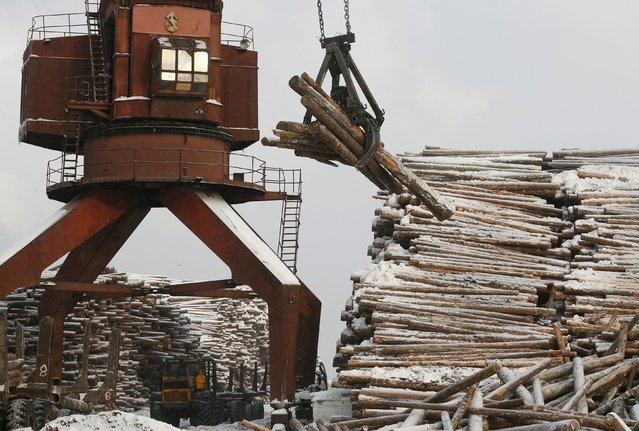
A crane loads logs at the Novoyeniseisk wood processing plant, with the air temperature at about minus 20 degrees Celsius (minus 4 degrees Fahrenheit), in the town of Lesosibirsk in Krasnoyarsk Region, Siberia, Russia, February 16, 2016. The plant exports timber to Europe, Northern Africa and Asia. The Taiga, also known as the boreal forest, on the coast of the Angara River and Yenisei River is one of the main areas for the industrial cutting of wood thanks to the high quality of the Angara pine. (Photo by Ilya Naymushin/Reuters)

A crane loads logs at the Novoyeniseisk wood processing plant, with the air temperature at about minus 20 degrees Celsius (minus 4 degrees Fahrenheit), in the town of Lesosibirsk in Krasnoyarsk Region, Siberia, Russia, February 16, 2016. The plant exports timber to Europe, Northern Africa and Asia. The Taiga, also known as the boreal forest, on the coast of the Angara River and Yenisei River is one of the main areas for the industrial cutting of wood thanks to the high quality of the Angara pine. Open air work continues all year around regardless to temperatures which can drop to minus 52 degrees Celsius (minus 61.6 degrees Fahrenheit), according to employees. (Photo by Ilya Naymushin/Reuters)
Details
18 Feb 2016 13:10:00
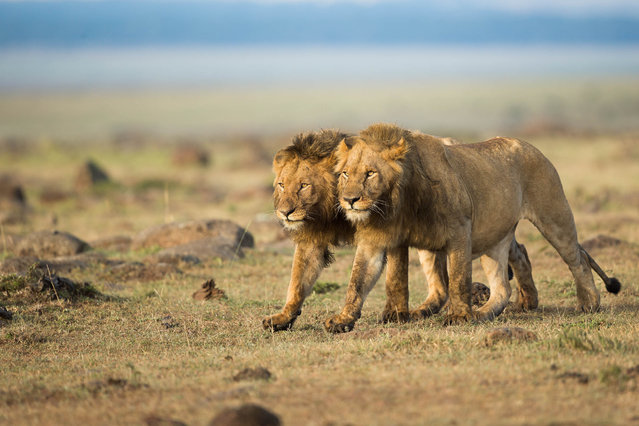
“Two Brothers”. We found about 20 lions eating a buffalo. When the male leaved the group we anticipated him to take photos. It is 8AM, light is perfect and the position too. The lion stops and looks down from the hill, another lion is coming up, it stiffens, I think that will be a fight, i'm tense, the camera is OK, the shots previously made perfect. Photo location: Masai Mara, Kenya. (Photo and caption by Massimo Mei/National Geographic Photo Contest)

“Two Brothers”. We found about 20 lions eating a buffalo. When the male leaved the group we anticipated him to take photos. It is 8AM, light is perfect and the position too. The lion stops and looks down from the hill, another lion is coming up, it stiffens, I think that will be a fight, i'm tense, the camera is OK, the shots previously made perfect. The two meet, looking directly into their eyes, they sniff, rub against their heads, the tension drops, they start walking with the same step as when they were puppies, they are two brothers. Photo location: Masai Mara, Kenya. (Photo and caption by Massimo Mei/National Geographic Photo Contest)
Details
02 Jul 2014 09:45:00
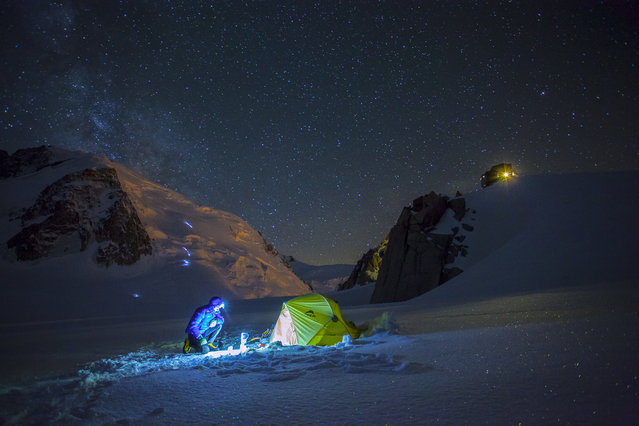
“A snapshot from mountaineer's life”. Have you ever wondered how does a mountaineer's day start? (Photo and caption by Kamil Tamiola/National Geographic Traveler Photo Contest)

“A snapshot from mountaineer's life”. Have you ever wondered how does a mountaineer's day start? I will give you a hint: you wake up at 3 am, set the stove, wake up your partner, pretend it is warm, quickly consume a high-calorie breakfast, watch your friends slowly ascending the icy slopes of your dream summit with their tiny head torches glimmering against perfectly blue ice, and hope for the good weather. One would ask: why all this trouble? The answer is easy: for the love of the adventure and the unknown. Location: Chamonix, Haute Savoye, France. (Photo and caption by Kamil Tamiola/National Geographic Traveler Photo Contest)

ATTENTION! All pictures are presented in high resolution. To see Hi-Res images – just TWICE click on any picture. In other words, click small picture – opens the BIG picture. Click BIG picture – opens VERY BIG picture.
Details
27 Jun 2013 12:47:00
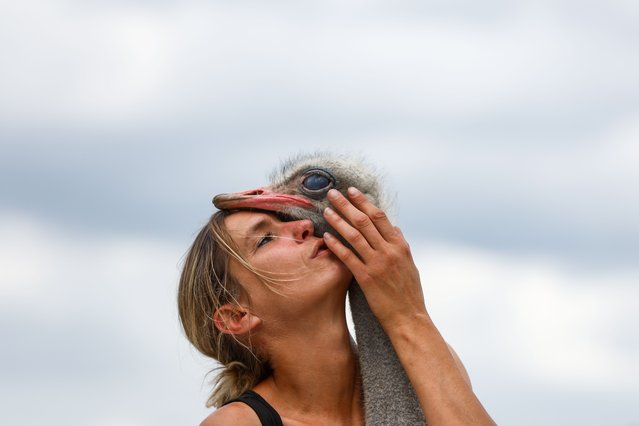
Wendy Adriaens, owner of animal rescue farm “De Passiehoeve” and nicknamed the Ostrich Whisperer, poses for a photo with three-year-old male ostrich Flodder, in Kalmthout, Belgium, 25 July 2022. Flodder and Wendy were separated for seven months since Wendy moved to a bigger farm in January. Flodder spent the seven months at another farm in order to ease the tension between the two ostriches Flodder and Blue who were fighting to the death and had to be separated. Wendy Adriaens has been taking in all kinds of animals that have been mistreated or neglected for some four years at her farm located in the Province of Antwerp. She lives mainly from donations from people who have known her via social networks. An entrance fee to the farm is requested if visitors want to spend some time there. This makes it possible to buy the necessary for the convalescence of the animals. (Photo by Stephanie Lecocq/EPA/EFE/Rex Features/Shutterstock)

Wendy Adriaens, owner of animal rescue farm “De Passiehoeve” and nicknamed the Ostrich Whisperer, poses for a photo with three-year-old male ostrich Flodder, in Kalmthout, Belgium, 25 July 2022. (Photo by Stephanie Lecocq/EPA/EFE/Rex Features/Shutterstock)
Details
31 Jul 2022 06:16:00
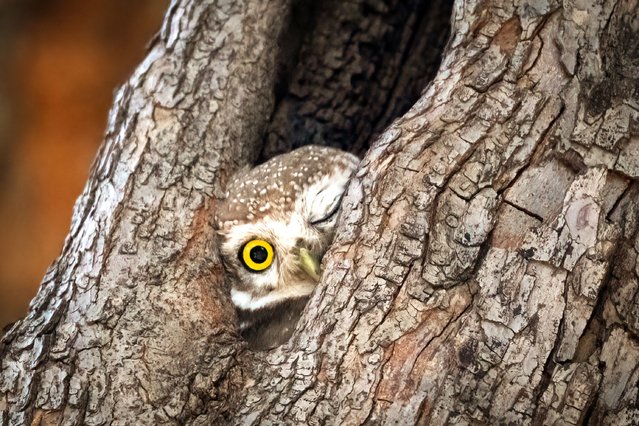
An owl curiously peeks out from a tree hollow. The pictures of the spotted owlet were taken by Anuj Jain in Chandigarh, India in the second decade of November 2025. (Photo by Anuj Jain/Solent News & Photo Agency)

An owl curiously peeks out from a tree hollow. The pictures of the spotted owlet were taken by Anuj Jain in Chandigarh, India in the second decade of November 2025. (Photo by Anuj Jain/Solent News & Photo Agency)
Details
30 Nov 2025 02:57:00
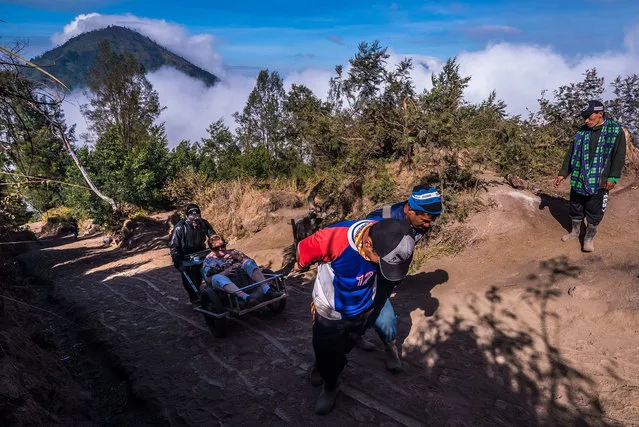
Miners pulling up lazy tourists to the rim of Kawah Ijen (Ijen Volcano), East Java, Indonesia on September 21, 2017. They will earn as much as they would bring down a load of sulfur. Nomadic Explorer, Cultural Lifestyle Photographer Claudio Sieber captured striking images of miners working at Ijen volcanic range in East Java, Indonesia. The sulphur miners risk their lives daily as they climb the active volcano carrying heavy loads, which they sell to sugar refineries. Shortly after midnight curious tourists are flocking in hundreds through the gate of Ijen's foothills to be right on time, driven by the images others took before them. Kawah Ijen is the one of the world's largest acidic volcanic crater lake; famous for its turquoise color as well as the unreal atmosphere it offers during darkness. A dusty path zigzags 3 kilometers up to the crater rim. This doesn't mean anything challenging; in particular, special sights have to be deserved anyway. The irritating smell of sulfur announces the near of the crater's existence. Arriving on the crater's rim the reward for the torture becomes visible. Blue fire darts its tongues through the fumes of sulfur dioxide. Somehow, the spectacle isn't as romantic as expected, since it is also the rough working space of approx. 150 sulfur miners who start their shift at 1 am. Lately, harvesting the abundance of devil's gold received international attention. This did obviously not really improve a miner's lifestyle; neither did it contribute to a better wage. (Photo by Claudio Sieber/Barcroft Images)

Miners pulling up lazy tourists to the rim of Kawah Ijen (Ijen Volcano), East Java, Indonesia on September 21, 2017. They will earn as much as they would bring down a load of sulfur. Nomadic Explorer, Cultural Lifestyle Photographer Claudio Sieber captured striking images of miners working at Ijen volcanic range in East Java, Indonesia. The sulphur miners risk their lives daily as they climb the active volcano carrying heavy loads, which they sell to sugar refineries. (Photo by Claudio Sieber/Barcroft Images)
Details
02 Oct 2017 08:31:00
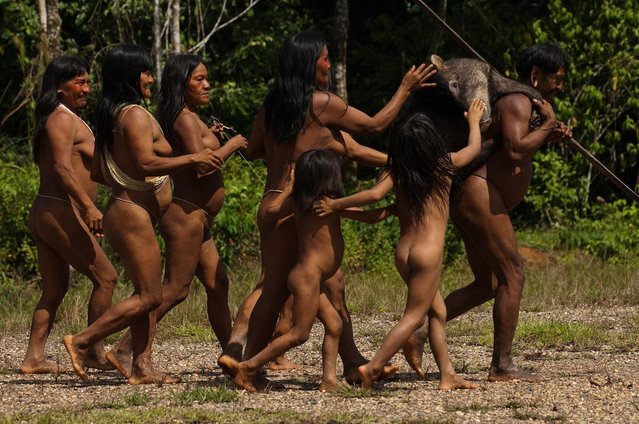
Spectacular images offering insight into the lives of the Huaorani people in the Ecuadorian Amazon have been revealed showing how they use traditional methods to hunt monkeys for food. The stunning pictures were taken by conservation photographer Pete Oxford from Torquay, Devon in the Ecuadorian Amazon. “The Huaorani Indians are a forest people highly in tune with their environment. Many are now totally acculturated since the 1950s by missionaries”, said Pete. “Today they face radical change to their culture to the proximity of oil exploration within their territory and the Yasuni National Park and Biosphere Reserve, they are vastly changed. Some still live very traditionally and for this shoot, through my Huaorani friend, a direct relative of those photographed he wanted to depict them as close to their original culture as possible. They still largely hunt with blow pipes and spears eating a lot of monkeys and peccaries”. The Huaorani are also known as the Waorani, Waodani or the Waos and are native Amerindians. Their lands are located between the Curaray and Napo rivers and speak the Huaorani language. Pete says that during his visit he was welcomed into the group and hopes that ancient cultures can be saved. Here: The tribe were seen celebrating after a hunter returned to camp with a wild pig. (Photo by Pete Oxford/Mediadrumworld.com)

Spectacular images offering insight into the lives of the Huaorani people in the Ecuadorian Amazon have been revealed showing how they use traditional methods to hunt monkeys for food. The stunning pictures were taken by conservation photographer Pete Oxford from Torquay, Devon in the Ecuadorian Amazon. Here: The tribe were seen celebrating after a hunter returned to camp with a wild pig. (Photo by Pete Oxford/Mediadrumworld.com)
Details
20 Jan 2017 07:58:00