Loading...
Done
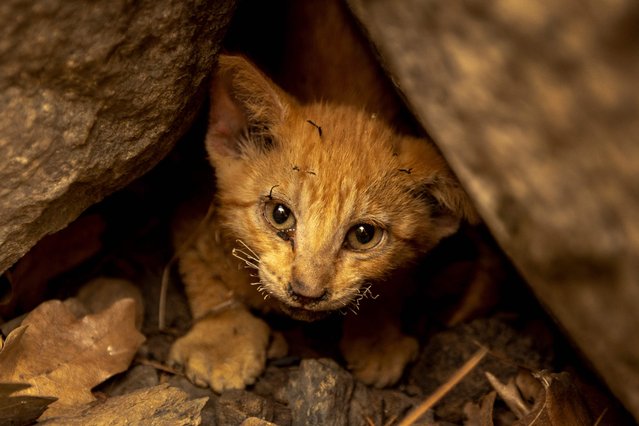
A kitten singed whiskers that survived the McKinney Fire hides in  rocks in the Klamath National Forest northwest of Yreka, California, on July 31, 2022. The largest fire in California this year is forcing thousands of people to evacuate as it destroys homes and rips through the state's dry terrain, whipped up by strong winds and lightning storms. The McKinney Fire was zero percent contained, CalFire said, spreading more than 51,000 acres near the city of Yreka. (Photo by David McNew/AFP Photo)

A kitten singed whiskers that survived the McKinney Fire hides in rocks in the Klamath National Forest northwest of Yreka, California, on July 31, 2022. The largest fire in California this year is forcing thousands of people to evacuate as it destroys homes and rips through the state's dry terrain, whipped up by strong winds and lightning storms. The McKinney Fire was zero percent contained, CalFire said, spreading more than 51,000 acres near the city of Yreka. (Photo by David McNew/AFP Photo)
Details
08 Aug 2022 06:18:00
A herd of wildebeest cross the skyline against the fading light in Masai Mara, Kenya, 25 August 2017. Stunning sunset photos silhouette Africa’s wildlife against streaks of orange and red sky. In August, German photographer Ingo Gerlach was on safari in the Masai Mara when he convinced his safari guide to stop and take in the sunset. The wildlife photographer was rewarded with his patience by an eye-catching sunset, which cast Africa’s wildlife into dark shadows against the vibrant skies. (Photo by Ingo Gerlach/Barcroft Images)

A herd of wildebeest cross the skyline against the fading light in Masai Mara, Kenya, 25 August 2017. Stunning sunset photos silhouette Africa’s wildlife against streaks of orange and red sky. In August, German photographer Ingo Gerlach was on safari in the Masai Mara when he convinced his safari guide to stop and take in the sunset. The wildlife photographer was rewarded with his patience by an eye-catching sunset, which cast Africa’s wildlife into dark shadows against the vibrant skies. (Photo by Ingo Gerlach/Barcroft Images)
Details
14 Sep 2017 08:17:00
A man assists two young hostages who managed to escape from the school building after special forces entered the school in Beslan, North Ossetia, Friday 03 September 2004. Streams of hostages fled the besieged school in Beslan in southern Russia Friday amid intensive shooting and a series of powerful explosions that signalled a bloody end to the three-day stand-off with terrorists. (Photo by Yuri Kochetkov/EPA)

On September 1, 2004, Chechen militants stormed an elementary school in the town of Beslan in the Russian republic of North Ossetia. They took 1,100 teachers, children, and their relatives hostage, demanding the withdrawal of federal forces from Chechnya as a condition for their release. On September 3, 2004, Russian security forces stormed the building, resulting in a battle in which more than 330 hostages died, including 186 children. Here: A man assists two young hostages who managed to escape from the school building after special forces entered the school in Beslan, North Ossetia, Friday 03 September 2004. (Photo by Yuri Kochetkov/EPA)
Details
25 Sep 2017 06:41:00
Chieftain Japarupi Waiapi shows a roasted monkey -part of Waiapi's diet, also based in Manioc and fruits- at the reserve in Amapa state in Brazil on October 13, 2017. When Waiapis walks into the Amazon forest surrounding their village, they do not see trees, but a kind of shopping mall providing medicine, food, shelter, tools and weapons  all under the eye of multiple spirits. (Photo by Apu Gomes/AFP Photo)

Chieftain Japarupi Waiapi shows a roasted monkey -part of Waiapi's diet, also based in Manioc and fruits- at the reserve in Amapa state in Brazil on October 13, 2017. When Waiapis walks into the Amazon forest surrounding their village, they do not see trees, but a kind of shopping mall providing medicine, food, shelter, tools and weapons all under the eye of multiple spirits. (Photo by Apu Gomes/AFP Photo)
Details
27 Oct 2017 08:39:00
At 10,582 square kilometres, the Bolivian salt flats – otherwise known as Salar de Uyuni – are the largest on the planet and contain between 50 and 70% of the world’s lithium reserves. After exploring Chile and Argentina, photographer Joel Santos decided to travel to Bolivia in January 2017 to check the salt flats off his bucket list. With an electrical storm rolling in, Joel and his two travelling companions were the only souls left on the vast flats and captured the eerie flats without a person in sight. (Photo by Joel Santos/Barcroft Images)

At 10,582 square kilometres, the Bolivian salt flats – otherwise known as Salar de Uyuni – are the largest on the planet and contain between 50 and 70% of the world’s lithium reserves. After exploring Chile and Argentina, photographer Joel Santos decided to travel to Bolivia in January 2017 to check the salt flats off his bucket list. With an electrical storm rolling in, Joel and his two travelling companions were the only souls left on the vast flats and captured the eerie flats without a person in sight. (Photo by Joel Santos/Barcroft Images)
Details
12 Aug 2019 00:03:00
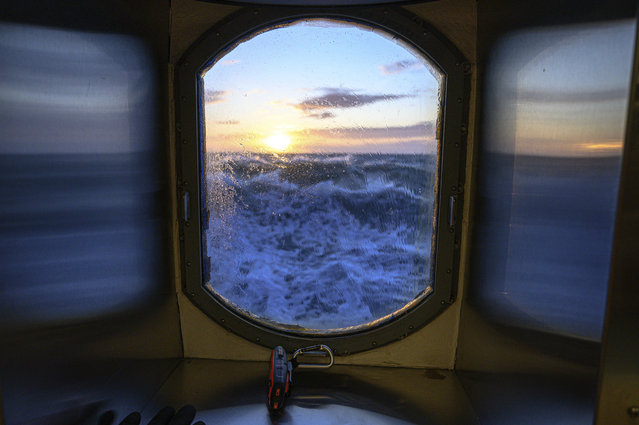
This November 8, 2019, photo provided by John Guillote shows a view from the main lab of the Sikuliaq in the Chukchi Sea. University of Washington scientists onboard the research vessel are studying the changes and how less sea ice will affect coastlines, which already are vulnerable to erosion because increased waves delivered by storms. More erosion would increase the chance of winter flooding in villages and danger to hunters in small boats. (Photo by John Guillote via AP Photo)

This November 8, 2019, photo provided by John Guillote shows a view from the main lab of the Sikuliaq in the Chukchi Sea. University of Washington scientists onboard the research vessel are studying the changes and how less sea ice will affect coastlines, which already are vulnerable to erosion because increased waves delivered by storms. More erosion would increase the chance of winter flooding in villages and danger to hunters in small boats. (Photo by John Guillote via AP Photo)
Details
26 Aug 2021 08:22:00
A ballet dancer practices in the sunshine at the Southbank skatepark in London on Monday, September 17, 2018, as Storm Helene is due to bring unseasonably warm weather in London and the south east, as the low pressure draws up warm air from the south. Forecasters have downgraded warnings that Helene could pose a risk to life when it hits this week – but warned coastal communities to stay vigilant. (Photo by Kirsty O'Connor/PA Wire)

A ballet dancer practices in the sunshine at the Southbank skatepark in London on Monday, September 17, 2018, as Storm Helene is due to bring unseasonably warm weather in London and the south east, as the low pressure draws up warm air from the south. Forecasters have downgraded warnings that Helene could pose a risk to life when it hits this week – but warned coastal communities to stay vigilant. (Photo by Kirsty O'Connor/PA Wire)
Details
18 Sep 2018 08:32:00
In this Wednesday, January 23, 2019, an anti-government protester covers her face with a Venezuelan flag, and uses toothpaste around her eyes to help lessen the effect of tear gas, during clashes with security forces after a rally demanding the resignation of President Nicolas Maduro in Caracas, Venezuela. The head of Venezuela's opposition-run congress declared himself interim president at the rally, until new elections can be called. (Photo by Fernando Llano/AP Photo)

In this Wednesday, January 23, 2019, an anti-government protester covers her face with a Venezuelan flag, and uses toothpaste around her eyes to help lessen the effect of tear gas, during clashes with security forces after a rally demanding the resignation of President Nicolas Maduro in Caracas, Venezuela. The head of Venezuela's opposition-run congress declared himself interim president at the rally, until new elections can be called. (Photo by Fernando Llano/AP Photo)
Details
25 Jan 2019 09:14:00