Loading...
Done
Migrants wait to cross the Slovenia-Austria border in Sentilj, Slovenia, October 27, 2015. The first five border guards – all German – of 400 promised to Slovenia by fellow EU countries are expected to arrive on Wednesday to help channel a huge flow of migrants through the tiny Alpine state, its government said. (Photo by Srdjan Zivulovic/Reuters)

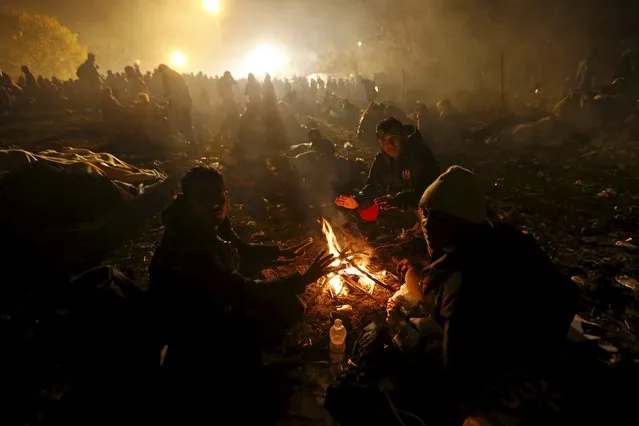
Migrants wait to cross the Slovenia-Austria border in Sentilj, Slovenia, October 27, 2015. The first five border guards – all German – of 400 promised to Slovenia by fellow EU countries are expected to arrive on Wednesday to help channel a huge flow of migrants through the tiny Alpine state, its government said. Interior Ministry state secretary Bostjan Sefic also said 100-120 customs police would join Slovenian soldiers, regular police and private security firms in dealing with an influx that has strapped the country's limited resources. (Photo by Srdjan Zivulovic/Reuters)
Details
30 Oct 2015 08:03:00
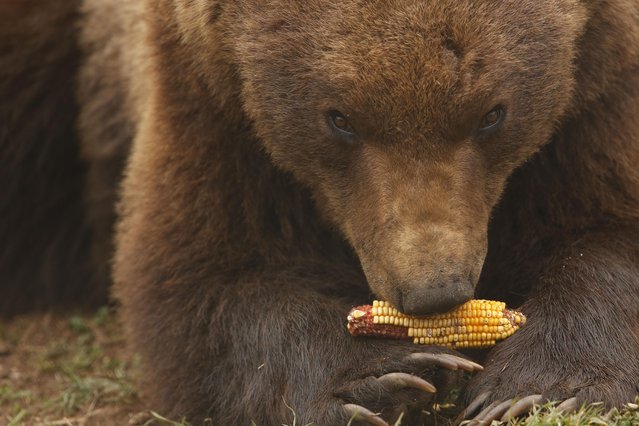
In this photo taken on Saturday, April, 4, 2015, a bear chews on a corncob at a shelter that attracts hundreds of visitors and volunteers from around the world every year, in Kutarevo, Croatia. Over a decade ago, Ivan Crnkovic-Pavenka, a retired Croatian social worker decided to help bears become “ambassadors of the wilderness” among people and set up a unique shelter for brown bears in the idyllic mountain village of Kutarevo in central Croatia, where eight bears currently live in two huge enclosures. (Photo by Amel Emric/AP Photo)

In this photo taken on Saturday, April, 4, 2015, a bear chews on a corncob at a shelter that attracts hundreds of visitors and volunteers from around the world every year, in Kutarevo, Croatia. Over a decade ago, Ivan Crnkovic-Pavenka, a retired Croatian social worker decided to help bears become “ambassadors of the wilderness” among people and set up a unique shelter for brown bears in the idyllic mountain village of Kutarevo in central Croatia, where eight bears currently live in two huge enclosures. (Photo by Amel Emric/AP Photo)
Details
20 Apr 2015 13:03:00
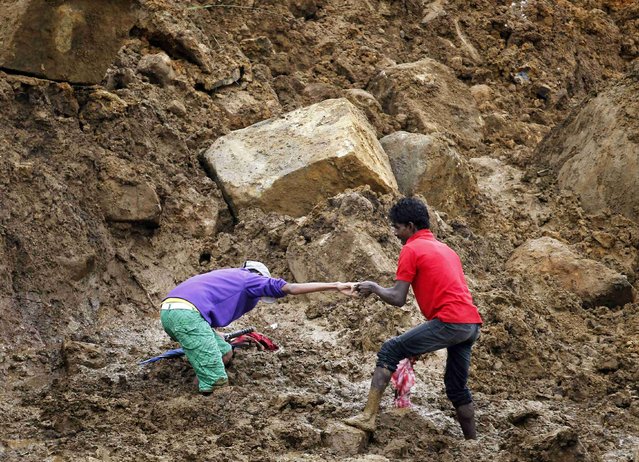
A man helps another make his way through deep mud at the site of a landslide at the Koslanda tea plantation near Haldummulla October 30, 2014. Hopes of finding survivors under the mud and rubble of a landslide in south-central Sri Lanka had run out by first light on Thursday, though a government minister cut the estimated death toll to more than 100 from 300 the previous night. (Photo by Dinuka Liyanawatte/Reuters)

A man helps another make his way through deep mud at the site of a landslide at the Koslanda tea plantation near Haldummulla October 30, 2014. Hopes of finding survivors under the mud and rubble of a landslide in south-central Sri Lanka had run out by first light on Thursday, though a government minister cut the estimated death toll to more than 100 from 300 the previous night. (Photo by Dinuka Liyanawatte/Reuters)
Details
30 Oct 2014 13:32:00
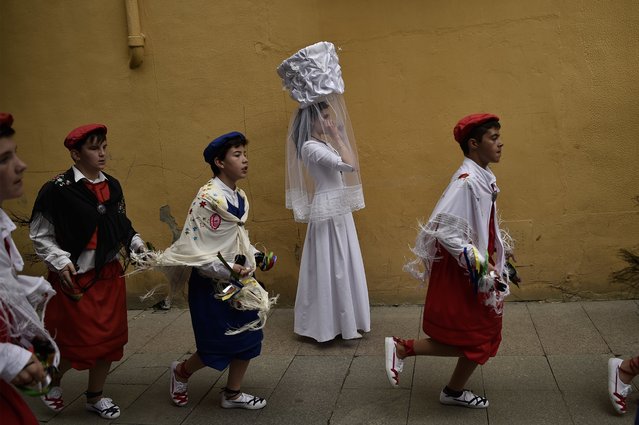
A participant of  “Bread Procession of the Saint”, takes part in the ceremony in honor of Domingo de La Calzada Saint (1019-1109) who helped poor people and pilgrimage, in Santo Domingo de La Calzada, northern Spain, Wednesday, May 11, 2016. (Photo by Alvaro Barrientos/AP Photo)

A participant of “Bread Procession of the Saint”, takes part in the ceremony in honor of Domingo de La Calzada Saint (1019-1109) who helped poor people and pilgrimage, in Santo Domingo de La Calzada, northern Spain, Wednesday, May 11, 2016. Every year during spring season, “Las Doncellas” (White Virgins), hold on their head a basket cover with white cloth while they walk past along of this old village in honor of the saint. (Photo by Alvaro Barrientos/AP Photo)
Details
12 May 2016 14:59:00
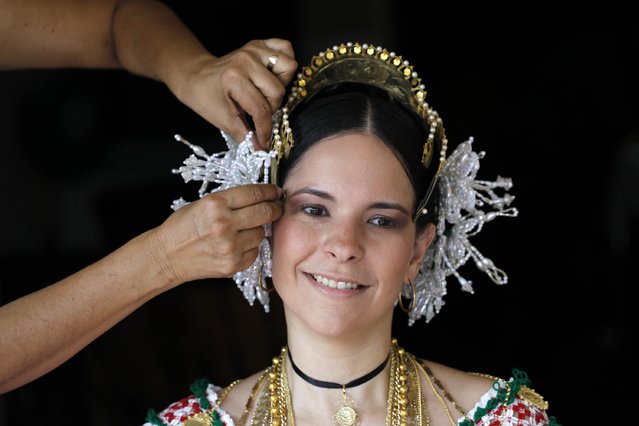
A woman is helped with adorning her hair with jewelry, part of the traditional clothing known as “Pollera”, before the annual Thousand Polleras parade in Las Tablas, in the province of Los Santos January 10, 2015. According to local residents, the Pollera dates back to the 18th century and was worn by the Spanish lower classes. (Photo by Carlos Jasso/Reuters)

A woman is helped with adorning her hair with jewelry, part of the traditional clothing known as “Pollera”, before the annual Thousand Polleras parade in Las Tablas, in the province of Los Santos January 10, 2015. According to local residents, the Pollera dates back to the 18th century and was worn by the Spanish lower classes. Today, it has become the Panamanian national costume. The dress is made entirely by hand and the jewellery worn is pure gold and worth thousands of dollars. (Photo by Carlos Jasso/Reuters)
Details
12 Jan 2015 15:46:00
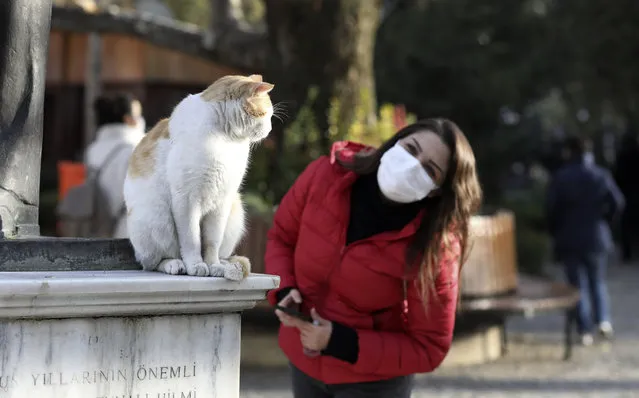
A woman wearing a mask to help protect against the spread of coronavirus, tries to communicate with Efe, a cat living in Kugulu public garden, in Ankara, Turkey, Monday, November 30, 2020.Turkey's President Recep Tayyip Erdogan has announced Monday the most widespread lockdown so far amid a surge in COVID-19 infections, extending curfews to weeknights and full lockdowns over weekends. (Photo by Burhan Ozbilici/AP Photo)

A woman wearing a mask to help protect against the spread of coronavirus, tries to communicate with Efe, a cat living in Kugulu public garden, in Ankara, Turkey, Monday, November 30, 2020.Turkey's President Recep Tayyip Erdogan has announced Monday the most widespread lockdown so far amid a surge in COVID-19 infections, extending curfews to weeknights and full lockdowns over weekends. (Photo by Burhan Ozbilici/AP Photo)
Details
29 Dec 2020 00:03:00
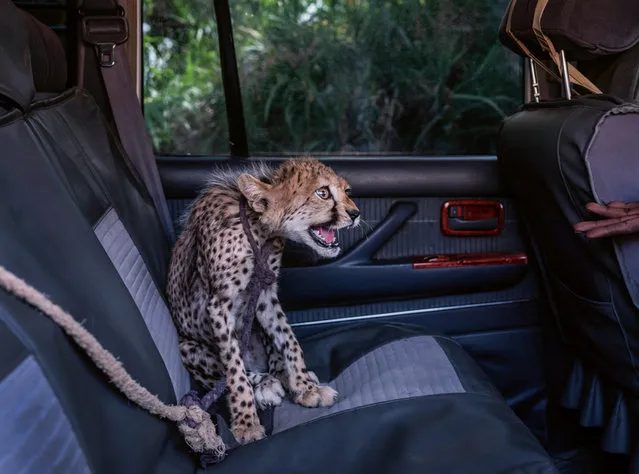
A five-month-old cheetah seated in the back of a Land Cruiser growls at an outstretched hand after being taken from traffickers in Ethiopia and driven to Harirad, Somaliland, in 2020. This photo is part of the work of more than 100 artists in Why We Photograph Animals, a new collection of wildlife photography that aims to help understand why people have photographed animals at different points in history and what it means in the present. (Photo by Nichole Sobecki/Thames & Hudson)

A five-month-old cheetah seated in the back of a Land Cruiser growls at an outstretched hand after being taken from traffickers in Ethiopia and driven to Harirad, Somaliland, in 2020. This photo is part of the work of more than 100 artists in Why We Photograph Animals, a new collection of wildlife photography that aims to help understand why people have photographed animals at different points in history and what it means in the present. (Photo by Nichole Sobecki/Thames & Hudson)
Details
28 Apr 2024 03:15:00
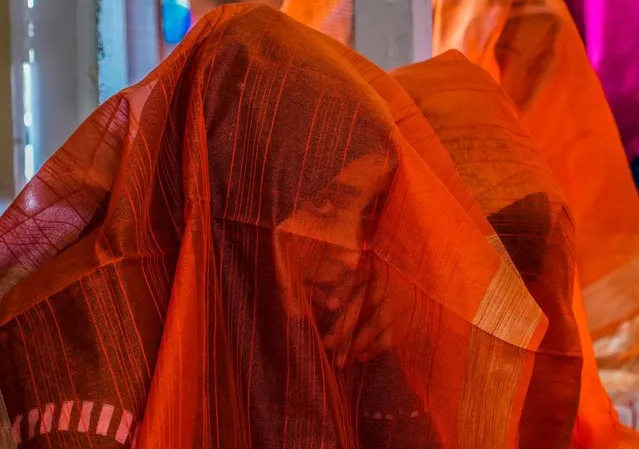
A Kashmiri Muslim bride looks through her veil during a mass wedding event in Srinagar, Indian controlled Kashmir, Thursday, June 15, 2023. Mass weddings in India are organized by social organizations primarily to help the economically backward families who cannot afford the high ceremony costs as well as the customary dowry and expensive gifts that are still prevalent in many communities. (Photo by Mukhtar Khan/AP Photo)

A Kashmiri Muslim bride looks through her veil during a mass wedding event in Srinagar, Indian controlled Kashmir, Thursday, June 15, 2023. Mass weddings in India are organized by social organizations primarily to help the economically backward families who cannot afford the high ceremony costs as well as the customary dowry and expensive gifts that are still prevalent in many communities. (Photo by Mukhtar Khan/AP Photo)
Details
22 Jun 2023 02:21:00