Loading...
Done
“Show us our butts! Mucawana tribe – Angola. In Soba village, the Muhacaona (Mucawana) tribe, perhaps the best place i have visited. They use cow dung and fat to make this so nice haircut, and love the beads. They asked me to make pictures of their backs... and butts to see on the camera screen if everything was perfect!”. (Eric Lafforgue)

“Show us our butts! Mucawana tribe – Angola. In Soba village, the Muhacaona (Mucawana) tribe, perhaps the best place i have visited. They use cow dung and fat to make this so nice haircut, and love the beads. They asked me to make pictures of their backs... and butts to see on the camera screen if everything was perfect!”. (Photo and comments by Eric Lafforgue)
Details
09 Nov 2012 15:04:00
The anthropomorphic robot named hitchBOT sits on the shoulder of Highway 102 to begin its 6000 kilometer cross country journey outside of Halifax, Nova Scotia, July 27, 2014. The hitch hiking robot is part of a social experiment to see if drivers will pick up and drop off the robot in one piece to an art gallery in Victoria, British Columbia. (Photo by Paul Darrow/Reuters)

The anthropomorphic robot named hitchBOT sits on the shoulder of Highway 102 to begin its 6000 kilometer cross country journey outside of Halifax, Nova Scotia, July 27, 2014. The hitch hiking robot is part of a social experiment to see if drivers will pick up and drop off the robot in one piece to an art gallery in Victoria, British Columbia. (Photo by Paul Darrow/Reuters)
Details
02 Aug 2014 13:12:00
A selection of hand-made leis, traditional Hawaiian necklaces made of flowers and worn mostly on special occasions, fill a cooler at Lin's Lei Shop in the Chinatown district of Honolulu, Hawaii December 22, 2015. Hawaii, whose economy depends heavily on tourism, sees a brief lull in visitors each year in January and February. But in addition to the usual tourist destinations, the state shows a unique overlay of mainland U.S. culture atop tropical beauty year-round. (Photo by Jonathan Ernst/Reuters)

A selection of hand-made leis, traditional Hawaiian necklaces made of flowers and worn mostly on special occasions, fill a cooler at Lin's Lei Shop in the Chinatown district of Honolulu, Hawaii December 22, 2015. Hawaii, whose economy depends heavily on tourism, sees a brief lull in visitors each year in January and February. But in addition to the usual tourist destinations, the state shows a unique overlay of mainland U.S. culture atop tropical beauty year-round. (Photo by Jonathan Ernst/Reuters)
Details
16 Jan 2016 08:00:00
This undated image provided by World View shows World View capsule and balloon spacecraft that will rise to 100,000 feet above Earth for passengers to see the curvature of the planet and the blackness of space. (Photo by World View via AP Photo)

This undated image provided by World View shows World View capsule and balloon spacecraft that will rise to 100,000 feet above Earth for passengers to see the curvature of the planet and the blackness of space. Space tourism companies are employing designs including winged vehicles, vertical rockets with capsules and high-altitude balloons. While developers envision ultimately taking people to orbiting habitats, the moon or beyond, the immediate future involves short flights into or near the lowest reaches of space without going into orbit. (Photo by World View via AP Photo)
Details
15 Feb 2016 10:28:00
Norwegian Trolls By Ivar Rodningen Part 1

Ivar Rodningem is a professional illustrator, whose imaginative mind transports us into a parallel world where trolls roam the lands. These creatures might seem scary at first sight, but in reality they are very docile and friendly, help each other and humans that they happen to meet. One of their characteristic features is of course their large noses and long tails. They are one with the nature, which is why it is almost impossible to see a troll if he doesn’t want to be found. Just like you and I they love having fun, though it is hard thing to do, considering their size.


See also:Part 2
Details
26 Feb 2015 20:03:00
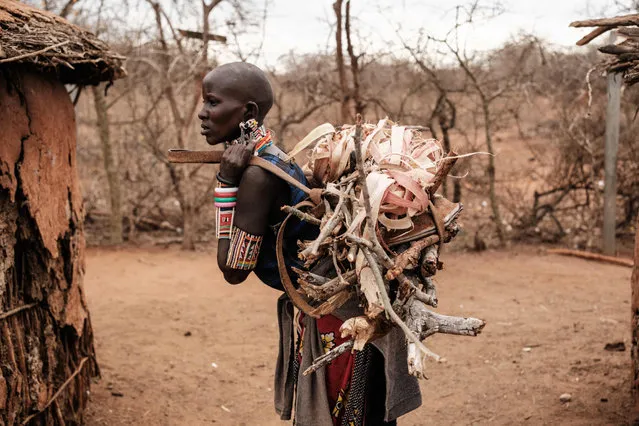
A Maasai woman arrives with collected firewoods at a village nearby Selenkay Conservancy, a community-owned conservation area running by a private company, in Amboseli, Kenya, on June 22, 2022. The camp's ten luxurious tents see tourists flocking again, after the shutdown linked to Covid-19. They observe in small groups elephants, giraffes, antelopes or lions on 5,000 hectares, located on the edge of Amboseli National Park, in the south of the country, and have a glimpse of the life of the Masai, the owners of the land. (Photo by Yasuyoshi Chiba/AFP Photo)

A Maasai woman arrives with collected firewoods at a village nearby Selenkay Conservancy, a community-owned conservation area running by a private company, in Amboseli, Kenya, on June 22, 2022. The camp's ten luxurious tents see tourists flocking again, after the shutdown linked to Covid-19. They observe in small groups elephants, giraffes, antelopes or lions on 5,000 hectares, located on the edge of Amboseli National Park, in the south of the country, and have a glimpse of the life of the Masai, the owners of the land. (Photo by Yasuyoshi Chiba/AFP Photo)
Details
22 Jul 2022 04:32:00
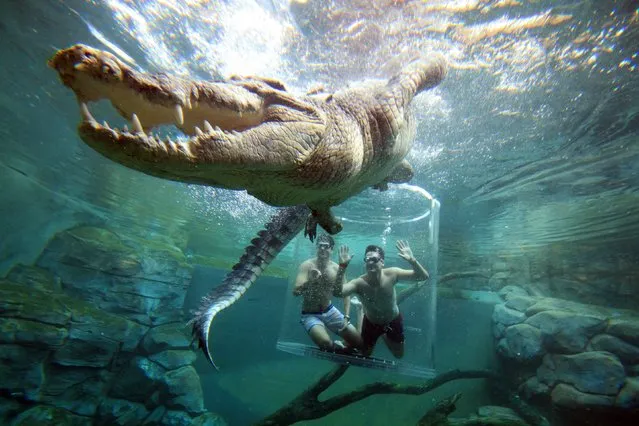
The Cage of Death at Crocosaurus Cove in Darwin City, Australia. The Cage of Death starts out above the water where the two tourists in it can see the huge crocodile below before the cage is lowered into the pen. The tourists are then inches from the 16-foot-long Saltwater crocodile as it greedily snaps its jaws over meaty treats that are being dangled right in front of the cage. (Photo by Crocosaurus Cove/Media Drum World/Profimedia)

The Cage of Death at Crocosaurus Cove in Darwin City, Australia. The Cage of Death starts out above the water where the two tourists in it can see the huge crocodile below before the cage is lowered into the pen. The tourists are then inches from the 16-foot-long Saltwater crocodile as it greedily snaps its jaws over meaty treats that are being dangled right in front of the cage. (Photo by Crocosaurus Cove/Media Drum World/Profimedia)
Details
20 Nov 2022 06:06:00
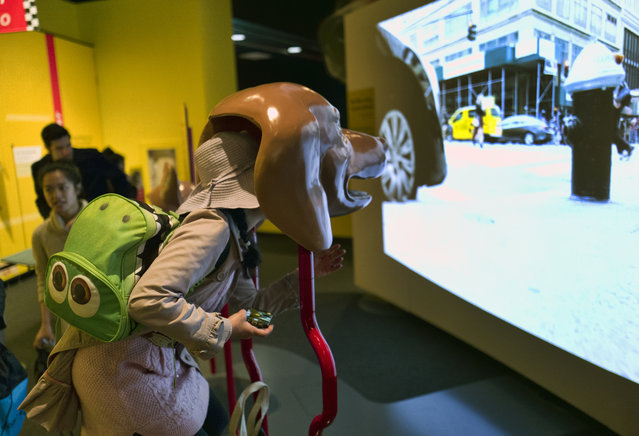
In this Tuesday, March 12, 2019 photo, a visitor takes part in an immersive experience showing visitors how dogs see from inside the head of a dog at the California Science Center in Los Angeles. A new exhibit at a Los Angeles museum examines the relationship between dogs and humans and explores why the two species seem to think so much alike and get along so well. “Dogs! A Science Tail” opens Saturday, March 16, 2019, at the California Science Center. (Photo by Richard Vogel/AP Photo)

In this Tuesday, March 12, 2019 photo, a visitor takes part in an immersive experience showing visitors how dogs see from inside the head of a dog at the California Science Center in Los Angeles. A new exhibit at a Los Angeles museum examines the relationship between dogs and humans and explores why the two species seem to think so much alike and get along so well. “Dogs! A Science Tail” opens Saturday, March 16, 2019, at the California Science Center. (Photo by Richard Vogel/AP Photo)
Details
15 Mar 2019 08:49:00