Aerialists of the Hungarian troupe Vincze Tunde Production perform on the opening night of Strand Festival in Zamardi, Hungary, 20 August 2025. (Photo by Tamas Vasvari/EPA)
An athlete takes part in a warm-up around the track of the National Stadium in Tokyo on September 12, 2025, ahead of the World Athletics Championships. (Photo by Kirill Kudryavtsev/AFP Photo)
Erika Kirk stands next to the microphone which was used by Charlie Kirk at Utah Valley University on the day he was killed as she waits to greet U.S. Vice President JD Vance before closing out AmericaFest, the first Turning Point USA summit since the assassination of Charlie Kirk, in Phoenix, Arizona, U.S. on December 21, 2025. (Photo by Cheney Orr/Reuters)
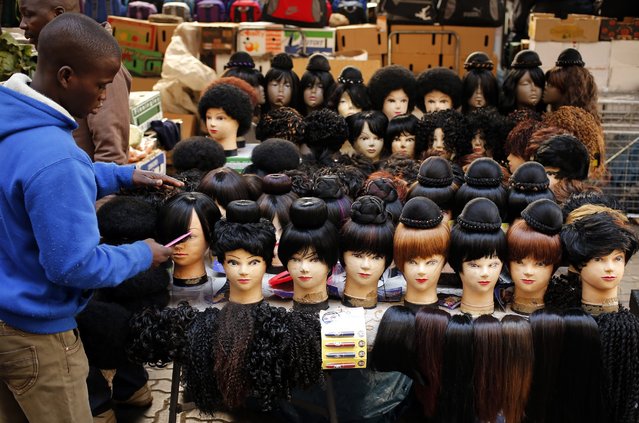
Man prepares wigs as he waits for customers in downtown Johannesburg, on August 5, 2014. Some estimates put Africa's dry hair industry at as much as $6 billion a year; Nigerian singer Muma Gee recently boasted that she spends 500,000 naira ($3,100) on a single hair piece made of 11 sets of human hair. (Photo by Siphiwe Sibeko/Reuters)
A frosty sunset is seen through icicles in Peremilovo village, 65 km (40,6 miles) north of Moscow, Russia, Sunday, December 16, 2018. Temperatures in the Moscow region on Sunday dropped to –12 degree Celsius (10 Fahrenheit). (Photo by Alexander Zemlianichenko/AP Photo)
Kha Tu Ngoc rests in her two- square- meter house in Ho Chi Minh City on May 2, 2018. The “micro- house” dwellings are dotted throughout Vietnam' s bustling southern hub, occupied by families clinging to postage stamp- sized plots a city developing at breakneck pace. Tucked away in winding alleys, nestled under new condo developments or sandwiched between street food stalls and shops, the tiny houses are easily missed by the unattentive passerby. (Photo by Thanh Nguyen/AFP Photo)
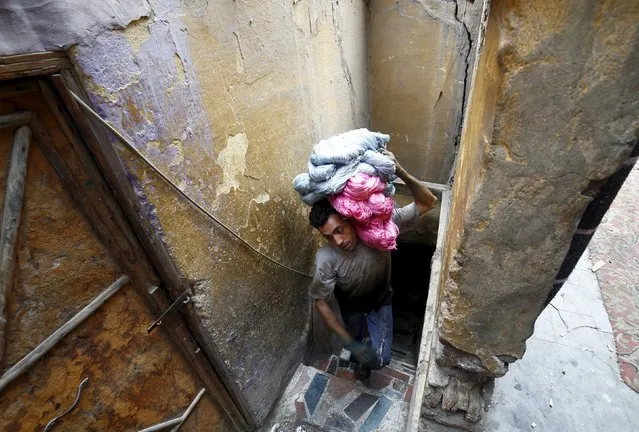
Mohamed Mostafa, 35, carries dyed yarns at a dye workshop in old Cairo, Egypt, March 17, 2016. Egypt's hard currency crisis and competition from modern factories in Asia and at home threaten one of the last dye workshops in Egypt. But one of its owners takes comfort in the trade's ancient resilience. Mohamed Mostafa boasts that the profession dates back 3,000 years, so it can survive anything. (Photo by Amr Abdallah Dalsh/Reuters)