Loading...
Done
Rip Cord Tape

There are so many little, seemingly simple, yet ingenious things that make our life so much simpler. Take scotch tape for example. It’s just a roll of thin plastic film that is sticky on one side, yet how much simpler it made the packaging process of various goods! However, the removal of scotch tape, now there is a problem. Unless you have something sharp, it’s nearly impossible to tear it. To combat this, a brand new product has come out. Rip cord tape – is a regular scotch tape combined with a rip cord. The manufacturer of this product claims that it will make the removal of scotch tape much easier. However, when we look at the pictures, we realize, that yes, the rip cord will remove the middle of the scotch tape; however, the sides will remain in place! This will once again present a problem during the removal process.
Details
09 Nov 2014 09:09:00
The expertly colourised shots were brought to life by French bank technician, Frédéric Duriez (51). The images were provided by the Valois collection which belongs to the BDIC. “By colourising these photos, I reduce the time that separates us today from this conflict”, said Frédéric. “A black and white photo does not attract the attention of young people, if you colour it, then people will look at it with curiosity. After this, we see the greater the misery and distress of these French fighters”. The total number of casualties in WW1 was more that 38 million. By the end of the war, over eight-million men had been called up to fight in the French army. France suffered 4.2 million casualties during the war with 1.3 million people dead. Here: Car cannon sections in firing position, Auxi-le-Château. (Photo by Frédéric Duriez/BDIC/Mediadrumworld.com)

The expertly colourised shots were brought to life by French bank technician, Frédéric Duriez (51). The images were provided by the Valois collection which belongs to the BDIC. “By colourising these photos, I reduce the time that separates us today from this conflict”, said Frédéric. Here: Car cannon sections in firing position, Auxi-le-Château. (Photo by Frédéric Duriez/BDIC/Mediadrumworld.com)
Details
03 May 2017 08:41:00
Tridacna Gigas, or Giant Clams

“The giant clam, Tridacna gigas (known as pā’ua in Cook Islands Māori), is the largest living bivalve mollusc. T. gigas is one of the most endangered clam species. It was mentioned as early as 1825 in scientific reports. One of a number of large clam species native to the shallow coral reefs of the South Pacific and Indian oceans, they can weigh more than 200 kilograms (440 lb) measure as much as 120 cm (47 in) across, and have an average lifespan in the wild of 100 years or more”. – Wikipedia

Photo: Tridacna Gigas, or Giant Clams spew water as a traditional fisherman passes by a small sanctuary on January 23, 2004 near Bolinao in the Northern Philippines. The clams, prime builders for coral reefs and providing shelter for spawning fish and other marine life, are exposed by low tides in the sanctuary. Overfishing and pollution throughout the country are not only threatening food security, but are also starting to choke one of the few working clam sanctuaries in the world. (Photo by David Greedy/Getty Images)
Details
01 Oct 2011 13:10:00
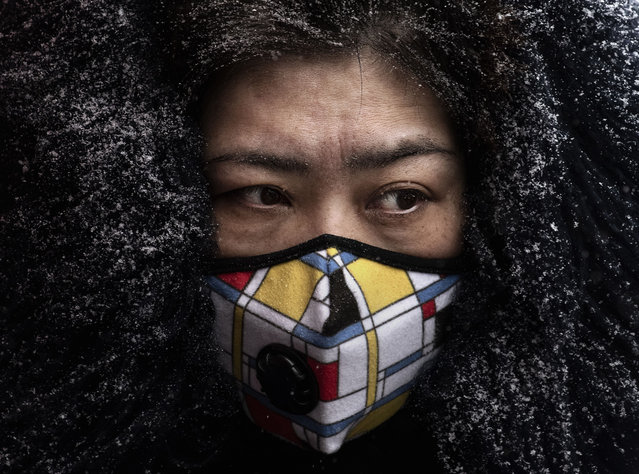
A Chinese woman wears a protective mask as she shops in a market on February 6, 2020 in Beijing, China. The number of cases of a deadly new coronavirus rose to more than 28000 in mainland China Thursday, days after the World Health Organization (WHO) declared the outbreak a global public health emergency. China continued to lock down the city of Wuhan in an effort to contain the spread of the pneumonia-like disease which medicals experts have confirmed can be passed from human to human. In an unprecedented move, Chinese authorities have put travel restrictions on the city which is the epicenter of the virus and municipalities in other parts of the country affecting tens of millions of people. The number of those who have died from the virus in China climbed to over 564 on Thursday, mostly in Hubei province, and cases have been reported in other countries including the United States, Canada, Australia, Japan, South Korea, India, the United Kingdom, Germany, France and several others. The World Health Organization has warned all governments to be on alert and screening has been stepped up at airports around the world. Some countries, including the United States, have put restrictions on Chinese travelers entering and advised their citizens against travel to China. (Photo by Kevin Frayer/Getty Images)

A Chinese woman wears a protective mask as she shops in a market on February 6, 2020 in Beijing, China. The number of cases of a deadly new coronavirus rose to more than 28000 in mainland China Thursday, days after the World Health Organization (WHO) declared the outbreak a global public health emergency. (Photo by Kevin Frayer/Getty Images)
Details
09 Feb 2020 00:07:00
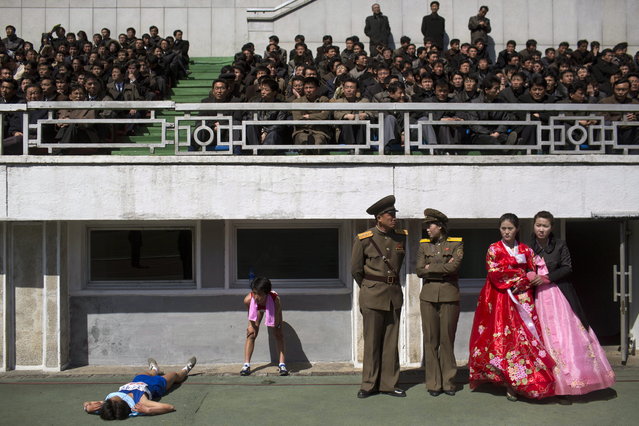
Runners rest inside Kim Il Sung Stadium in Pyongyang, North Korea on Sunday, April 14, 2013. North Korea hosted the 26th Mangyongdae Prize Marathon to mark the upcoming April 15, 2013 birthday of the late leader Kim Il Sung. (Photo by Alexander F. Yuan/AP Photo)

Runners rest inside Kim Il Sung Stadium in Pyongyang, North Korea on Sunday, April 14, 2013. North Korea hosted the 26th Mangyongdae Prize Marathon to mark the upcoming April 15, 2013 birthday of the late leader Kim Il Sung. (Photo by Alexander F. Yuan/AP Photo)
Details
14 Apr 2013 11:27:00
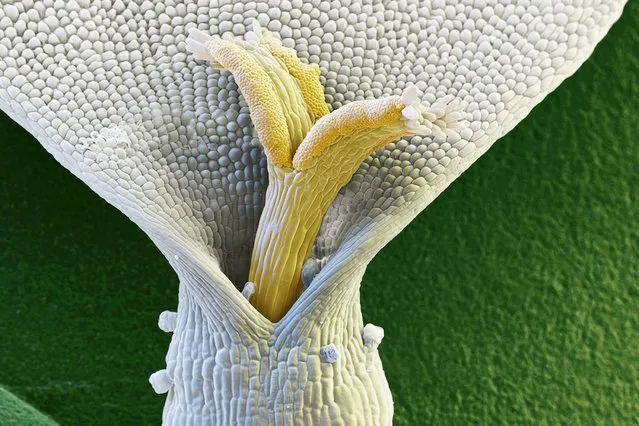
The floret of a Chamomile flower up close and personal. (Photo by Oliver Meckes/Barcroft Media)

These images have been created using a colour scanning electron microscope (SEM) by the award-winning Eye of Science, comprised of snapper Oliver Meckes and biologist Nicole Ottawa. For a decade the pair, based in Reutlingen in the south of Germany, worked with an old SEM they saved from the scrapheap, but for the last five years they have used a £250,000 FEI Quanta Series Field Emission SEM. Oliver said: “Flowers are beautiful in 'normal' view, but when you look closer, some parts get very bizarre and unexpected structures appear – flowers within flowers, worlds within worlds”. Photo: The floret of a Chamomile flower up close and personal. (Photo by Oliver Meckes/Barcroft Media)
Details
26 May 2014 13:51:00
Battle-weary American troops withdraw from Yong San in Korea, 1950

Battle-weary American troops withdraw from Yong San in Korea. (Photo by Keystone/Getty Images). 1950
Details
10 May 2011 10:09:00
American soldiers leaping from an armoured personnel carrier during exercises in Korea, 17th March 1954.  (Photo by Three Lions)

American soldiers leaping from an armoured personnel carrier during exercises in Korea, 17th March 1954. (Photo by Three Lions)
Details
03 Aug 2012 06:42:00