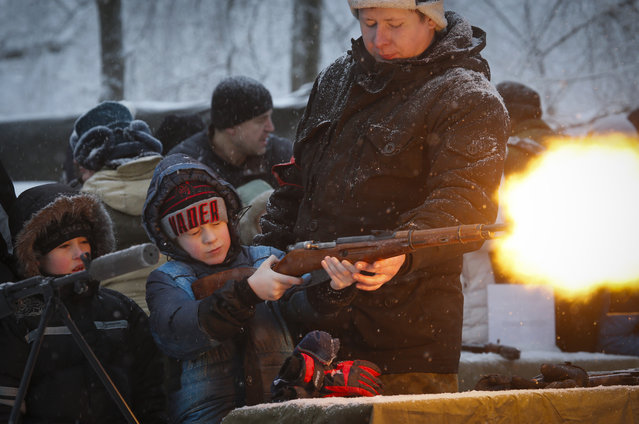
A military instructor helps a boy to shoot a rifle with blanks at a weapon exhibition during a military show in St.Petersburg, Russia, Sunday, January 17, 2016. (Photo by Dmitry Lovetsky/AP Photo)
A child coughs as migrants and refugees run away after Macedonian police fired tear gas at hundreds of Iraqi and Syrian migrants who tried to break through the Greek border fence in Idomeni, on February 29, 2016. Greek police said more than 6,000 people were massed at the border, in a buildup triggered by Austria and Balkan states capping the numbers of migrants entering their territory. (Photo by Louisa Gouliamaki/AFP Photo)
UFC women's bantamweight champion Holly Holm and Miesha Tate face off during the UFC 196 weigh ins at the MGM Grand Garden Arena in Las Vegas on Friday, March 4, 2016. (Photo by L.E. Baskow/Las Vegas Sun via AP Photo)
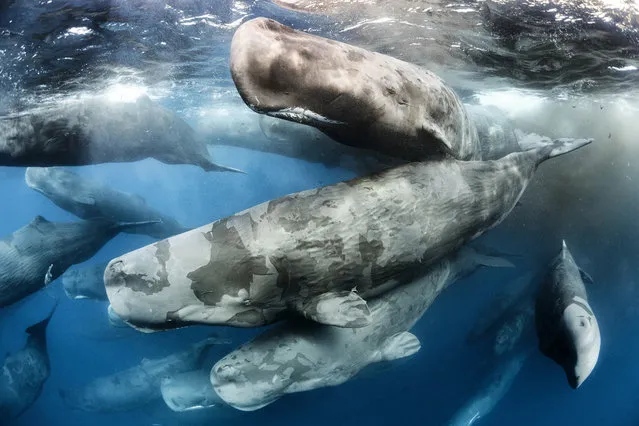
A new book published by the UK Natural History Museum showcases some of the most memorable underwater photographs taken over the last few decades in its annual wildlife photographer of the year competition. Here: Giant gathering by Tony Wu. “The first indication that something extraordinary was going on were the blows, huge numbers of them – the exhalations of huge numbers of whales. Entering the water, the photographer witnessed an extraordinary scene”. (Photo by Tony Wu/Unforgettable Underwater Photography/NHM)
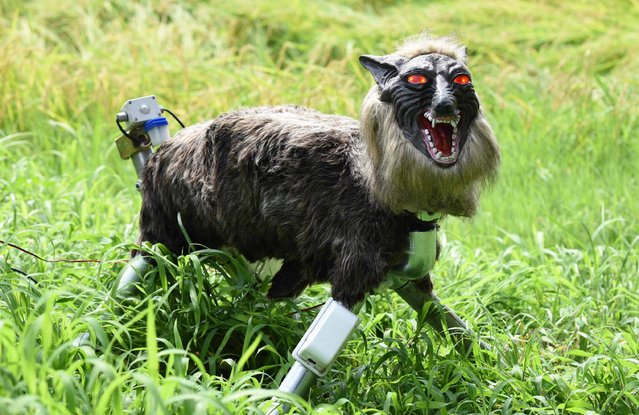
A wolf-like robot “Super Monster Wolf” stands beside a rice field to drive away wild animals that cause damages to crops in Kisarazu, Chiba prefecture, on August 25, 2017. The agricultural coopetative association JA Kisarazu-shi introduced the 65cm-long and 50cm-high robot recently on a trial basis which can detect wild animals such as boars and deers with an infrared ray sensor when they approach and intimidates them, flashing the red LED eyes and blaring 48 types of sounds including a wolf growl and human voice. (Photo by Toru Yamanaka/AFP Photo)
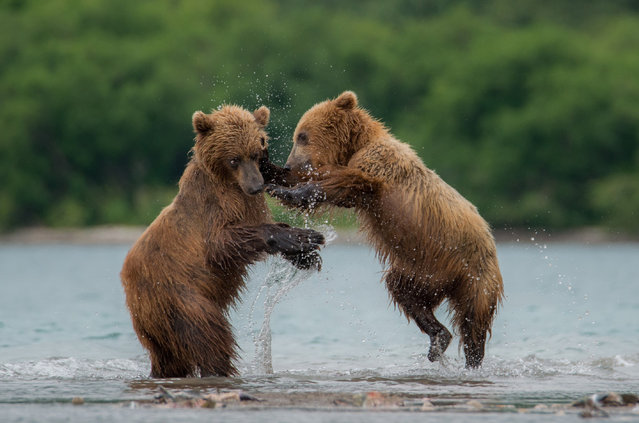
Kamchatka brown bears at Kurile Lake in Kamchatka peninsula’s volcanic terrain, Russia on August, 2017. Kamchatka brown bears are generally not dangerous to humans, and only 1% of encounters result in attack. (Photo by Igor Ivanko/Anadolu Agency/Getty Images)