Loading...
Done


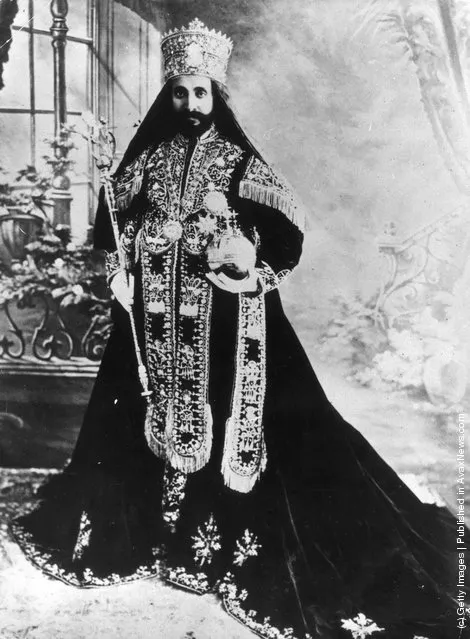
“Haile Selassie I (23 July 1892 – 27 August 1975), born Tafari Makonnen, was Ethiopia's regent from 1916 to 1930 and Emperor of Ethiopia from 1930 to 1974. The heir to a dynasty that traced its origins to the 13th century, and from there by tradition back to King Solomon and Queen Makeda, Empress of Axum, known in the Abrahamic tradition as the Queen of Sheba. Haile Selassie is a defining figure in both Ethiopian and African history.

Haile Selassie is revered as the returned Messiah of the Bible, God incarnate, among the Rastafari movement, the number of followers of which is estimated between 200,000 and 800,000. Begun in Jamaica in the 1930s, the Rastafari movement perceives Haile Selassie as a messianic figure who will lead a future golden age of eternal peace, righteousness, and prosperity. He himself remained an Ethiopian Orthodox Christian throughout his life”. – Wikipedia

Photo: Negusa Negasti, Emperor of Ethiopia Haile Selassie I, known as “Lord of Lords”, “The Conquering Lion of the tribe of Judah”, “Light of the world”, “Elect of God”, in full ceremonial regalia following his coronation. (Photo by Hulton Archive/Getty Images)
Details
21 Jun 2011 11:04:00
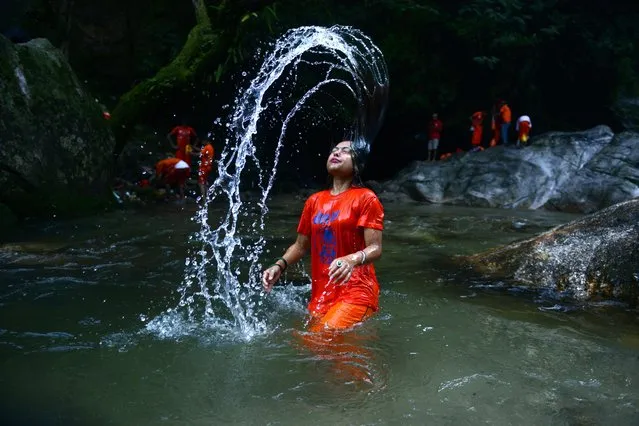
A Nepalese Hindu devotee bathes in the Bagmati River on her way to the Pashupatinath Temple to offer prayers to Lord Shiva, Hindu god of destruction during Shravan festivities in Sundarijal, on the outskirts of Kathmandu on August 3, 2015. According to the Nepali calendar, Shravan is considered the holiest month of the year with each Monday of the month known as Shravan Somvar when worshippers offer prayers for a happy and prosperous life. (Photo by Prakash Mathema/AFP Photo)

A Nepalese Hindu devotee bathes in the Bagmati River on her way to the Pashupatinath Temple to offer prayers to Lord Shiva, Hindu god of destruction during Shravan festivities in Sundarijal, on the outskirts of Kathmandu on August 3, 2015. According to the Nepali calendar, Shravan is considered the holiest month of the year with each Monday of the month known as Shravan Somvar when worshippers offer prayers for a happy and prosperous life. (Photo by Prakash Mathema/AFP Photo)
Details
04 Aug 2015 12:46:00
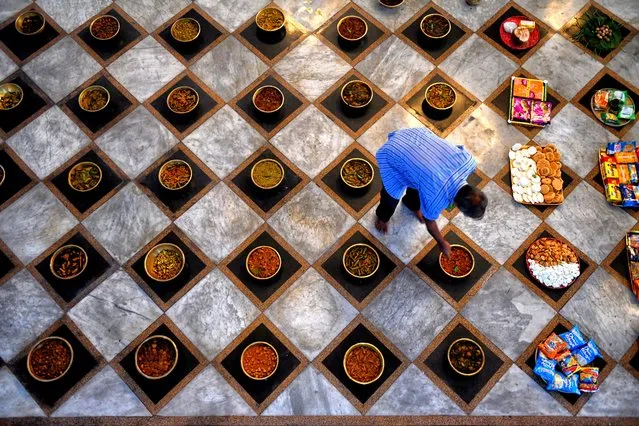
A Hindu devotee prepares for Annakut or Goverdhan puja at Naba Brindaban temple in Kolkata on November 14, 2023. Annakut or Govardhan Puja is a Hindu festival in which devotees prepare and offer a large variety of vegetarian food to Lord Krishna as a sign of gratitude for saving them from floods as per Hindu Mythology. (Photo by Avishek Das/SOPA Images/Rex Features/Shutterstock)

A Hindu devotee prepares for Annakut or Goverdhan puja at Naba Brindaban temple in Kolkata on November 14, 2023. Annakut or Govardhan Puja is a Hindu festival in which devotees prepare and offer a large variety of vegetarian food to Lord Krishna as a sign of gratitude for saving them from floods as per Hindu Mythology. (Photo by Avishek Das/SOPA Images/Rex Features/Shutterstock)
Details
29 Nov 2023 00:00:00


A woman sits next to a Gollum figure on the “Middle-earth Shuttle” subway train November 18, 2003 in New York City. The train's cars were decorated with Middle-earth creatures, vines, moss and stones to celebrate the November 18 DVD and VHS release of the Special Extended Edition of The Lord of the Rings: The Two Towers. (Photo by Mario Tama/Getty Images)
Details
08 Jun 2011 09:36:00
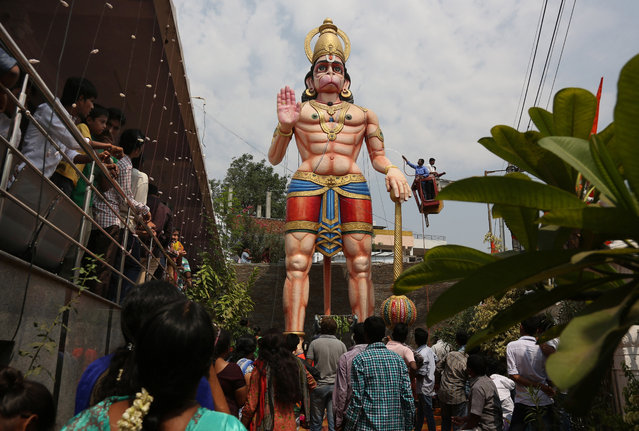
Hindu devotees watch as a 12 meter (40 feet) high statue of Hindu monkey-god Hanuman is washed during Hanuman Jayanti, the birthday of Lord Hanuman in Hyderabad, India, Friday, April 22, 2016. Hanuman is one of the most popular gods in the crowded pantheon of Hindu deities, and devout Hindus ascribe great strength and valor to him. (Photo by Mahesh Kumar A./AP Photo)

Hindu devotees watch as a 12 meter (40 feet) high statue of Hindu monkey-god Hanuman is washed during Hanuman Jayanti, the birthday of Lord Hanuman in Hyderabad, India, Friday, April 22, 2016. Hanuman is one of the most popular gods in the crowded pantheon of Hindu deities, and devout Hindus ascribe great strength and valor to him. (Photo by Mahesh Kumar A./AP Photo)
Details
25 Apr 2016 09:28:00
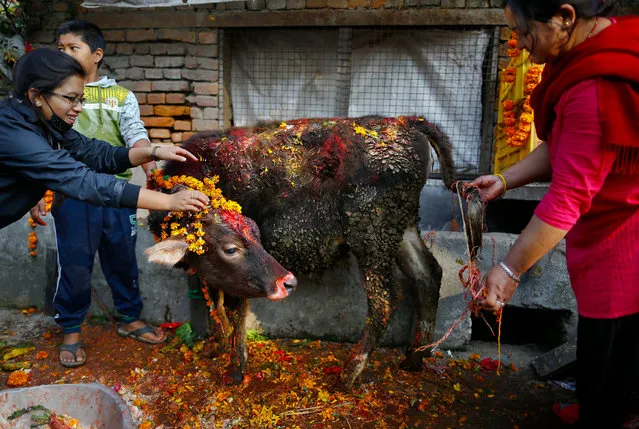
A Nepalese devotee bows in front of a cow during the 'Gai Puja', also known as the Cow Worship Day, as part of the Tihar festival in Kathmandu, Nepal, 11 November 2015. The Tihar festival is the second most important event for Nepalese Hindus. During the celebrations people worship cows, considered the incarnation of Lord Laxmi, the god of wealth. (Photo by Narendra Shrestha/EPA)

A Nepalese devotee bows in front of a cow during the 'Gai Puja', also known as the Cow Worship Day, as part of the Tihar festival in Kathmandu, Nepal, 11 November 2015. The Tihar festival is the second most important event for Nepalese Hindus. During the celebrations people worship cows, considered the incarnation of Lord Laxmi, the god of wealth. (Photo by Narendra Shrestha/EPA)
Details
14 Nov 2015 08:05:00
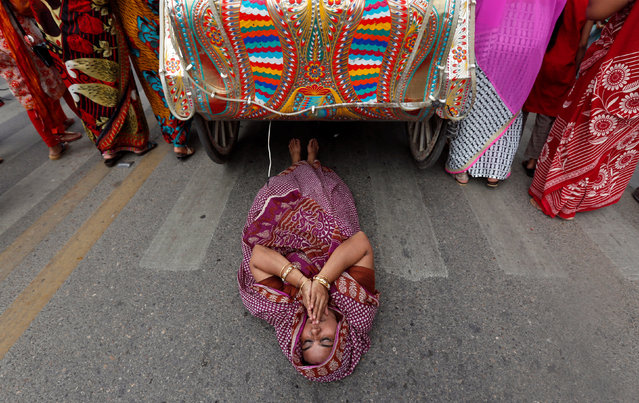
A Hindu devotee lies on a road as the holy “Rath”, or the chariot of lord Jagannath, passed over her during the Rath Yatra, or chariot procession in Karachi, Pakistan, July 17, 2016. Ratha-jatra is derived from two Odia words ratha/rotho meaning “chariot” and jatra meaning “journey”. The festival involves an annual procession (journey) of a deity's idols. Other names for the festival include ratha jatra or chariot festival. (Photo by Akhtar Soomro/Reuters)

A Hindu devotee lies on a road as the holy “Rath”, or the chariot of lord Jagannath, passed over her during the Rath Yatra, or chariot procession in Karachi, Pakistan, July 17, 2016. Ratha-jatra is derived from two Odia words ratha/rotho meaning “chariot” and jatra meaning “journey”. The festival involves an annual procession (journey) of a deity's idols. Other names for the festival include ratha jatra or chariot festival. (Photo by Akhtar Soomro/Reuters)
Details
18 Jul 2016 12:42:00
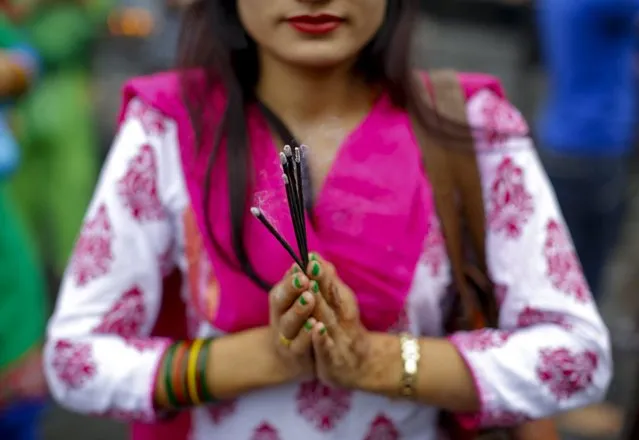
Nepalese Hindu women pray to worship Lord Shiva during the first day of the Sarwan Brata festival, the month of fasting, at the premises of Pashupati Temple in Kathmandu, Nepal, 18 July 2016. Thousands of married and single Nepalese Hindu women will gather in temples for each Monday of the Sawan month (spanning from 16 July to 16 August) to pray for a long and prosperous life of their husbands or for a chance to find a good one. (Photo by Narendra Shrestha/EPA)

Nepalese Hindu women pray to worship Lord Shiva during the first day of the Sarwan Brata festival, the month of fasting, at the premises of Pashupati Temple in Kathmandu, Nepal, 18 July 2016. Thousands of married and single Nepalese Hindu women will gather in temples for each Monday of the Sawan month (spanning from 16 July to 16 August) to pray for a long and prosperous life of their husbands or for a chance to find a good one. (Photo by Narendra Shrestha/EPA)
Details
19 Jul 2016 12:59:00