A British fan waits to enter the Malmo arena ahead of the finals of the 2013 Eurovision Song Contest on May 18, 2013. (Photo by John MacDougall/AFP Photo)
Sabera Bayanne, 20, a student of the Shaolin Wushu club, practices in Kabul, Afghanistan January 29, 2017. On a snowy mountaintop to the west of Kabul, a group of Afghan girls practise the flowing movements of Wushu, a sport developed from ancient Chinese kung fu martial arts, stretching and bending and slashing the air with bright swords. (Photo by Mohammad Ismail/Reuters)
Jamaica's Tissanna Hickling competes in the Women's Long Jump heats at the 2019 IAAF Athletics World Championships at the Khalifa International stadium in Doha on October 5, 2019. (Photo by Dylan Martinez/Reuters)
Audience take photos of a model presenting a creation by Greek designer Dimitrios Ordoulidis during the 10th Athens Exclusive Fashion Week in Athens, Greece, October 22, 2016. (Photo by Alkis Konstantinidis/Reuters)
2016 Rio Olympics, Judo, Final, Women, 48 kg Bronze Medal Contests, Carioca Arena 2, Rio de Janeiro, Brazil on August 6, 2016. Otgontsetseg Galbadrakh (KAZ) of Kazakhstan and Dayaris Mestre Alvarez (CUB) of Cuba react. (Photo by Kai Pfaffenbach/Reuters)
An exhibitor takes a photo with a Huawei Mate 10 Pro during the 2018 CES in Las Vegas, Nevada, U.S. January 9, 2018. CES, the world's largest annual consumer technology trade show, runs through January 12 and features about 3,900 exhibitors showing off their latest products and services to more than 170,000 attendees. (Photo by Steve Marcus/Reuters)
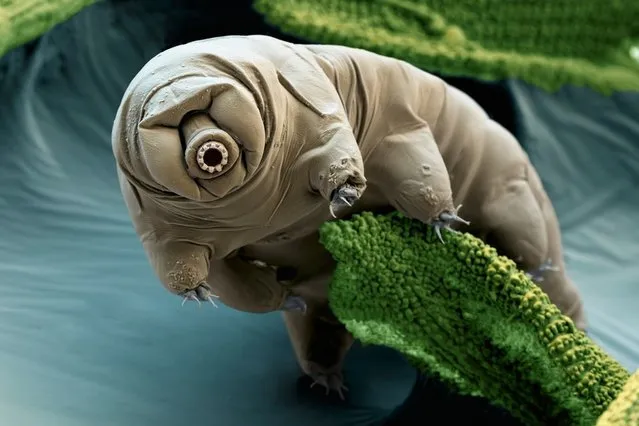
“Tardigrades (commonly known as waterbears or moss piglets) are small, water-dwelling, segmented animals with eight legs. Tardigrades were first discovered in 1773 by Johann August Ephraim Goeze, who called them kleiner Wasserbär, meaning “little water bear” in German. The name Tardigrada means “slow walker” and was given by Lazzaro Spallanzani in 1777. The name water bear comes from the way they walk, reminiscent of a bear's gait. The biggest adults may reach a body length of 1.5 millimetres (0.059 in), the smallest below 0.1 mm. Freshly hatched tardigrades may be smaller than 0.05 mm”. – Wikipedia. Photo: Tardigrades. (Photo by SPL/East News)
“The finless porpoise (Neophocaena phocaenoides) is one of six porpoise species. In the waters around Japan, at the northern end of its range, it is known as the sunameri. A freshwater population found in the Yangtze River in China is known locally as the jiangzhu or «river pig»”. – Wikipedia
Photo: A newly born Yangtze finless porpoise (top) swims with his mother at the Hydrobiology Institute of the Chinese Academy of Sciences on June 3, 2007 in Wuhan of Hubei Province, China. (Photo by China Photos/Getty Images)