Loading...
Done
Women labourers work at the construction site of a road in Kolkata January 8, 2015. Across towns and cities in India, it is not uncommon to see women cleaning building sites, carrying bricks and or shoveling gravel - helping construct the infrastructure necessary for the country's economic and social development. (Photo by Rupak De Chowdhuri/Reuters)

Women labourers work at the construction site of a road in Kolkata January 8, 2015. Across towns and cities in India, it is not uncommon to see women cleaning building sites, carrying bricks and or shoveling gravel – helping construct the infrastructure necessary for the country's economic and social development. They help build roads, railway tracks, airports, and offices. They lay pipes for clean water supplies, cables for telecommunications, and dig the drains for sewage systems. But although women make up at least 20 percent of India's 40 million construction workers, they are less recognized than male workers with lower pay and often prone to safety hazards and sexual harassment. They are often unaware of their rights or scared to complain, say activists now trying to campaign for better treatment of women in the construction industry. (Photo by Rupak De Chowdhuri/Reuters)
Details
15 Jan 2015 13:47:00
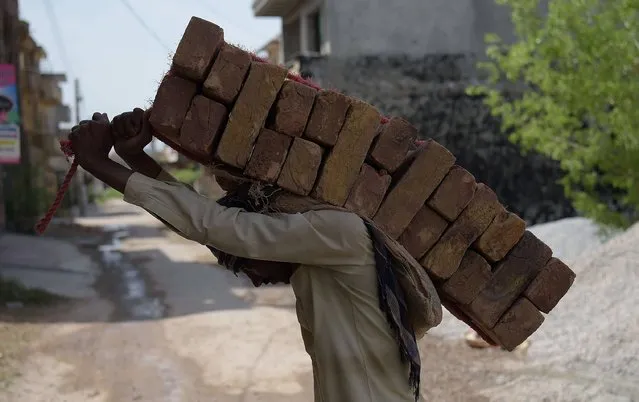
A worker stack bricks on his head at a brick factory in Lalitpur January 12, 2015. (Photo by Navesh Chitrakar/Reuters)

A worker stack bricks on his head at a brick factory in Lalitpur January 12, 2015. (Photo by Navesh Chitrakar/Reuters)
Details
16 Jan 2015 12:40:00
Noriaki Iwashima gestures as he lies in a coffin to try it out during an end-of-life seminar held by Japan's largest retailer Aeon Co in Tokyo October 24, 2014. (Photo by Toru Hanai/Reuters)

Noriaki Iwashima gestures as he lies in a coffin to try it out during an end-of-life seminar held by Japan's largest retailer Aeon Co in Tokyo October 24, 2014. Funeral arrangements are normally left to those who have been left behind but the latest trend in Japan, which literally translates to “End of life” preparations, is for the ageing to prepare their own funerals and graves before they set off on their journey to the great beyond. With a population that is expected to shrink by nearly 30 million people over the next 50 years, the market for funerals, graves and anything related to the afterlife is still very much alive. (Photo by Toru Hanai/Reuters)
Details
10 Nov 2014 13:48:00
Photographer Sandro Giordoan has created a photo series of people who look like they’ve just taken terrible falls, spilling all their things around them. “Each shot ‘tells’ about worn out characters who, as if a sudden black-out of mind and body took over, let themselves crash with no attempt to save themselves, unable, because of the fatigue of the everyday ‘representation’ of living, oppressed by ‘appearance’ instead of simply ‘existing’,” said Giordano. (Photo by Sandro Giordoan)

Photographer Sandro Giordoan has created a photo series of people who look like they’ve just taken terrible falls, spilling all their things around them. “Each shot ‘tells’ about worn out characters who, as if a sudden black-out of mind and body took over, let themselves crash with no attempt to save themselves, unable, because of the fatigue of the everyday ‘representation’ of living, oppressed by ‘appearance’ instead of simply ‘existing’,” said Giordano. (Photo by Sandro Giordoan)
Details
26 Jun 2014 11:46:00
A sales woman of a fish shop shows king crabs to a customer and negotiates the price in Noryangjin Fish Market is seen on August 1, 2015 in Seoul, South Korea. Noryangjin Fish Market was established in 1927 as Gyeongseong Susan in Jung-gu near Seoul Station and moved to its current location in 1971. (Photo by Shin Woong-jae/The Washington Post)

A sales woman of a fish shop shows king crabs to a customer and negotiates the price in Noryangjin Fish Market is seen on August 1, 2015 in Seoul, South Korea. Noryangjin Fish Market was established in 1927 as Gyeongseong Susan in Jung-gu near Seoul Station and moved to its current location in 1971. (Photo by Shin Woong-jae/The Washington Post)
Details
11 Sep 2015 12:21:00
As the sun sets on the Malecon in Havana on Friday January 23, 2015, Surenis Angulo de la Paz, 24, center, dances as group of locals play music around her.  Behind her is Fidel Lopez, 55. (Photo by Sarah L. Voisin/The Washington Post)

As the sun sets on the Malecon in Havana on Friday January 23, 2015, Surenis Angulo de la Paz, 24, center, dances as group of locals play music around her. Behind her is Fidel Lopez, 55. (Photo by Sarah L. Voisin/The Washington Post)
Details
16 Sep 2015 14:04:00
Pupils of the Dao ethnic tribe return home from school along a hillside path at Suoi Thau village in Hoang Su Phi district of Vietnam's northern province of Ha Giang, located at the border with China, September 18, 2015. (Photo by Reuters/Kham)

Pupils of the Dao ethnic tribe return home from school along a hillside path at Suoi Thau village in Hoang Su Phi district of Vietnam's northern province of Ha Giang, located at the border with China, September 18, 2015. (Photo by Reuters/Kham)
Details
13 Oct 2015 08:04:00
Indian girls in traditional attire pose for photographs as they practice the Garba, the traditional dance of Gujarat state, ahead of Navratri festival in Ahmadabad, India, Saturday, October 3, 2015. Navratri or nine night festival will begin on Oct. 13. (Photo by Ajit Solanki/AP Photo)

Indian girls in traditional attire pose for photographs as they practice the Garba, the traditional dance of Gujarat state, ahead of Navratri festival in Ahmadabad, India, Saturday, October 3, 2015. Navratri or nine night festival will begin on October 13. (Photo by Ajit Solanki/AP Photo)
Details
14 Oct 2015 08:04:00