Loading...
Done
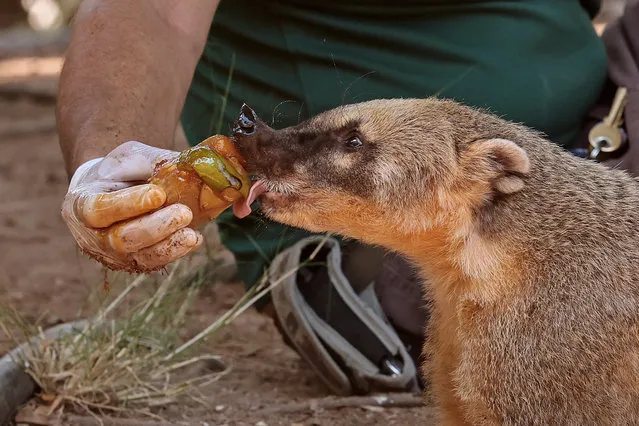
A South American Coati licks a block of frozen fruits at Israel's Safari Zoo in Ramat Gan, north of the Mediterranean coastal city of Tel Aviv, as temperatures reach 35 degrees Celsius on July 13, 2023. (Photo by Jack Guez/AFP Photo)

A South American Coati licks a block of frozen fruits at Israel's Safari Zoo in Ramat Gan, north of the Mediterranean coastal city of Tel Aviv, as temperatures reach 35 degrees Celsius on July 13, 2023. (Photo by Jack Guez/AFP Photo)
Details
30 Jul 2023 03:46:00
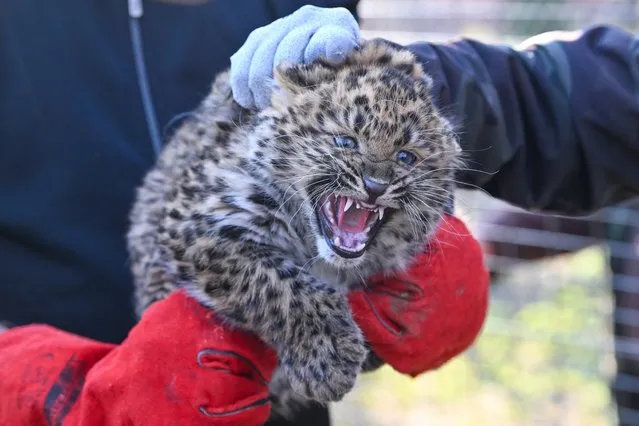
A ten-week-old North China leopard (Panthera pardus japonensis) is handled during a routine health check in the Zoo of Debrecen, northeastern Hungary, 30 January 2024. The female cub, which was born on 21 November 2023, belongs to a leopard subspecies that is endemic to the forest habitats of Northern China. (Photo by Zsolt Czegledi/EPA/EFE)

A ten-week-old North China leopard (Panthera pardus japonensis) is handled during a routine health check in the Zoo of Debrecen, northeastern Hungary, 30 January 2024. The female cub, which was born on 21 November 2023, belongs to a leopard subspecies that is endemic to the forest habitats of Northern China. (Photo by Zsolt Czegledi/EPA/EFE)
Details
11 Feb 2024 07:48:00
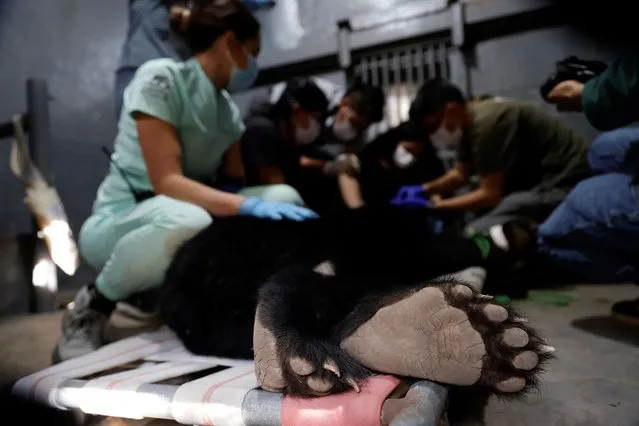
Veterinarians and biologists from the Quito Zoo and the Andean Condor Foundation fit a tracking collar that juvenile Andean bear Tupak will wear for the next four years, prior to his reintroduction into the wild, after the bear's life was deemed in danger due to proximity to humans, in Quito, Ecuador on March 31, 2024. (Photo by Karen Toro/Reuters)

Veterinarians and biologists from the Quito Zoo and the Andean Condor Foundation fit a tracking collar that juvenile Andean bear Tupak will wear for the next four years, prior to his reintroduction into the wild, after the bear's life was deemed in danger due to proximity to humans, in Quito, Ecuador on March 31, 2024. (Photo by Karen Toro/Reuters)
Details
07 Apr 2024 02:58:00
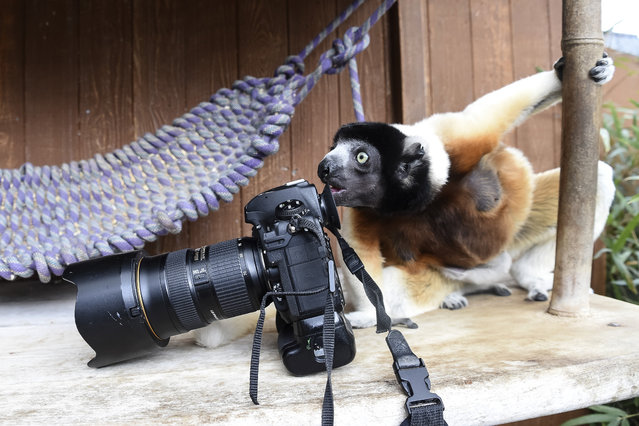
Poppy, a female Crowned sifaka, inspects a photographer's camera in the enclosure at the zoo of Mulhouse, eastern France, on March 5, 2019. The Crowned sifaka is a critically endangered species from Madagascar. (Photo by Sebastien Bozon/AFP Photo)

Poppy, a female Crowned sifaka, inspects a photographer's camera in the enclosure at the zoo of Mulhouse, eastern France, on March 5, 2019. The Crowned sifaka is a critically endangered species from Madagascar. (Photo by Sebastien Bozon/AFP Photo)
Details
10 Mar 2019 00:03:00
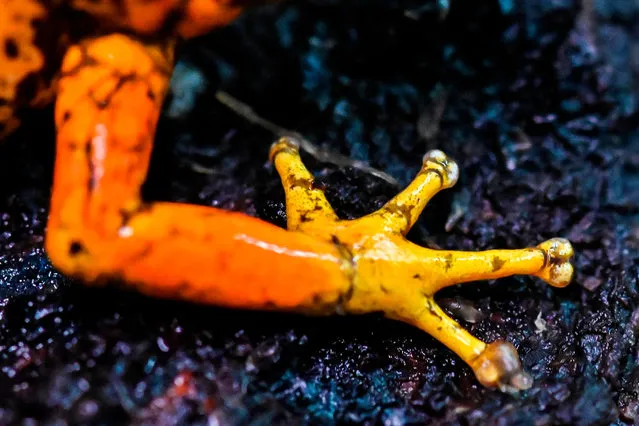
A leg of a “diablito” frog (Oophaga sylvatica) is photographed in a laboratory at a laboratory in the zoo of Cali, Colombia, on July 19, 2019. Colombia is the second country with the largest number of amphibians in the world after Brazil. More than 40% of amphibian species worldwide are in danger of extinction. (Photo by Luis Robayo/AFP Photo)

A leg of a “diablito” frog (Oophaga sylvatica) is photographed in a laboratory at a laboratory in the zoo of Cali, Colombia, on July 19, 2019. Colombia is the second country with the largest number of amphibians in the world after Brazil. More than 40% of amphibian species worldwide are in danger of extinction. (Photo by Luis Robayo/AFP Photo)
Details
28 Nov 2020 00:03:00
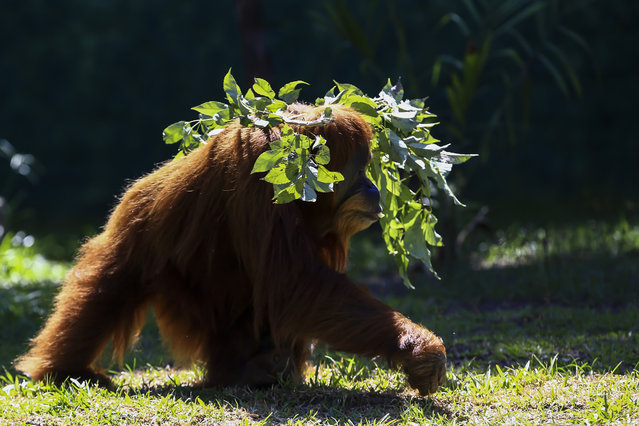
An Orangutan named Elze walks in the Biopark of Rio during a media tour in Rio de Janeiro, Brazil, Thursday, March 18, 2021. The park was closed to the public for renovations to convert the city zoo into a center for biodiversity conservation and will reopen to the general public at the end of March. (Photo by Bruna Prado/AP Photo)

An Orangutan named Elze walks in the Biopark of Rio during a media tour in Rio de Janeiro, Brazil, Thursday, March 18, 2021. The park was closed to the public for renovations to convert the city zoo into a center for biodiversity conservation and will reopen to the general public at the end of March. (Photo by Bruna Prado/AP Photo)
Details
28 Mar 2021 09:55:00
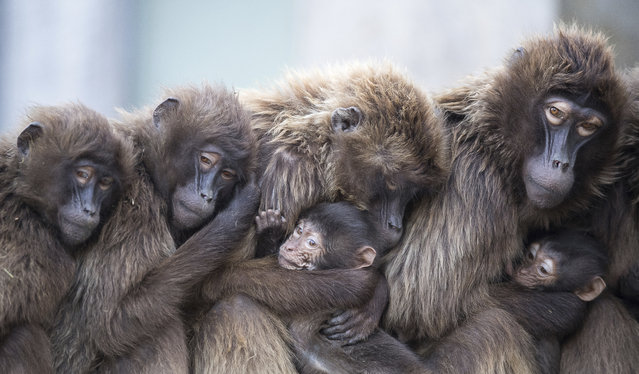
In this January 3, 2018 photo several female Gelada baboons, also known as bleeding-heart baboons, cuddle with their youngs in order to keep warm at the Wilhelma zoo in Stuttgart, Germany. (Photo by Sebastian Gollnow/DPA via AP Photo)

In this January 3, 2018 photo several female Gelada baboons, also known as bleeding-heart baboons, cuddle with their youngs in order to keep warm at the Wilhelma zoo in Stuttgart, Germany. (Photo by Sebastian Gollnow/DPA via AP Photo)
Details
07 Jan 2018 08:08:00


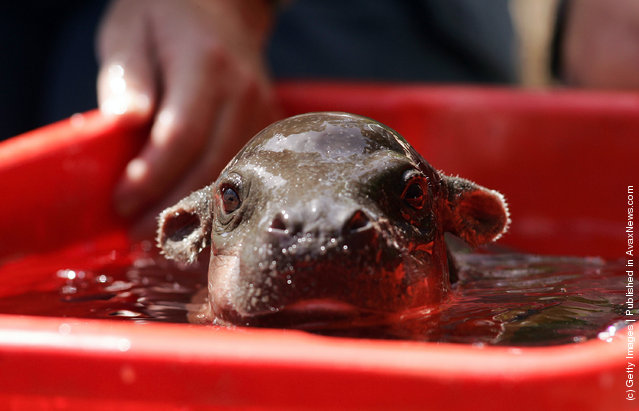
“The pygmy hippopotamus (Choeropsis liberiensis or Hexaprotodon liberiensis) is a large mammal native to the forests and swamps of western Africa (the specific name liberiensis means “of Liberia”, as this is where the vast majority live). The pygmy hippo is reclusive and nocturnal. It is one of only two extant species in the Hippopotamidae family, the other being its much larger cousin the common hippopotamus”. – Wikipedia

Photo: Monifa, a one month old baby Pygmy Hippopotamus takes a morning bath at Taronga Zoo on November 7, 2008 in Sydney, Australia. Monifa is the first Pygmy Hippopotamus to be born at Taronga Zoo in the past twenty three years. (Photo by Sergio Dionisio/Getty Images)
Details
11 Apr 2011 08:11:00